
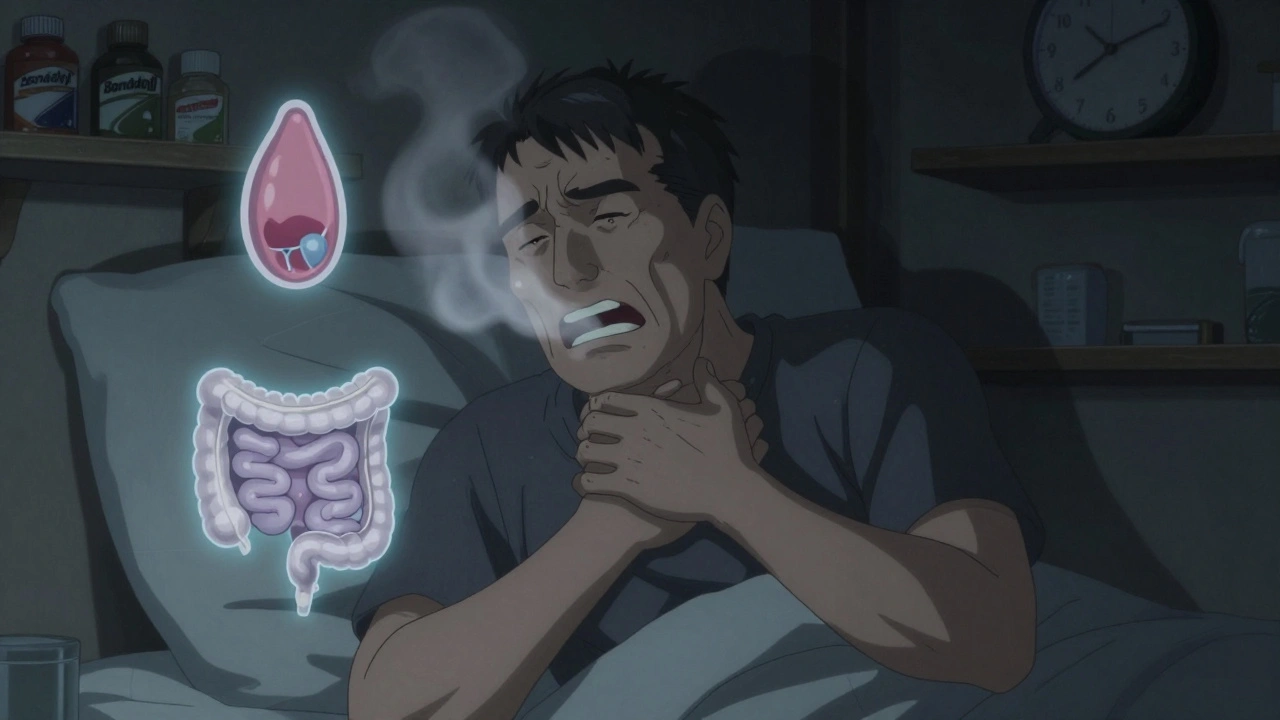
Antihistamine Side Effect Risk Calculator
How Antihistamines Affect Your Body
First-generation antihistamines block acetylcholine receptors, causing dry mouth (28% risk), constipation (15-20%), and urinary issues (5-8% in elderly). Second-generation versions have significantly lower risks.
Risk Assessment Results
Many people reach for antihistamines like Benadryl for allergies, colds, or even sleep. But what they don’t realize is that these common meds are doing more than just blocking histamine-they’re also messing with a key chemical in your body called acetylcholine. This unintended effect, called anticholinergic activity, causes real, sometimes serious, side effects: dry mouth, constipation, trouble peeing, and even brain fog. And while second-generation antihistamines like Zyrtec and Claritin are designed to avoid these issues, first-generation ones still dominate the shelves-and the medicine cabinets-of millions.
Why First-Generation Antihistamines Cause These Side Effects
First-generation antihistamines like diphenhydramine, chlorpheniramine, and promethazine were developed in the 1940s. Back then, scientists weren’t trying to avoid side effects-they were trying to stop sneezing and runny noses. What they didn’t know was that these drugs didn’t just block histamine receptors. They also stuck tightly to muscarinic receptors, which are part of the parasympathetic nervous system. That system controls things like saliva production, bowel movement, and bladder emptying. When antihistamines block these receptors, your body can’t signal properly. Salivary glands stop making enough saliva. The muscles in your intestines slow down. Your bladder doesn’t contract strongly enough to push urine out. That’s why dry mouth, constipation, and urinary retention aren’t random annoyances-they’re direct biological results of the drug’s chemistry. The numbers don’t lie. At standard doses, about 28% of people taking diphenhydramine report dry mouth. For constipation, it’s 15-20%. And for older adults, especially men with enlarged prostates, urinary retention can happen in 5-8% of cases. Compare that to second-generation antihistamines: cetirizine causes dry mouth in only 4% of users, and fexofenadine in just 2%.The Real Cost of Dry Mouth
Dry mouth isn’t just uncomfortable. It’s a gateway to bigger problems. Saliva isn’t just for comfort-it protects your teeth, neutralizes acids, and washes away bacteria. When it drops by 60-70% due to anticholinergic effects, your risk of cavities, gum disease, and oral infections skyrockets. A 2022 study from the American Dental Association found that people on daily anticholinergics had 3 times more dental decay over 3 years than those not taking them. Many patients blame dry mouth on dehydration or aging. Only 28% of users recognize it as a medication side effect. That means most don’t take steps to fix it. Chewing sugar-free gum with xylitol can boost saliva flow by 40-60% within minutes. Drinking water helps, but it doesn’t replace what your glands aren’t making. For long-term users, fluoride rinses and regular dental checkups become essential, not optional.Constipation: More Than Just an Inconvenience
Constipation from antihistamines isn’t just about feeling backed up. These drugs slow gut movement by 30-40% and can double the time food takes to pass through your system. For older adults, this can lead to fecal impaction-a dangerous condition where stool hardens and gets stuck, requiring medical intervention. Clinical trials show that taking polyethylene glycol (Miralax) at 17g daily reduces constipation risk from 18% to just 5% in people using first-generation antihistamines. That’s a 72% drop. Yet, few doctors mention this. Patients often wait days, then turn to stimulant laxatives, which can cause dependency. Prevention is simple: fiber, water, and a stool softener. But awareness? That’s the missing piece.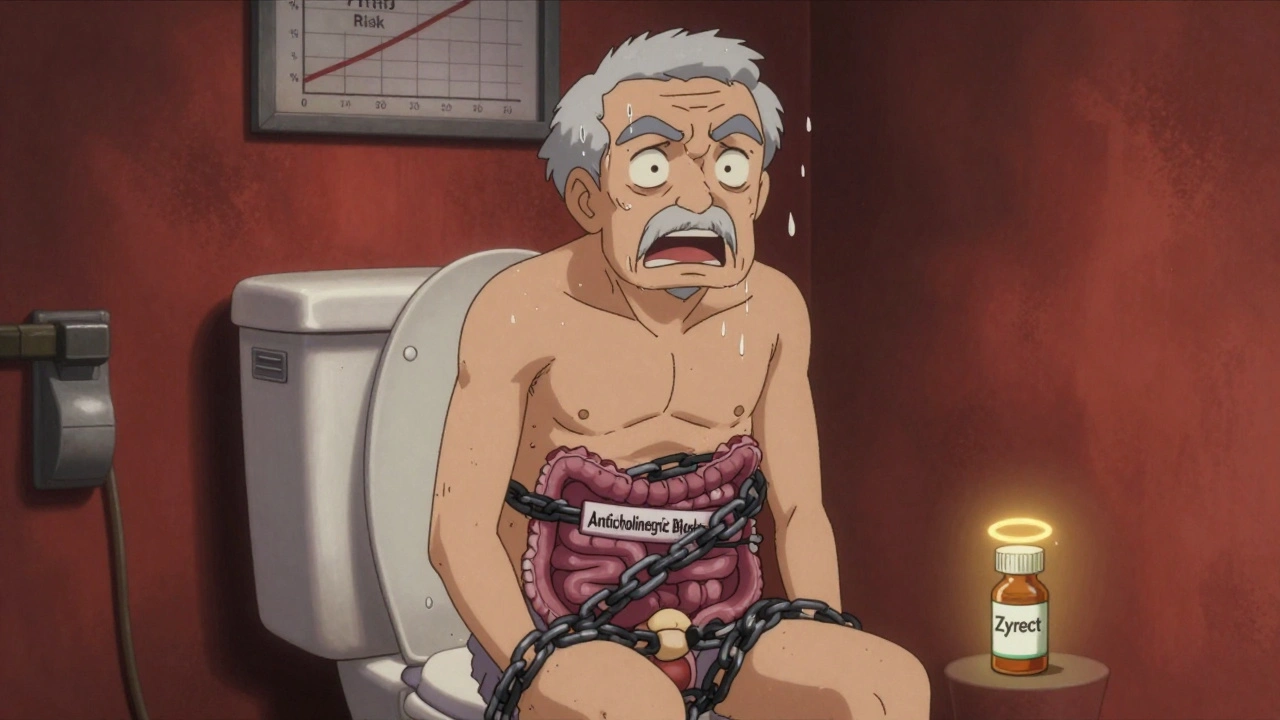
Urinary Retention: A Silent Emergency
Urinary retention is one of the most dangerous anticholinergic effects-especially for men over 65. If you have an enlarged prostate (which affects about half of men in that age group), antihistamines can push you into acute urinary retention. Your bladder fills, but you can’t empty it. This isn’t just uncomfortable-it’s a medical emergency. Within 48 hours of taking diphenhydramine, 31% of men with moderate to severe prostate symptoms can’t urinate at all. The American Urological Association says: don’t give first-generation antihistamines to men with an International Prostate Symptom Score above 8. That’s not a suggestion-it’s a warning. Yet, these drugs are still sold over the counter, often in sleep aids and cold formulas. People don’t read labels. Pharmacists don’t always ask about prostate health. And by the time someone ends up in the ER with a distended bladder and severe pain, it’s too late.Second-Generation Antihistamines: The Better Choice
Second-generation antihistamines like cetirizine, loratadine, and fexofenadine were made to fix the problems of the old ones. They don’t cross the blood-brain barrier as easily. They barely touch muscarinic receptors. Their binding strength to those receptors is over 10 times weaker than diphenhydramine’s. In practical terms? They work just as well for allergies-with far fewer side effects. A 2021 study in the Annals of Allergy, Asthma & Immunology showed that at standard doses, second-generation drugs cause dry mouth in under 5% of users. Constipation? 3-5%. Urinary issues? Less than 1%. And they last 24 hours, so you only take one pill a day. They’re more expensive-$12-18 for a month’s supply versus $4-6 for generic diphenhydramine. But when you factor in dental visits, laxatives, ER trips, and lost productivity from brain fog, the cost difference shrinks fast. And for older adults, the safety advantage is undeniable.The Cognitive Risk You Can’t Ignore
The most alarming consequence of long-term anticholinergic use isn’t dry mouth or constipation-it’s dementia. Dr. Shelley Gray’s landmark 2015 study in JAMA Internal Medicine followed over 3,400 older adults for 7 years. Those who took the equivalent of 3 or more anticholinergic drugs per year had a 54% higher risk of developing dementia. For every extra year of use beyond 90 daily doses, the risk climbed another 20%. Diphenhydramine has the highest possible anticholinergic cognitive burden score: 3.0. That’s the same level as some antidepressants and bladder meds linked to memory loss. The American Geriatrics Society lists first-generation antihistamines as “potentially inappropriate” for older adults. The European Academy of Allergy and Clinical Immunology says to avoid them entirely in patients over 65. And it’s not just long-term use. Even short-term use-7 days straight-increases fall risk by 34% in seniors due to drowsiness and poor coordination. That’s why Mayo Clinic removed diphenhydramine from its inpatient formulary in 2022. Hospitals saw too many cases of anticholinergic delirium: confusion, hallucinations, agitation. All triggered by a simple allergy pill.
What You Should Do Now
If you’re taking diphenhydramine, chlorpheniramine, or promethazine regularly, it’s time to reconsider. Ask yourself:- Am I using this for allergies-or sleep?
- Do I have trouble peeing, constipation, or dry mouth?
- Am I over 65, or do I have an enlarged prostate?
Man, I had no idea Benadryl was this sneaky. I’ve been taking it for sleep for years. Guess I’m switching to Zyrtec tomorrow. 😅
It's not just dry mouth-it's the cognitive fog that creeps up after weeks of use. I didn't connect my brain fog to my nightly allergy pill until I stopped. Took three weeks for my memory to feel normal again. The data here is terrifyingly accurate.
This is gold! I’m from India and we use diphenhydramine like candy-cold, allergy, sleep, even anxiety. My uncle had urinary retention last year after a cold. No one told him the pill was the cause. This post should be shared everywhere. Thanks for putting this out there!
Let’s be real-Big Pharma doesn’t want you to know that a $4 bottle of Benadryl is quietly sabotaging your brain, bladder, and breath. Second-gen antihistamines? They’re the quiet heroes you never knew you needed. Ditch the ancient junk. Your future self will high-five you.
I worked in a UK pharmacy for 12 years. We used to hand out diphenhydramine like candy. Now we have posters up: 'This pill may make you forget your own name.' We’ve seen the ER visits. We’ve seen the dementia cases. It’s not hype-it’s history repeating. The tide is turning, but slowly.
As a registered nurse who works with geriatric patients, I see this every single day. A patient comes in with confusion, falls, urinary retention-and we trace it back to their nightly Benadryl. It’s not dementia yet. It’s anticholinergic toxicity. And it’s reversible-if caught early. Please, if you’re over 60, stop. Switch. Survive.
First gen bad. Second gen good. Switch. Done.
So we’ve got a society where people pay $15 for a month’s supply of a drug that won’t turn them into a confused, constipated zombie… and yet they still grab the $4 bottle labeled 'Helps You Sleep.' The real tragedy isn’t the drug-it’s that we’ve normalized self-sabotage as convenience.
My grandmother took diphenhydramine for years. She forgot my name once. She didn’t remember my wedding. I thought it was aging. Turns out, it was the pill. I cried reading this. Please, if you’re reading this and your parent/grandparent is on this-talk to them. It’s not too late.
I’m a pharmacologist, and I’ve reviewed the data on anticholinergic burden across 12 countries. The cognitive risk isn’t linear-it’s exponential. Every extra year beyond 90 cumulative doses? That’s not a risk factor. That’s a countdown. And yet, the OTC shelves are still packed with these pills. We’ve normalized danger because it’s cheap and familiar. It’s time to stop being passive consumers and start being informed patients. The science isn’t just telling us to switch-it’s screaming it.