

When a patient walks in with shortness of breath, fatigue, or swollen ankles, the question isn't just what is wrong-it's how fast can you rule out the most dangerous possibility? For clinicians, that answer often starts with a single blood test: NT-proBNP.
Why NT-proBNP Is the First Test You Should Order
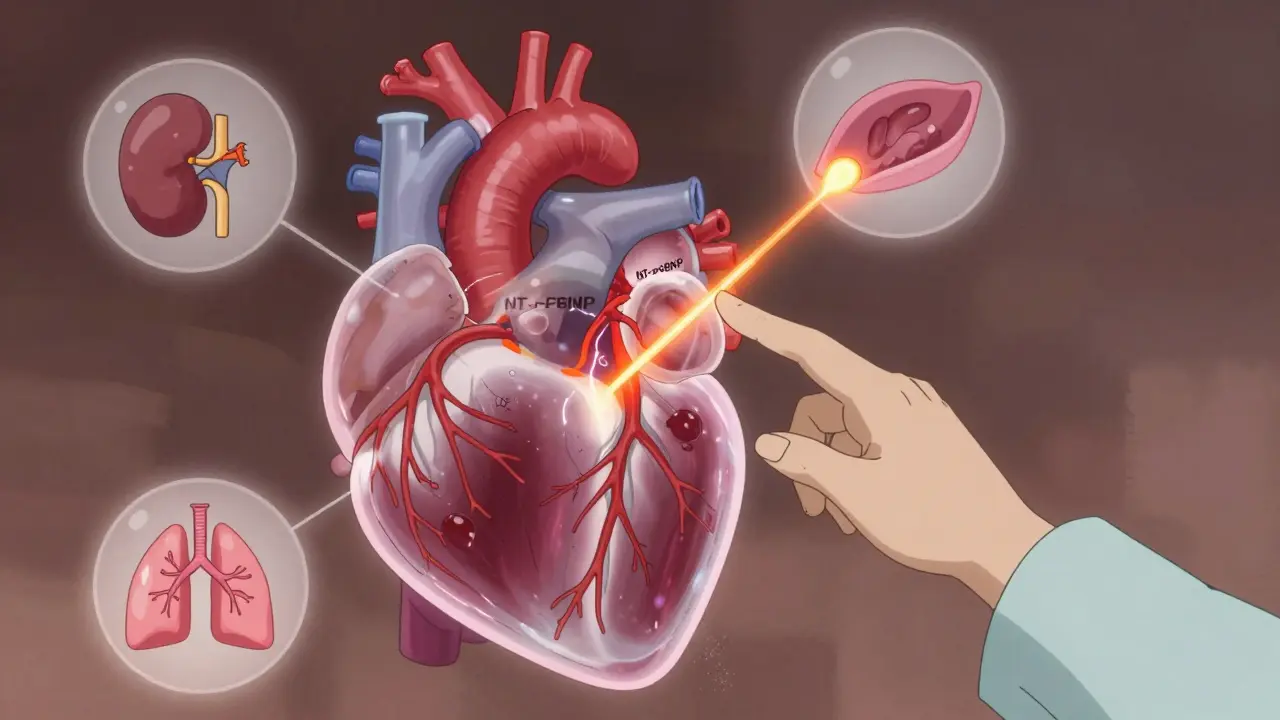
NT-proBNP isn't just another lab value. It's the most reliable blood marker for heart failure. When the heart's ventricles are under pressure-whether from high blood pressure, a weak pump, or fluid overload-they release this protein fragment into the bloodstream. The higher the level, the more strain the heart is under. Unlike imaging or invasive tests, NT-proBNP gives you an objective, rapid answer in minutes.Here’s the key: if NT-proBNP is below 300 pg/mL, heart failure is almost certainly not the cause of symptoms. That’s not a guess. It’s backed by 28 years of outcome data and endorsed by every major cardiology society. In emergency departments, this single number can prevent unnecessary hospital admissions, avoid $3,000 echocardiograms, and reduce patient anxiety.
Take an 82-year-old with COPD and sudden breathlessness. If their NT-proBNP is 120 pg/mL, you don’t need a chest X-ray or echo. You treat the lung flare-up. No delay. No cost. No false alarm. That’s the power of this test.
When to Order NT-proBNP: The 5 Clear Scenarios
- Acute dyspnea in the ER - Every patient presenting with unexplained shortness of breath, especially over age 50, should get NT-proBNP. NICE guidelines make this a Class I recommendation. It’s faster and cheaper than imaging.
- Unexplained fatigue or reduced exercise tolerance - Older adults often dismiss these as "just aging." But if NT-proBNP is elevated, it’s a red flag for early heart failure. Early detection means better outcomes.
- Worsening edema or weight gain - A 5-pound weight gain in 3 days? That’s fluid. Is it kidney-related? Liver? Or heart failure? NT-proBNP tells you which direction to go.
- Before starting new heart failure meds - Before prescribing an SGLT2 inhibitor or ARNI, you need a baseline. NT-proBNP helps confirm the diagnosis and sets a benchmark for future monitoring.
- Post-acute coronary syndrome - Starting in 2024, new guidelines recommend NT-proBNP testing after a heart attack to assess risk of future heart failure. Patients with levels above 1,000 pg/mL have triple the risk of death or hospitalization within a year.
How to Interpret the Numbers: Age, Kidneys, and Obesity
NT-proBNP isn’t a one-size-fits-all number. You can’t just say "above 300 = heart failure." Context changes everything.Age matters. Levels naturally rise about 15-20% per decade after age 50, even in healthy people. So cutoffs are adjusted:
- Under 50: < 450 pg/mL = rule out
- 50-75: < 900 pg/mL = rule out
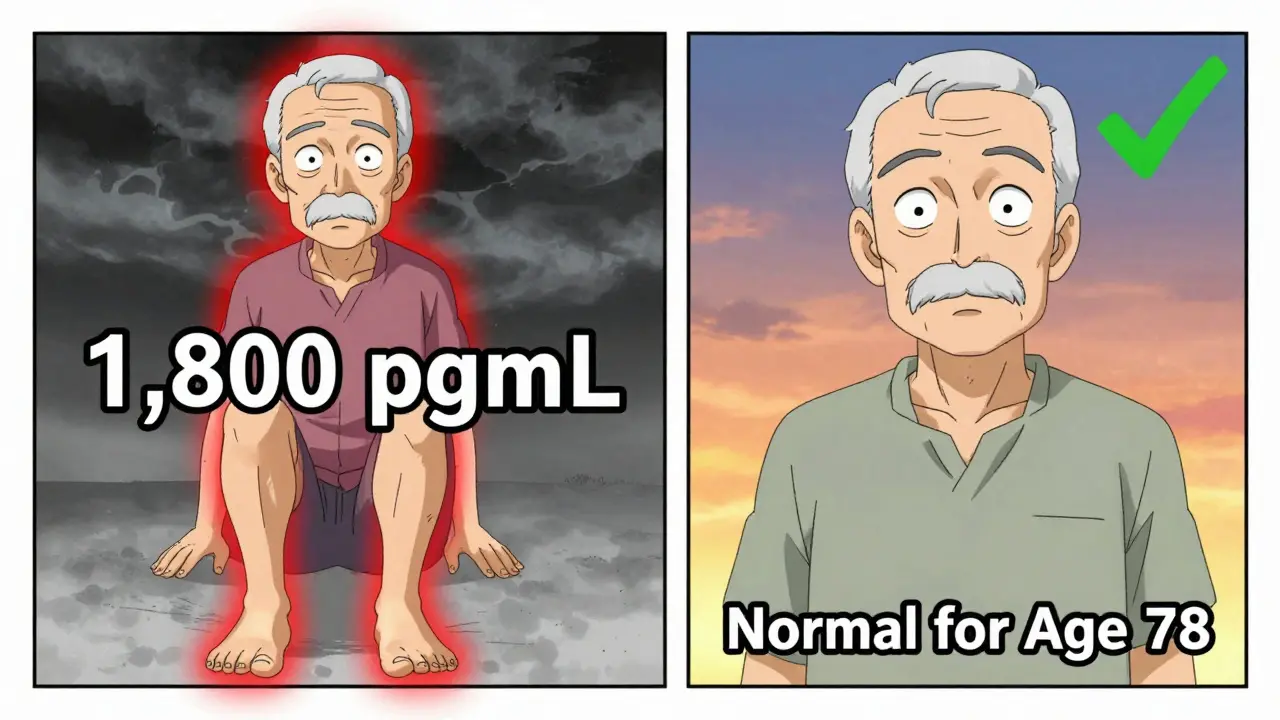
- Over 75: < 1,800 pg/mL = rule out
Kidney function changes the game. If a patient has CKD stage 3 or worse, NT-proBNP levels rise independently of heart stress. Renal clearance drops, so levels stay elevated. For these patients, use a higher rule-out threshold: < 1,200 pg/mL for stage 3-4 CKD. Don’t assume heart failure just because the number is high.
Obesity lowers NT-proBNP. Fat tissue absorbs the peptide. For every 5-point increase in BMI, levels drop 25-30%. So if an obese patient has a "normal" NT-proBNP of 250 pg/mL, it might actually be elevated. Don’t dismiss symptoms just because the number looks okay.
NT-proBNP vs. BNP: Why Most Clinicians Choose NT-proBNP
You might wonder: why not just use BNP? Both measure cardiac stress. But NT-proBNP has clear advantages:| Feature | NT-proBNP | BNP |
|---|---|---|
| Half-life | 60-120 minutes | 20 minutes |
| Stability in sample | 72 hours at 4°C | 4 hours at room temp |
| Renal clearance | Higher dependency | Lower dependency |
| Diagnostic accuracy (AUC) | 0.91 | 0.88 |
| Market share (US) | 68% | 32% |
NT-proBNP is more stable, easier to handle, and slightly more accurate. That’s why 73% of labs in the U.S. use Roche’s assay and why 89% of cardiologists call it "essential."
What NT-proBNP Can’t Do (And When to Be Cautious)
This test is powerful, but it’s not magic. Don’t use it as a standalone diagnostic tool.High NT-proBNP doesn’t always mean heart failure. It can be elevated in:
- Severe lung infections (like pneumonia)
- Advanced kidney disease (even without heart issues)
- Atrial fibrillation
- Pulmonary hypertension
- Recent cardiac surgery
That’s why Dr. Allan Jaffe of Mayo Clinic warns: "NT-proBNP should never be used in isolation." A 78-year-old with atrial fibrillation and stage 3 CKD who has an NT-proBNP of 850 pg/mL? That’s a gray zone. You need clinical context: Are they fluid overloaded? Is their ejection fraction low? Do they have crackles in the lungs?
Also, don’t order it routinely in asymptomatic patients. Medicare data shows 18% of tests are ordered in people with no symptoms-wasting resources and causing unnecessary worry. Since January 2025, CMS requires prior authorization for NT-proBNP in low-risk, asymptomatic cases.
How to Order the Test: Practical Tips
- Sample type: Serum. Use a standard red-top or SST tube. No special handling needed.
- Volume: 1 mL is enough.
- Turnaround: Most hospitals deliver results in under an hour. Point-of-care devices like Roche’s Cobas h 232 now give results in 12 minutes.
- Storage: Stable for 72 hours refrigerated, or 6 months frozen.
- Cost: Medicare reimburses $18.42 per test. It’s one of the most cost-effective diagnostics in cardiology.
Most integrated health systems now have standardized protocols. If your lab doesn’t offer it within 2 hours, push for it. By 2023, 92% of U.S. hospitals had it available on-site or via rapid transport.
What Comes Next After the Result?
- If NT-proBNP < 300 pg/mL (or age-adjusted cutoff): Rule out heart failure. Focus on other causes-COPD, anemia, anxiety, deconditioning.
- If NT-proBNP is elevated: Confirm with clinical exam, ECG, and possibly echo. Start guideline-directed medical therapy if heart failure is confirmed.
- For monitoring: Repeat every 3-6 months in stable heart failure patients. A 30% drop after treatment correlates with better survival.
Some clinicians use NT-proBNP to guide therapy. If levels stay high despite meds, it’s a signal to escalate treatment-add a SGLT2 inhibitor, increase diuretics, or refer for advanced heart failure evaluation.
The Bottom Line
NT-proBNP testing isn’t optional anymore. It’s standard of care. If you’re not ordering it for suspected heart failure, you’re missing the single most reliable, fast, and cost-effective tool in your diagnostic arsenal.It doesn’t replace clinical judgment-it enhances it. Used right, it prevents overtesting, reduces hospital stays, and saves lives. The data is clear. The guidelines are unanimous. The technology is fast and affordable.
So the next time someone walks in with shortness of breath, don’t reach for the stethoscope first. Reach for the order sheet. Order NT-proBNP. Then let the numbers guide your next step.
What is NT-proBNP and why is it important?
NT-proBNP is a protein fragment released by the heart when its ventricles are under strain, such as in heart failure. It’s measured in blood tests and is the most reliable biomarker to quickly rule out heart failure. Levels below 300 pg/mL have a 98% negative predictive value, meaning heart failure is extremely unlikely. This helps avoid unnecessary tests and hospitalizations.
When should I order an NT-proBNP test?
Order NT-proBNP when a patient presents with unexplained shortness of breath, fatigue, swelling, or sudden weight gain-especially if they’re over 50. It’s also recommended after a heart attack, before starting new heart failure meds, and in emergency departments for acute dyspnea. Don’t order it routinely in asymptomatic patients.
What are the normal NT-proBNP levels?
Normal cutoffs depend on age: under 50, <450 pg/mL; 50-75, <900 pg/mL; over 75, <1,800 pg/mL. For patients with moderate to severe kidney disease, use <1,200 pg/mL as the rule-out threshold. These are not diagnostic levels-they’re used to rule out heart failure.
Can NT-proBNP be high without heart failure?
Yes. NT-proBNP can be elevated in kidney disease, atrial fibrillation, severe lung infections, pulmonary hypertension, or after cardiac surgery. It’s not specific to heart failure alone. Always interpret the result with clinical context-symptoms, exam findings, and other tests.
How does obesity affect NT-proBNP levels?
Obesity lowers NT-proBNP levels by 25-30% for every 5-point increase in BMI. So a "normal" result in an obese patient may actually be elevated. Don’t dismiss heart failure based on a low number in someone with a high BMI-look at symptoms and other signs.
Is NT-proBNP better than BNP?
Yes, for most clinical uses. NT-proBNP is more stable in blood samples (lasts 72 hours vs. 4 hours for BNP), has a longer half-life, and shows slightly better diagnostic accuracy. It’s also the most widely used test in the U.S., accounting for 68% of natriuretic peptide orders.
Can NT-proBNP be used to monitor heart failure treatment?
Yes. A 30% or greater drop in NT-proBNP after starting treatment correlates with improved survival and reduced hospitalization risk. Serial measurements help guide therapy adjustments-especially when deciding whether to intensify medications like diuretics or SGLT2 inhibitors.
Troubleshooting Common Issues
- Result comes back high, but patient feels fine? Check for hidden causes: undiagnosed CKD, atrial fibrillation, or chronic lung disease. Don’t assume heart failure. Reassess with echo if needed.
- Lab says "out of range" but patient is stable? Verify the age-adjusted cutoff. A 78-year-old with 1,100 pg/mL might be normal. Don’t panic.
- Ordering too many tests? If you’re ordering NT-proBNP for every patient with fatigue, you’re overusing it. Stick to the five clear scenarios.
- Point-of-care device gives different result? New devices like Roche’s Cobas h 232 are highly accurate (94.7% concordance). If your lab and point-of-care disagree, send a repeat sample to the central lab.
Okay but have you seen the price of these tests lately? My cousin got one last month and her insurance denied it because they said 'not medically necessary'-even though she had swelling and couldn't walk up the stairs. Now she's paying $400 out of pocket. This whole 'standard of care' thing is just a fancy way for labs to make money.
The idea that we can rule out heart failure with a single number is dangerously oversimplified. Medicine isn't math. You can't reduce human suffering to a pg/mL value and call it a day.
I work in a rural ER. We don't have point-of-care devices. We send samples to a lab 45 minutes away. By the time we get results, the patient's condition has changed. So yes, we order the test-but we don't wait on it. You can't live by the numbers when the system's broken.
There's a philosophical tension here, isn't there? We want objective data to remove human bias… but then we ignore the context that makes the data meaningful. NT-proBNP is a mirror, not a map. It reflects what’s happening, but it doesn’t tell you why. And if you mistake the reflection for the truth, you’re not practicing medicine-you’re performing algorithmic rituals.
I must express my profound concern regarding the casual elevation of NT-proBNP to a diagnostic panacea. The overreliance on biomarkers in lieu of clinical acumen represents a dangerous erosion of the physician-patient relationship. One does not diagnose heart failure by spreadsheet.
In India, most clinics don't even have access to this test. We're treating based on symptoms, ECG, and chest X-ray. You're telling me this is 'standard of care' in the US but we're supposed to wait months for a machine that costs more than our annual budget? This isn't medicine-it's elitism dressed up as science.
I've been teaching med students for 15 years. NT-proBNP is a great tool-but only if you teach them how to use it with humility. Don't let them think a number replaces listening. A patient who says 'I can't breathe' deserves more than a lab result. They deserve a human being who cares.
This is all part of the Big Pharma playbook. They fund the studies, push the guidelines, and then sell you the test. Meanwhile, your Medicare copay keeps going up. They don't care if you're healthy-they care if you're a customer. Wake up.
So the 'gold standard' is a test that's useless in 30% of cases because of kidney issues or obesity? And you're telling me to trust it over my own eyes? Yeah, right. Next you'll say we should replace stethoscopes with QR codes.
Don't order it unless symptoms match. That's it.
I love that this post says 'don't order it routinely'... but then lists five scenarios that sound like every patient over 50 who walks in with any vague symptom. I mean… isn't that basically 'order it for everyone'? Also, I got mine done last year for 'fatigue'-turned out I was just stressed. So… yeah. I'm skeptical.
The assertion that NT-proBNP is 'standard of care' presupposes a uniformity of clinical practice that does not exist in the real world. Furthermore, the reliance on cost-effectiveness metrics as a proxy for clinical validity constitutes a form of utilitarian reductionism that undermines the ethical foundations of medical decision-making.
I'm a nurse practitioner and I use this test every day. It's saved so many patients from unnecessary hospital stays. I just wish more docs knew how to interpret it properly. 💙