
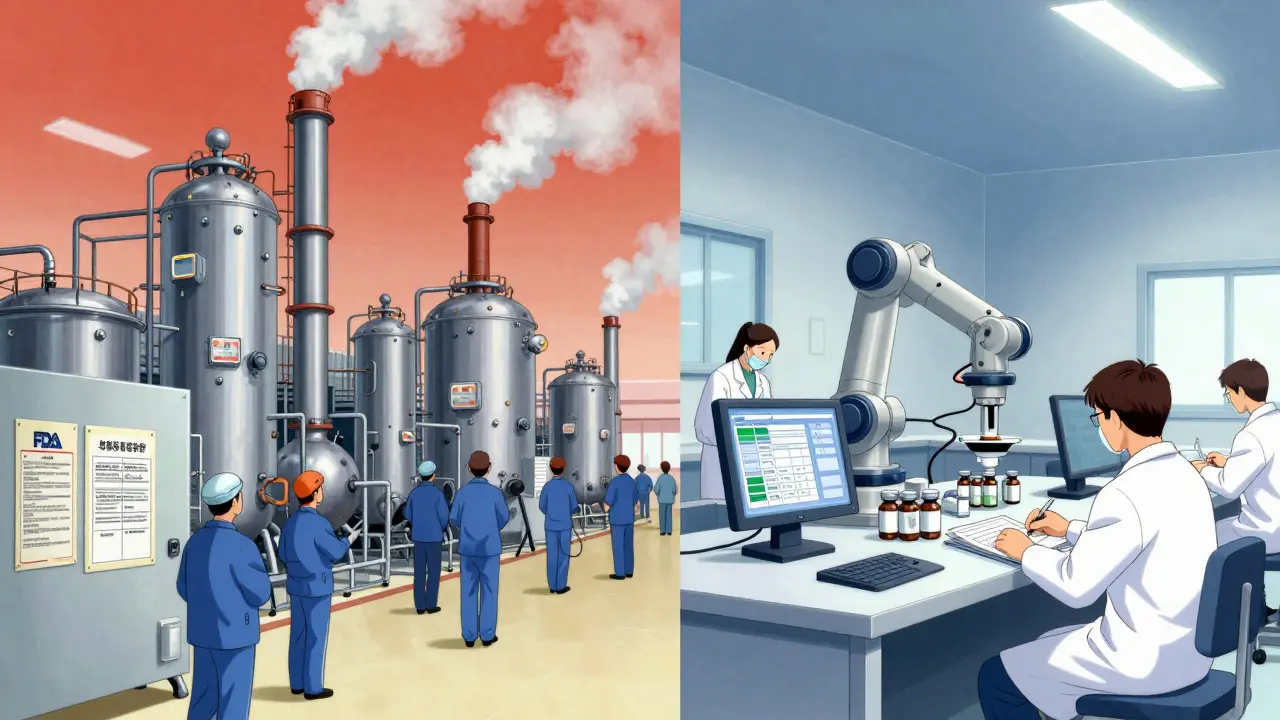
When you take a pill, you rarely think about where it was made. But for millions of drugs sold in the U.S. and Europe, the answer is either China or India. These two countries produce the raw ingredients and finished pills that keep the global medicine supply running. But they don’t operate the same way - and the differences matter for your safety.
The FDA doesn’t just approve drugs. It inspects the factories that make them. And when it comes to China and India, the inspection results tell a clear story. In 2023, nearly 37% of Chinese pharmaceutical facilities faced import alerts from the FDA - warnings that their products might be unsafe or non-compliant. In India? Just 18%. That’s not a coincidence. It’s the result of two very different approaches to quality control.
Why China Leads in Volume - But Not Trust
China makes about 80% of the world’s active pharmaceutical ingredients (APIs). That’s the core chemical that turns a pill into medicine. It’s cheaper, faster, and produced at a scale no other country matches. Factories in Shanghai, Zhejiang, and Jiangsu churn out billions of doses every year. But volume doesn’t equal reliability.
Historically, Chinese manufacturers have struggled with consistency. The FDA has cited problems with data integrity - records altered or deleted - poor sanitation, and unapproved changes in production processes. These aren’t rare glitches. They’re patterns. Between 2020 and 2023, FDA inspections of Chinese facilities turned up more than twice as many Form 483 observations (official notices of violations) as inspections in India. One U.S. pharmaceutical executive told us: "We’ve walked out of Chinese plants knowing we’d need to fix everything before we could trust them."
China’s biggest advantage is cost. Labor, land, and energy are cheaper. But that edge is shrinking. Wages have risen. Environmental regulations are tightening. And geopolitical tension has made companies nervous about putting all their eggs in one basket. That’s why many are now looking elsewhere - not to replace China entirely, but to reduce risk.
India’s Quiet Edge: Compliance Over Cost
India doesn’t make as much API as China. But it makes more FDA-approved finished drugs. Over 100 Indian manufacturing sites have FDA approval. China? Just 28. That’s a 257% gap in certified capacity.
Why? Because India built its pharma industry around compliance. After its 1970 Patents Act allowed generic drug production, companies didn’t just copy formulas - they learned how to meet global standards. Today, Indian firms invest heavily in digital systems that track every step of production. Sensors monitor temperature. Software logs batch records. Automated systems prevent human error. Bain & Company found that over 50% of Asia-Pacific contract research organizations are based in India - far ahead of China’s 18%.
Indian manufacturers also speak English. They understand FDA regulations like 21 CFR Part 211. They’ve trained inspectors, auditors, and quality teams to think like Americans. One sourcing manager at a major U.S. drug company said: "With India, we know what to expect. With China, we’re always preparing for surprises."
The Hidden Vulnerability: India’s Dependence on China
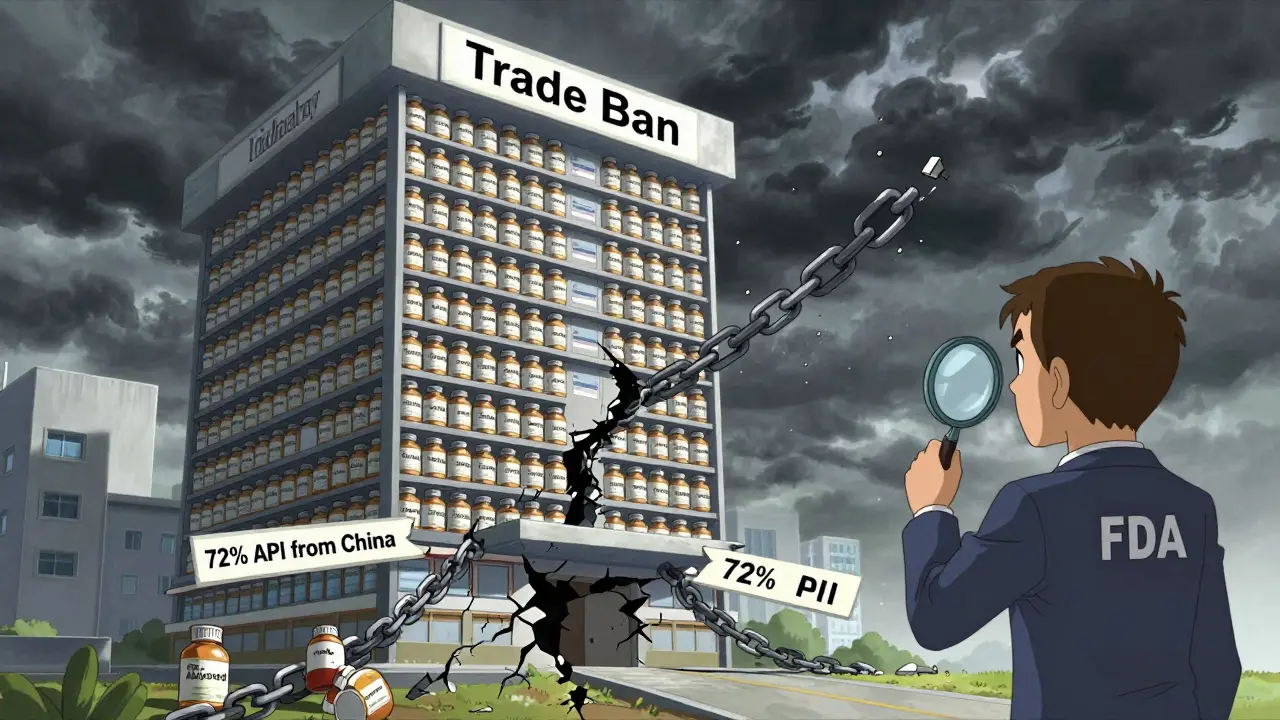
Here’s the twist: India can’t make its own APIs anymore. About 72% of the bulk chemicals used in Indian drug factories come from China. That’s up from 66% in 2022. It’s a supply chain paradox - India makes the pills, but China makes the medicine inside them.
This creates a single point of failure. If China shuts down exports - due to trade rules, disease outbreaks, or political conflict - Indian drug production could stall. And that means shortages in the U.S. and Europe. One pharmaceutical executive put it bluntly: "We’re outsourcing our safety to a country we don’t fully trust."
The Indian government knows this. That’s why it launched the "Make in India" initiative with nearly $3 billion in incentives. The goal? Build domestic API production. New plants are being built. New rules - like the 2023 revision of Schedule M - are forcing factories to meet stricter global standards. But progress is slow. Building API capacity takes years. And right now, India still leans on China.
FDA Monitoring: What Gets Checked and Why
The FDA doesn’t just show up unannounced. It has a system. Each facility gets inspected every two to three years. Inspectors look at:
- Raw material sourcing - where does the API come from?
- Process controls - are steps documented and repeatable?
- Lab testing - are samples tested properly? Are results falsified?
- Facility cleanliness - are surfaces sanitized? Is there cross-contamination?
- Quality systems - is there a team that owns safety?
Indian plants consistently score better. Why? Because they’ve been preparing for this for decades. Many have U.S.-trained quality managers. Their documentation is in English. Their audit trails are complete. Chinese plants often lack this infrastructure. They focus on output, not records. And that’s where they fail.
Import alerts are the FDA’s red flag. If a facility gets one, shipments are held at the border until the company proves it’s fixed the problem. In 2023, 37% of Chinese facilities had alerts. Only 18% of Indian ones did. That’s not luck. It’s culture.
What’s Changing in 2025 and Beyond
China isn’t standing still. It’s pushing hard into biologics - complex drugs made from living cells. Its biopharmaceutical market grew at 19.3% annually from 2015 to 2024. India’s growth is faster at 22%, but it’s starting from a much smaller base. China is betting big on innovation. India is betting big on reliability.
Meanwhile, the "China+1" strategy is real. U.S. and European companies are no longer just sourcing from China. They’re adding India as a second, more reliable option. In 2022, 12% of pharmaceutical firms preferred India over 9% who preferred China. That gap is widening.
India’s export market is projected to hit $350 billion by 2047. But only if it solves its API problem. China’s market share in outsourced manufacturing is expected to drop from 25% today to 15% by 2047. India could pick up most of that loss.
What This Means for You
If you’re a patient, this affects your medicine. If you’re a pharmacist, it affects your supply. If you’re a policymaker, it affects national health security.
Generic drugs from India are generally safer because they’re made under stricter oversight. But if the API inside them comes from a factory in China with a history of violations, that safety is only as strong as the weakest link.
The future of medicine won’t be made in just one country. It will be made in a network - some parts from India, some from China, some from elsewhere. But for now, if you want confidence in your pills, choose ones made in FDA-approved Indian facilities. They’re the ones with the cleanest records, the best audits, and the fewest surprises.
Why does the FDA inspect factories in India and China?
The FDA inspects foreign manufacturing sites because a large portion of U.S. drugs - including active ingredients and finished pills - are made overseas. The agency doesn’t have jurisdiction outside the U.S., so it must verify that foreign facilities meet U.S. safety standards before allowing products to enter the country. This protects patients from contaminated, mislabeled, or ineffective medicines.
Are Indian-made drugs safer than Chinese-made drugs?
Generally, yes - especially for finished generic drugs. Indian manufacturers have over 100 FDA-approved facilities compared to 28 in China. FDA inspection reports show Indian plants receive far fewer violations. That’s because Indian companies have spent decades building quality systems aligned with U.S. and international standards. However, many Indian drugs still rely on APIs from China, which introduces risk.
How does the FDA decide which factories to inspect?
The FDA uses risk-based prioritization. Factories that supply critical drugs, have past violations, or are located in countries with weaker regulatory systems get inspected more often. China and India are both high-risk because they supply so much of the world’s medicine. But India’s better track record means it gets fewer surprise inspections than China.
What is an FDA import alert?
An FDA import alert is a public warning that a product from a specific manufacturer or country may violate U.S. laws. When an alert is issued, shipments are automatically detained at the border until the company proves the product is safe and compliant. In 2023, 37% of Chinese pharmaceutical facilities had active import alerts - compared to 18% in India.
Why is India dependent on China for active ingredients?
India focused on making finished drugs, not raw chemicals. Over time, Chinese factories became cheaper and more efficient at producing APIs. India saved money by importing them instead of building its own. But this created a vulnerability: if China restricts exports - for any reason - India’s drug supply could slow down or stop. That’s why India is now investing billions to build domestic API capacity.
Will India replace China as the main supplier of generic drugs?
Not entirely, but it will take a bigger share. China still dominates API production and has advantages in scale and cost. But due to regulatory risks, many companies are shifting finished drug manufacturing to India. By 2047, India could capture 20-30% of the market share lost by China. The future will be a mix - not a replacement.
Really eye-opening breakdown. I never realized how much of my meds come from these two countries. The stats on FDA inspections really put things in perspective-India’s compliance culture is no accident. It’s built on decades of learning, not luck.
And honestly? The fact that Indian firms speak English and get 21 CFR Part 211 inside out? That’s not just about training. It’s about respect for the system. Chinese factories are churning out volume, but respect? Not so much.
Still, the dependency angle is wild. We’re trusting our health to a supply chain where the core ingredient comes from a place we don’t fully trust. That’s not sustainable. It’s like building a house on a fault line and calling it ‘cost-efficient.’
Yeah, I’ve been on a bunch of generics over the years. Never thought twice until now. But this makes sense-India’s got the paperwork, China’s got the price tag. Guess I’ll start checking the label more.
So let me get this straight-we’re outsourcing life-saving medicine to two countries with wildly different regulatory cultures, one of which has a history of falsifying data, and the other is literally dependent on the first for its core ingredients? And we call this a ‘strategy’?
Someone’s making a lot of money off this. And we’re just supposed to swallow it. Literally.
This is actually one of the most important public health discussions we’re not having. You think about drug safety like it’s a black box-but it’s a global supply chain with real human stakes.
And kudos to India for building a compliance-first culture. That’s not easy. It takes discipline, investment, and long-term vision. Meanwhile, China’s playing the numbers game-and we’re the ones paying the price in recalls and delays.
But here’s the real win: the ‘China+1’ shift is happening. Companies are diversifying. That’s not just smart-it’s necessary. And it’s happening because people like you and me are starting to ask questions.
Keep pushing this narrative. It matters.
The comparative regulatory architecture between the two nations is indeed a compelling case study in institutional development. India’s pharmaceutical regulatory ecosystem, shaped by post-1970 patent liberalization and subsequent alignment with ICH guidelines, has evolved into a robust, audit-ready infrastructure. This stands in stark contrast to China’s historically state-driven, output-oriented model, which prioritizes scale over traceability.
Furthermore, the linguistic and procedural alignment with FDA expectations-particularly the mastery of 21 CFR Part 211 and GMP documentation protocols-has rendered Indian facilities uniquely positioned as de facto extensions of U.S. pharmaceutical oversight. The 257% disparity in FDA-approved facilities is not merely a statistical anomaly; it reflects a fundamental divergence in epistemological approaches to quality assurance.
China’s not ‘bad’-they’re just being China. They make stuff fast, cheap, and if you’re lucky, it works. But we’ve been pretending this is a ‘risk-free’ system for decades. Meanwhile, India’s out here trying to be the good guy, but they’re still hooked on Chinese chemicals like a junkie on their dealer.
And don’t even get me started on how the FDA lets this happen. Two inspections every three years? That’s not oversight. That’s a nap.
Someone’s got to audit the auditors.
Wow. This is so important. I’ve been on the same generic blood pressure med for years. I never knew where it came from. Now I’m going to ask my pharmacist. And I’m going to start checking the label every time. Thank you for writing this. I feel more informed. And more worried. But informed is better than ignorant. Seriously. Thank you.
Let’s be real: this whole narrative is a Western fantasy. India isn’t ‘better’-it’s just better at marketing. Their facilities are clean because they’re inspected more often. But they still rely on China for 72% of their APIs. So who’s really in control? The same Chinese state-owned conglomerates that have been playing the long game for decades.
And let’s not pretend the FDA is some saintly guardian. They’re underfunded, overworked, and politically neutered. The real story? The U.S. government outsourced its pharmaceutical sovereignty to Asia and now pretends it’s safe because someone filled out a form in English.
Wake up. This isn’t about compliance. It’s about power.
Man, this post is gold. I’m a nurse, and I’ve seen patients panic when their med switched brands. They don’t know it’s the same thing-just made in a different country. But now? I’m gonna hand them this article.
And honestly? The India-China dynamic is like a marriage where one partner does all the work, and the other supplies the raw materials. It’s messy, it’s fragile, but it’s working-for now.
But if China ever cuts off exports? Boom. Hospitals empty. People die. And we’ll be the ones saying ‘we didn’t see this coming.’
Time to stop pretending this is just a business issue. It’s a national security issue. And we’re sleeping.
Interesting. But I’m curious: why do we assume that ‘FDA-approved’ means ‘safe’? The FDA doesn’t test every batch. They inspect processes. So even if a facility has perfect documentation, if someone slips a bad batch through? It still gets shipped.
And let’s not forget: many of these ‘FDA-approved’ Indian plants are owned by Chinese conglomerates. So is this really a divide between nations-or just a divide between corporate fronts?
Maybe the real issue isn’t geography. It’s accountability.
While the article presents a compelling narrative, it exhibits a conspicuous lack of quantitative rigor in its comparative analysis. The assertion that Indian facilities exhibit superior compliance is predicated upon Form 483 observations and import alert frequencies-metrics which are neither normalized by inspection volume nor contextualized by facility size or product criticality. Moreover, the 72% API import dependency figure from China is presented without reference to temporal trends or disaggregation by API class (e.g., antibiotics vs. antihypertensives).
Furthermore, the conflation of finished dosage form approvals with API manufacturing capability constitutes a category error. The two are functionally distinct. The conclusion that India is ‘safer’ is therefore methodologically unsound.
My dad died because his generic heart med was made in a Chinese factory with a history of data fraud. This isn’t about politics. It’s about bodies.
Bro, I work in pharma in India. We’re trying. Really. We’re building API plants, training people, even paying for FDA audits out of pocket. But you think it’s easy? The government promises money, but the roads to the new plants are still dirt. The power cuts? Yeah. We’ve got backup generators, but they cost more than the machines.
And yeah, we still buy from China. Because when you need 500kg of a certain chemical tomorrow? Only China can deliver. No one else.
Don’t hate us. Help us. We’re not the problem. We’re the middleman trying to keep your pills working.
Here’s what they’re not telling you: the FDA’s inspection system is rigged. The agencies that audit Indian plants? They’re often hired by the same companies they’re inspecting. The ‘approved’ labels? They’re paid for. And China? They’re being scapegoated so the real culprits-big pharma and Wall Street-can keep their profits.
Remember the 2018 valsartan scandal? Contaminated cancer meds? Made in India. But the FDA didn’t shut them down. They just issued a warning.
There’s no safety. Just theater. And we’re all just waiting for the next recall.
It’s absurd that we outsource the very foundation of public health to nations with fundamentally incompatible governance models. India’s adherence to Western regulatory frameworks is not a virtue-it is a colonial legacy. China’s emphasis on scale is not negligence-it is strategic sovereignty.
Meanwhile, the West, having hollowed out its own manufacturing base, now clings to the illusion of safety through bureaucratic rituals. The FDA’s inspections are performative. They do not guarantee safety. They guarantee liability coverage.
Real security lies in domestic production. Everything else is theater.