
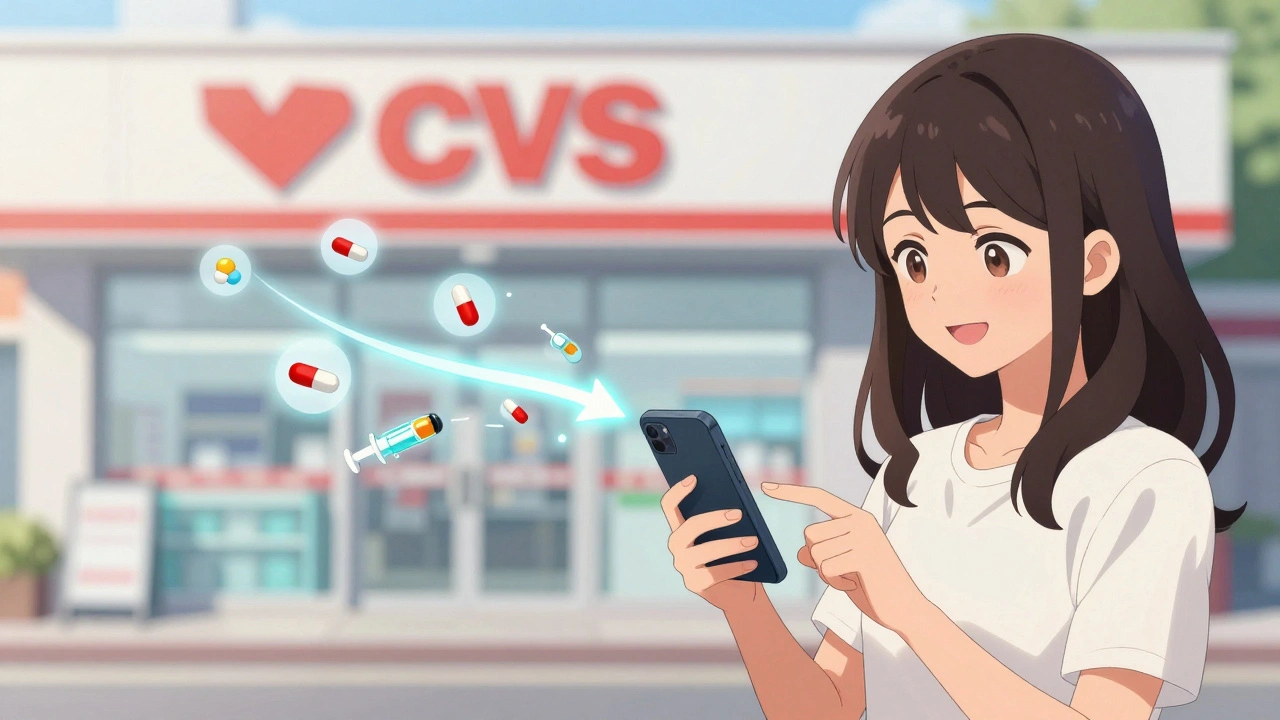
Switching to an online pharmacy used to mean calling your doctor, waiting for a new paper script, and driving to a new location. Now, you can move your prescriptions with just a few taps on your phone. Digital prescription transfer lets you send your current medication orders from your local pharmacy straight to an online service like CVS, Walgreens, or Amazon Pharmacy-no doctor visit needed. It’s faster, safer, and way less hassle. But how does it actually work? And what trips people up?
How Digital Prescription Transfer Works
Digital prescription transfer isn’t magic. It’s a secure electronic handshake between pharmacies. When you request a transfer, your current pharmacy sends your prescription data-medication name, dosage, refills left, prescriber info-over a protected network using the NCPDP SCRIPT Standard Version 201900. This system has been around since the early 2010s, but it only became truly useful for online pharmacies after 2020, when telehealth exploded and pharmacies upgraded their systems.
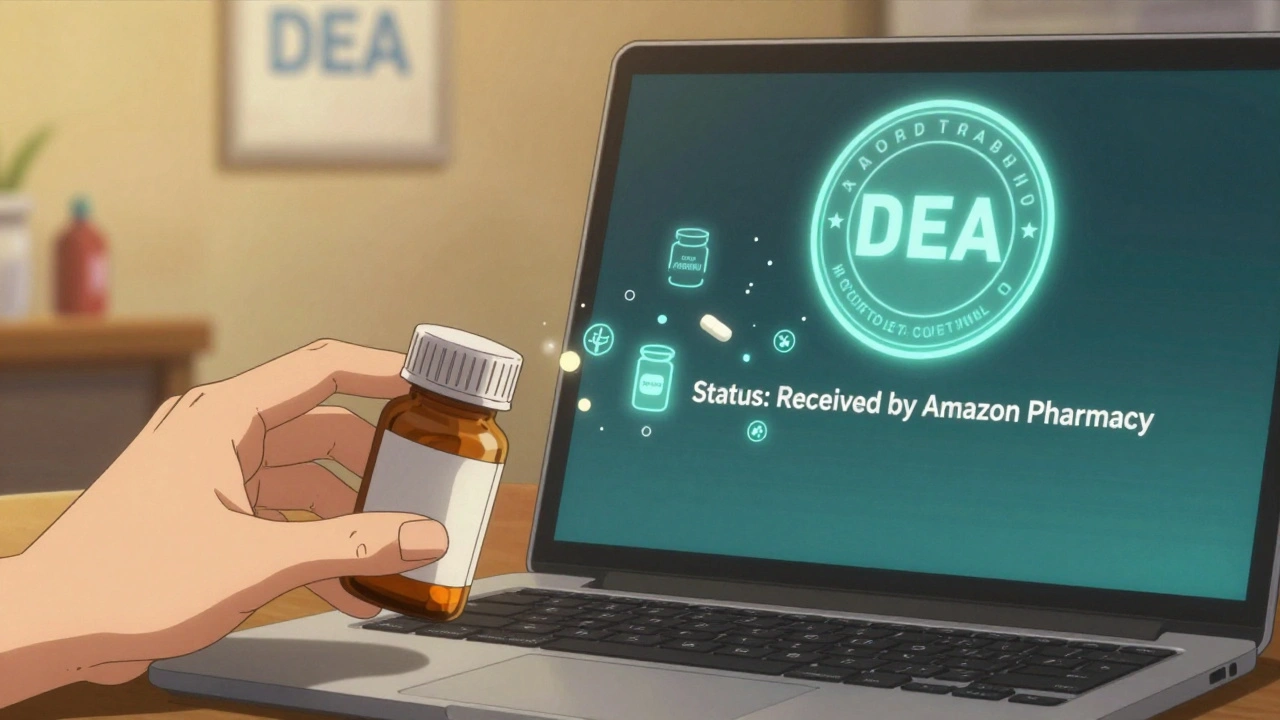
For most medications, the process is simple: you give the online pharmacy your name, date of birth, the name of the drug, and where you got it. That’s it. They handle the rest. But for controlled substances-like opioids, ADHD meds, or sleep aids-there’s a twist. Before August 2023, you had to go back to your doctor every time you wanted to switch pharmacies. That changed. The DEA updated its rules to allow one-time electronic transfers of Schedule II-V controlled substances between registered pharmacies. Now, if you’re moving from Walgreens to Amazon Pharmacy for your Adderall, you don’t need a new prescription. Just one transfer, and it’s done.
Why People Are Switching
Convenience is the biggest driver. A 2022 GoodRx survey found that 78% of users switched to online pharmacies because they saved time. No more waiting in line. No more forgetting refills. Many services now auto-fill your prescriptions and ship them with free delivery. CVS users report saving over three hours a month just by setting up auto-refills after a transfer.
Cost matters too. Online pharmacies often undercut brick-and-mortar stores, especially for generic drugs. Amazon Pharmacy, for example, offers discounts to Prime members-over 200 million of them as of mid-2023. And because these services integrate with insurance networks like OptumRx and CVS Caremark, your copay often stays the same or drops.
For seniors on Medicare Part D, digital transfers are a game-changer. CMS data shows 89% of Medicare plans now make it easy to transfer scripts online. That’s huge for people who can’t drive or have mobility issues. A 2023 Government Accountability Office report found that Medicare beneficiaries who switched to online pharmacies improved their medication adherence by 12%-meaning they took their pills on time more often.
How to Do It: Step by Step
Transferring your prescriptions online takes less than 10 minutes. Here’s how:
- Go to the website or app of your chosen online pharmacy (CVS, Walgreens, Amazon, etc.).
- Find the ‘Transfer a Prescription’ option. It’s usually on the homepage or under ‘Pharmacy’ in the menu.
- Enter your full name, date of birth, and the name of the medication.
- Provide your current pharmacy’s name and location. Many apps now auto-detect this if you type in the pharmacy’s name.
- Confirm your insurance info. If it’s not already linked, you may need to enter your plan ID or upload a card.
- Submit. You’ll get a confirmation email or text.
For non-controlled substances, you’ll usually get a response within 24 hours. CVS reports a 92% first-time success rate. Walgreens says most non-controlled transfers complete in 24-48 hours. For controlled substances, expect 48-72 hours because of extra DEA verification steps.
What Can Go Wrong-and How to Fix It
It’s not always smooth sailing. Here are the most common problems and how to solve them:
- Transfer fails because of mismatched names. If your name on file at your old pharmacy is ‘Robert J. Smith’ but you entered ‘Bob Smith,’ the system might reject it. Always use your legal name as it appears on your ID and insurance card.
- Insurance won’t cover the drug. Some specialty meds or compounded prescriptions aren’t in the online pharmacy’s formulary. Call customer support and ask if they can get it covered. Sometimes they can negotiate a price.
- Partial fills block the transfer. If you’ve already taken one pill from a controlled substance script, some online pharmacies can’t accept the rest. This is because of how states interpret the DEA’s one-transfer rule. California’s new law (SB 1056, effective Jan 2024) makes this even messier. If this happens, you’ll need to contact your prescriber to get a new script.
- Compounded medications won’t transfer. These are custom-mixed drugs, like hormone creams or pediatric suspensions. About 68% of these fail to transfer electronically. You’ll need to call the online pharmacy directly and email or fax the original prescription.
If you’re stuck, don’t panic. All major online pharmacies offer 24/7 transfer support. Amazon Pharmacy’s average wait time is just 4.2 minutes, compared to over 12 minutes at traditional pharmacies, according to J.D. Power’s 2023 study.
Which Online Pharmacy Is Best?
Not all services are equal. Here’s how the top players stack up:
| Pharmacy | Controlled Substance Transfer | Transfer Speed (Non-Controlled) | Special Features | Success Rate |
|---|---|---|---|---|
| CVS Pharmacy | Yes, once | 24 hours | 10,000+ physical locations; integrates with Caremark | 92% |
| Walgreens | Yes, once | 24-48 hours | App has barcode scanner for easy script entry | 88% |
| Amazon Pharmacy | Yes, once | 12-24 hours | Free 2-day shipping for Prime members; auto-refill alerts | 85% |
| OptumRx (UnitedHealth) | Yes, once | 48 hours | Best for Medicare Part D users; direct EHR integration | 90% |
CVS leads in network size and reliability. Amazon wins on speed and perks for Prime members. OptumRx is the top pick if you’re on a Medicare plan. Walgreens is solid but slower.
What’s Next for Digital Transfers
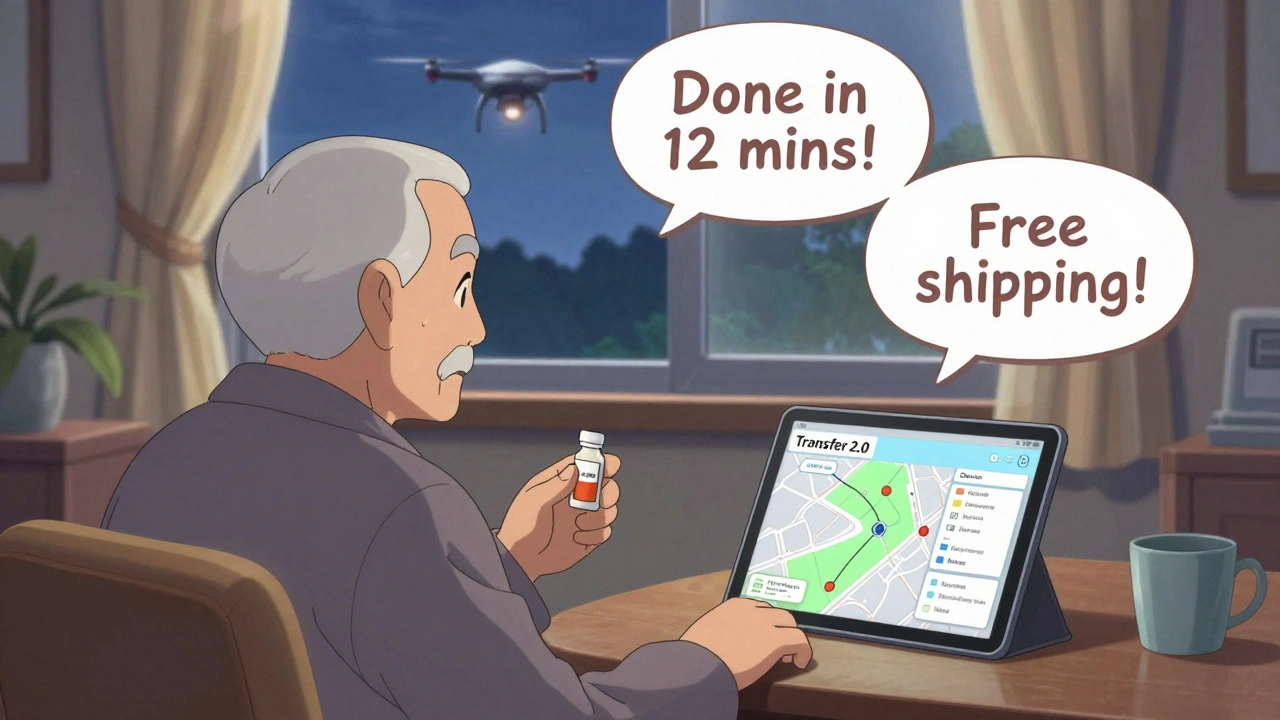
The system is getting smarter. Surescripts, the main network behind most transfers, is rolling out ‘Transfer 2.0’ in early 2024. This update will let you track your transfer in real time-like a package delivery-right in your pharmacy app. You’ll see when it’s received, processed, and shipped.
Amazon is testing voice-activated transfers through Alexa. Say, ‘Alexa, transfer my blood pressure med to Amazon Pharmacy,’ and it happens. Pilot testing with 5,000 users is already underway.
But challenges remain. The DEA’s one-transfer rule for controlled substances is causing confusion. Some pharmacies interpret it strictly; others are more flexible. And state laws are clashing-California’s new rules don’t line up with federal ones, forcing national pharmacies to build separate systems for different states.
Still, the trend is clear. Gartner predicts that by 2027, 75% of new pharmacy relationships will start with a digital transfer, not a walk-in visit. Younger generations don’t want to wait in line. They want their meds delivered. And the system is finally catching up.
Frequently Asked Questions
Can I transfer a prescription that’s already been partially filled?
It depends. For non-controlled substances, yes-most online pharmacies will accept the remaining refills. For controlled substances, if you’ve taken even one pill, many online pharmacies won’t accept the rest because of the DEA’s one-transfer rule. Some state laws, like California’s SB 1056, make this even stricter. If you’re unsure, call the online pharmacy and give them your prescription number. They can check your refill history.
How long does a digital prescription transfer take?
For regular medications, most transfers complete in 24 hours. CVS and Amazon often finish in under 12 hours. For controlled substances, expect 48 to 72 hours because of extra DEA verification. If it’s been more than 72 hours and you haven’t heard anything, contact the online pharmacy’s support team. Delays usually happen because of insurance issues or mismatched patient info.
Is digital transfer safe and private?
Yes. All transfers use HIPAA-compliant networks and encrypted systems. Your prescription data is never emailed or sent as a PDF. It moves directly between pharmacy systems using the NCPDP SCRIPT Standard. For controlled substances, DEA rules require two-factor authentication and audit trails. Your privacy is protected by law.
Can I transfer prescriptions from international pharmacies?
No. U.S. online pharmacies can only accept transfers from DEA-registered pharmacies within the United States. Even if you’re using a Canadian pharmacy, U.S. law doesn’t allow electronic transfers from outside the country. You’d need a new prescription from a U.S.-licensed provider.
What if my insurance doesn’t cover the drug after transfer?
This happens with specialty or brand-name drugs. First, check if the online pharmacy offers a discount card or cash price. Many have lower out-of-pocket costs than local pharmacies. If it’s still too expensive, call your insurer. Sometimes they can override the formulary if you provide a letter from your doctor. You can also ask the pharmacy to file a prior authorization on your behalf.
Do I need to notify my doctor when I transfer my prescription?
No, you don’t need to. The transfer happens between pharmacies electronically. But your doctor might get a notification if they use an EHR system linked to Surescripts or another network. Some doctors appreciate knowing where their patients get meds-it helps them track adherence. But you’re not required to tell them.
Final Thoughts
Digital prescription transfer isn’t just a convenience-it’s a shift in how we manage our health. It cuts down errors, saves time, and makes it easier to stick with your meds. The system isn’t perfect. Controlled substance rules are still messy. Some pharmacies lag behind. But the momentum is clear: more people are moving their scripts online every year. By 2025, over $45 billion in prescriptions will be handled this way. If you’re still driving to the pharmacy for refills, you’re doing it the hard way. The future of pharmacy is in your inbox-and your phone.
I just transferred my blood pressure med to CVS last week-took 18 hours. No drama. No calls. Just... done. I didn’t even think about it after hitting submit. Life’s too short for pharmacy lines.
I must say, the sheer *naivety* of assuming this system is universally seamless is… quaint. 🤦♂️ The DEA’s "one-time transfer" rule? A legal minefield disguised as convenience. And don’t get me started on how Walgreens’ "barcode scanner" is just a glorified OCR tool that misreads half the time. If you’re not using OptumRx and you’re on Medicare, you’re essentially gambling with your health. And yes, I’ve seen the GAO report. It’s cherry-picked. 📊
For those unfamiliar with NCPDP SCRIPT 201900, it’s the backbone of all e-prescribing in the U.S.-it’s HL7-compliant, uses X12 EDI standards, and supports bidirectional messaging. The real win here isn’t convenience-it’s interoperability. When pharmacies can exchange structured clinical data without human intervention, you reduce transcription errors by ~40%. That’s not a feature. That’s a public health upgrade. And yes, Amazon’s voice transfer pilot? That’s the future. Alexa will be your new pharmacist before your primary care doc.
I appreciate how straightforward this is. No fluff. No drama. Just a system that works. If you’ve got a prescription, and you want it delivered, this is the way. I’ve used it for my dad’s diabetes meds-no more driving 30 minutes in the rain. Simple. Effective. Thank you for laying it out so clearly.
Oh please. You say "no doctor visit needed" like it’s a virtue. You’re letting algorithms decide your meds now? And you think the DEA’s "one-time transfer" rule is a win? It’s a loophole dressed as progress. My cousin got her Adderall transferred… then the pharmacy refused to refill it because "the system flagged it as a partial fill." She had to call her doctor at 11pm. This isn’t innovation. It’s automation with a side of bureaucratic chaos.
I’ve been using Amazon Pharmacy for 18 months now. Free shipping, auto-refill reminders, and the app tells me exactly when my script is being processed. I used to miss doses because I’d forget to refill. Now, I get a notification three days before it runs out. For seniors, this isn’t luxury-it’s safety. And yes, I know the success rate isn’t 100%. But 85% is better than 60% from a walk-in.
I transferred my thyroid med last month. Took 22 hours. No issues. I didn’t even know I needed to use my legal name until I tried with my nickname and it failed. Lesson learned. Also, I didn’t realize compounded meds couldn’t transfer. I had to fax mine. Took 48 hours. Still easier than driving downtown.
My mom just switched to OptumRx after her Medicare plan pushed it. She’s 76. Couldn’t use her phone. I set it up for her. Took 8 minutes. She got her meds delivered the next day. She cried. Not because it was hard-because she hadn’t missed a dose in 3 years. That’s the real win.
We’ve got something similar here in the UK, but it’s called the NHS Electronic Prescription Service. Much more centralized. No need to pick a pharmacy-you just nominate one and it auto-sends. Still, it’s cool to see the U.S. catching up. Though I’d worry about privacy if I were you. Your meds are your business, not Amazon’s marketing data.
To clarify something in the original post: the NCPDP SCRIPT Standard doesn’t just handle transfers-it also supports electronic prior authorizations, drug utilization reviews, and real-time formulary checks. That’s why some transfers fail: the system’s flagging a coverage issue before it even reaches the pharmacy. It’s not broken. It’s just doing its job. And yes, the voice transfer pilot? It’s using AWS Transcribe + NLP models trained on pharmacy jargon. This isn’t Siri. It’s a clinical-grade voice interface. The future is here. We just need to stop calling it "convenient" and start calling it "necessary."