

A fever isn't just a number on a thermometer-it's your body’s alarm system. When your temperature hits 100.4°F (38°C) or higher, it’s not an accident. Your brain, specifically the hypothalamus, is raising your body’s thermostat to fight off invaders like viruses or bacteria. This isn’t a flaw. It’s a defense. But knowing when that defense turns dangerous is key. Most fevers in healthy adults go away on their own within 48 to 72 hours. But if you wait too long or ignore warning signs, a simple fever can become something serious.
What Counts as a Fever?
Many people still think 98.6°F is the normal baseline, but that’s outdated. People vary. Some naturally run a little lower, others higher. The real threshold for a fever is 100.4°F (38°C) or above. Below that, you might feel warm or achy, but it’s not classified as a fever. Clinically, fevers are broken into three levels:
- Low-grade: 99.1°F to 100.4°F (37.3°C to 38.0°C) - Often mild, usually viral
- Moderate: 100.6°F to 102.2°F (38.1°C to 39.0°C) - More uncomfortable, may need treatment
- High-grade: 102.4°F to 105.8°F (39.1°C to 41°C) - Requires close attention
Temperature matters, but how you measure it matters too. Digital oral thermometers are the most accurate for adults. Forehead (temporal artery) thermometers are okay, but can be off by a degree or two. Don’t trust armpit readings-they’re unreliable. And if you just came in from a hot shower or went for a run, wait 30 minutes before checking. Heat from activity can falsely spike your reading.
When to Call a Doctor
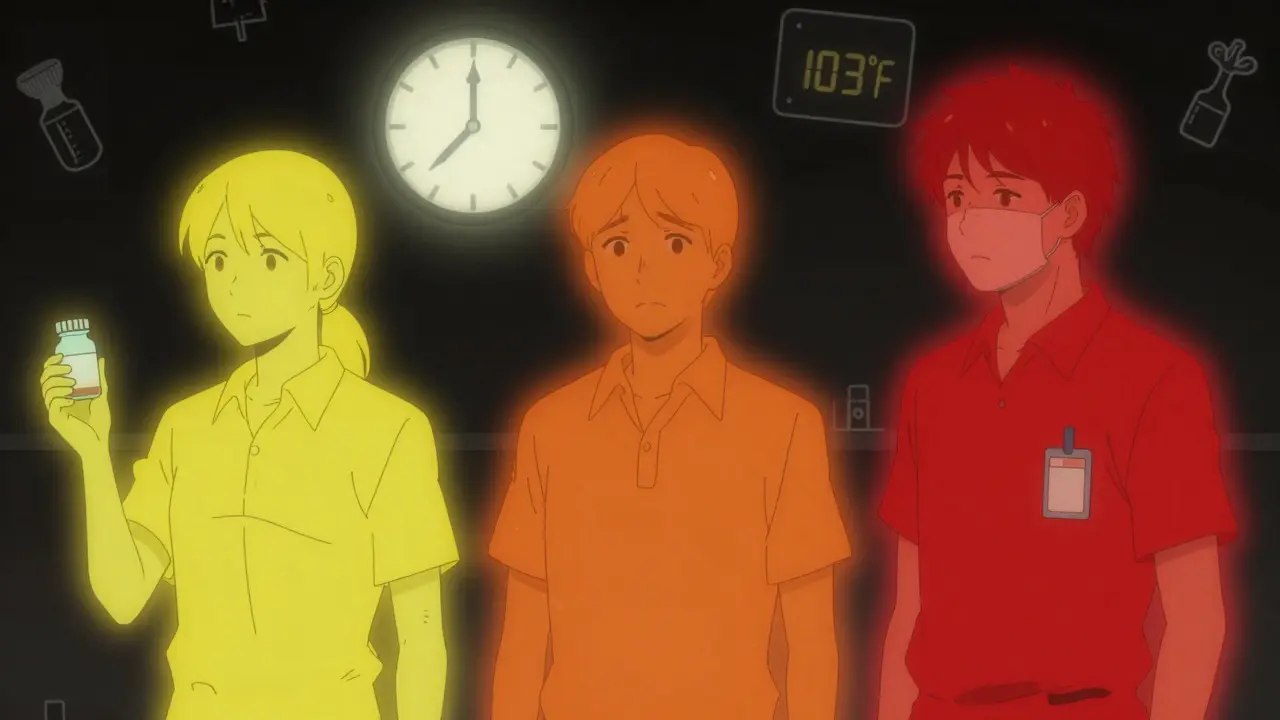
Not every fever needs an ER visit. But there are clear red flags. If your fever hits 103°F (39.4°C) or higher and doesn’t come down with rest, fluids, or over-the-counter meds like acetaminophen or ibuprofen, it’s time to call your doctor. This isn’t just a suggestion-it’s backed by guidelines from Penn Medicine, Hackensack Meridian Health, and Mission Health. At this point, your body is fighting something that may need more than home care.
And don’t wait for it to get worse. If your fever lasts longer than 72 hours, even if it’s only 101°F, you should get checked. Most viral infections clear up in three days. If yours is still going strong after that, it could be bacterial-like a sinus infection, urinary tract infection, or even pneumonia. A 2022 study from the American Academy of Urgent Care Medicine found that 30% of adults who waited past 72 hours ended up needing hospitalization. That delay made things worse.
Who Needs to Act Faster?
Some people don’t get the same luxury as healthy adults. If you’re over 65, or if your immune system is weakened-whether from cancer treatment, HIV, organ transplant, or long-term steroid use-you need to act at a lower threshold. For you, a fever of 101°F (38.3°C) or higher is a signal to contact a provider immediately. This isn’t alarmist. It’s based on real data. During the 2020-2023 pandemic, delayed fever evaluation in older or immunocompromised adults led to 18% of preventable hospitalizations, according to the CDC. Your body can’t fight as hard. So you can’t wait.
Same goes if you have chronic conditions like diabetes, COPD, heart disease, sickle cell anemia, or cystic fibrosis. Even a low-grade fever can signal a dangerous infection in these cases. Don’t assume it’s “just a cold.”
Red Flags That Demand Immediate Care
Temperature alone doesn’t tell the whole story. Some symptoms that come with fever are emergencies. If you have any of these, go to the ER or call 911 right away:
- Confusion, trouble staying awake, or inability to respond
- Stiff neck, especially with headache or light sensitivity (signs of meningitis)
- Difficulty breathing, blue lips or tongue, or wheezing
- Seizure or convulsion
- Severe pain-especially in the abdomen, chest, or lower back
- Loss of consciousness
- Rash that doesn’t fade when pressed (could be meningococcal disease or toxic shock)
- Painful urination with fever (possible kidney infection)
- Not urinating for 12+ hours
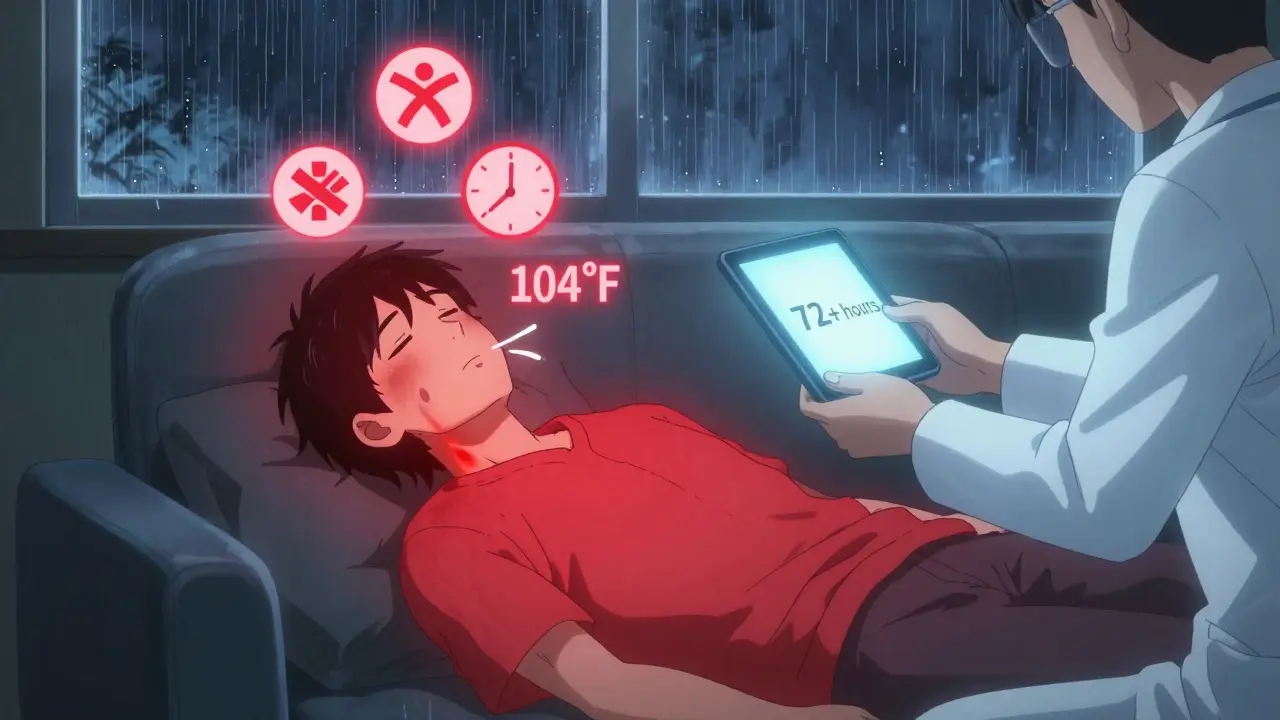
These aren’t rare. A Kaiser Permanente survey in 2023 found that 42% of adults waited until their fever hit 104°F before seeking help. But at 104°F (40°C), your body is at risk of protein damage. That’s not theoretical-it’s from pathophysiology in Harrison’s Principles of Internal Medicine. At that point, cells start breaking down. You don’t want to get there.
What to Do While You Wait
If your fever isn’t an emergency but you’re unsure, here’s what works:
- Drink water or electrolyte drinks. Dehydration makes fever worse.
- Wear light clothing. Don’t bundle up-it traps heat.
- Use acetaminophen (Tylenol) or ibuprofen (Advil) if needed. Don’t double-dose. Stick to the label.
- Rest. Your body needs energy to fight.
- Take your temperature again in 2-3 hours. Is it going up, down, or stuck?
And if you have access to telehealth-like Hackensack Meridian Health’s 24/7 virtual care-use it. A 2023 study in Telemedicine and e-Health found that 62% of non-emergency fever cases were safely managed remotely. No need to risk exposure in a crowded waiting room.
Why So Many People Get It Wrong
Most of us grew up thinking fever = bad. So we panic at 99°F. Or we think, “I’ve had worse,” and ignore it until it’s too late. The truth is, fever is a symptom-not a disease. It’s a clue. The real danger isn’t the fever itself. It’s what’s causing it. And if you ignore the clues, you might miss something serious.
Think of it like a smoke alarm. It’s not the smoke that’s dangerous-it’s the fire behind it. A fever is your body’s alarm. You don’t turn it off and pretend everything’s fine. You check. You look. You act.
Is a fever of 102°F dangerous in adults?
A fever of 102°F (38.9°C) is moderate and common with viral infections like the flu. It’s not dangerous on its own if it lasts less than 48 hours and you’re otherwise healthy. But if it climbs higher, doesn’t respond to medication, or comes with symptoms like confusion or trouble breathing, you should seek medical advice. For older adults or those with chronic conditions, even 102°F warrants a call to your provider.
Can stress or anxiety cause a fever?
Stress alone doesn’t cause a true fever (100.4°F or higher). But it can make you feel warmer or trigger mild temperature spikes under 100°F. This is sometimes called psychogenic fever, but it’s rare and not well understood. If your temperature is over 100.4°F, it’s almost certainly due to infection or inflammation-not just stress. Don’t assume it’s "all in your head"-get it checked.
Should I take medicine to bring down a low-grade fever?
Not necessarily. A low-grade fever (99.1°F-100.4°F) is your body’s natural defense. Taking fever-reducing meds like acetaminophen or ibuprofen might make you feel better, but it doesn’t speed up recovery. Only take them if you’re uncomfortable, achy, or having trouble sleeping. Let your body fight-if you’re otherwise okay, you don’t need to suppress it.
What’s the difference between a fever and hyperthermia?
A fever is your body raising its temperature on purpose to fight infection. Hyperthermia is when your body overheats from outside sources-like heatstroke, excessive exercise in hot weather, or drug reactions. In hyperthermia, your brain isn’t signaling the change. It’s a mechanical failure. Hyperthermia is life-threatening and needs emergency cooling. Fever, while serious if uncontrolled, is a regulated response.
Can I have a fever without being sick?
Yes-but it’s rare. Fever without an obvious illness can be caused by autoimmune disorders like rheumatoid arthritis, certain cancers (like lymphoma), or drug reactions (like antibiotics or seizure meds). If you have repeated fevers with no clear cause, see a doctor. You may need blood tests, imaging, or specialist evaluation to find the hidden trigger.