

When gabapentin or pregabalin was first prescribed for nerve pain, many doctors saw them as safer alternatives to opioids. But over the last decade, the reality has changed. These drugs - known as gabapentinoids - are now linked to serious risks: dizziness that leads to falls, dangerous misuse, and even overdose deaths. If you're taking one of these medications, or if you're a caregiver helping someone who is, understanding how to use them safely isn't optional - it's life-saving.
What Gabapentinoids Actually Do (And Why Dosing Matters)
Gabapentin and pregabalin work by calming overactive nerves. They were originally designed for seizures but quickly became go-to treatments for diabetic nerve pain, shingles pain, and fibromyalgia. But here’s the catch: their effectiveness doesn’t keep rising with higher doses. In fact, after a certain point, more doesn’t mean better - it just means more side effects.
For neuropathic pain, most patients get relief with doses between 900 mg and 1,800 mg per day of gabapentin, split into three doses. Pregabalin works at lower doses - typically 75 mg to 150 mg twice daily. The FDA and major medical groups like the American Academy of Neurology now agree: doses above 1,800 mg daily for gabapentin or 300 mg twice daily for pregabalin offer little extra pain relief but sharply increase risks. A 2021 study in the Journal of Pain Research showed dizziness jumped from 15% at low doses to over 32% at high doses. That’s not just discomfort - it’s a fall risk.
And renal function changes everything. If your kidneys aren’t working well - which is common in older adults or people with diabetes - your body can’t clear these drugs efficiently. A person with a creatinine clearance under 30 mL/min should never take more than 900 mg of gabapentin daily. Many doctors still miss this. Always ask: What’s my kidney function? If you don’t know, get a simple blood test before starting.
Dizziness: The Most Common - and Dangerous - Side Effect
Dizziness isn’t just a nuisance. It’s the number one reason people stop taking gabapentinoids. About 20-30% of users report it, and for older adults, that number climbs to 40% or higher. It’s not random. It happens mostly during the first week of increasing the dose. One patient on Reddit wrote: “I felt like I was drunk every morning. I almost fell down the stairs.” That’s not rare.
The FDA found that nearly 3 out of 10 people in clinical trials quit pregabalin because dizziness was too severe. The problem gets worse at night if you take your last dose too late - you wake up wobbly. That’s why experts now recommend taking the last dose no later than early evening.
For people over 65, especially those with balance issues or a history of falls, the stakes are higher. The American Geriatrics Society’s 2022 Beers Criteria says: “Avoid starting gabapentinoids in frail elderly unless absolutely necessary.” If you must start, begin at 100 mg once daily and increase by 100 mg every week - not every few days. Slow titration cuts dizziness risk by more than half.
Real-world data backs this up. On Drugs.com, 41% of users quit gabapentin because of dizziness - and nearly 60% of those were on doses over 2,400 mg daily. But among those taking 900-1,800 mg daily, 73% said side effects were manageable. The sweet spot isn’t the highest dose - it’s the lowest dose that works.
Misuse Is Real - And It’s Rising
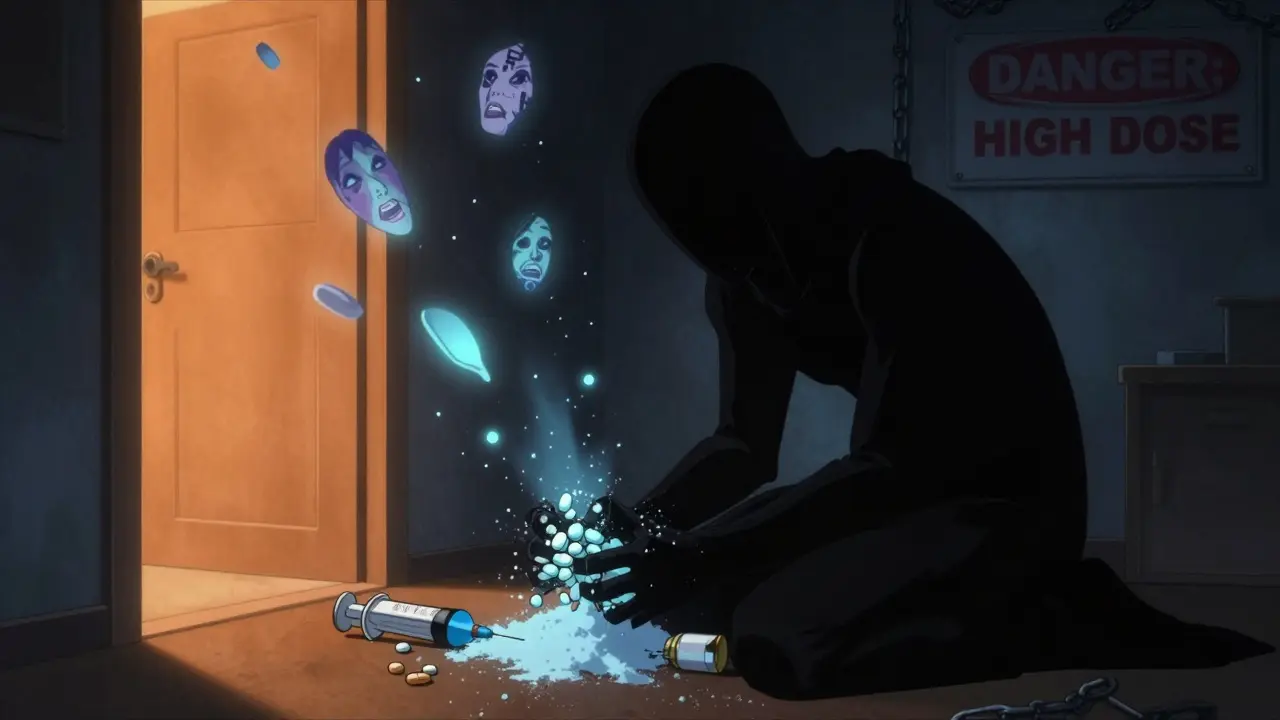
Here’s something many patients don’t realize: gabapentinoids can produce a mild high, especially when taken in large doses or combined with opioids or alcohol. Between 2012 and 2020, overdose deaths involving gabapentin rose by nearly 500%, according to the CDC. That’s not because people took too much for pain - it’s because they were using it to get high or to ease opioid withdrawal.
A 2022 study in Addiction found that 15-22% of people with opioid use disorder deliberately sought out gabapentin to boost the effects of heroin or prescription painkillers. Some reported taking 3,600-4,800 mg daily - far beyond any medical recommendation. One patient on PainForum.org described injecting crushed gabapentin pills: “It made me feel floaty. Then I passed out in the bathroom. They had to revive me.”
The FDA added warnings about misuse to gabapentinoid labels in 2019. Since then, 49 U.S. states have classified gabapentin as a controlled substance or added it to prescription monitoring programs (PDMPs). That means your doctor can see if you’re getting it from multiple pharmacies. It’s not about distrust - it’s about safety.
Doctors are now required to screen for substance use before prescribing. If you’ve ever misused alcohol, opioids, benzodiazepines, or even slept pills, tell your doctor. Hiding it puts you at higher risk. Urine drug testing at 3-month intervals is now standard for high-risk patients. It’s not punishment - it’s protection.

How to Use Gabapentinoids Safely: A Practical Guide
If you and your doctor decide gabapentinoids are right for you, follow these steps:
- Start low. Begin with 100-300 mg of gabapentin once daily at night. For pregabalin, start with 75 mg once daily.
- Go slow. Increase by no more than 300 mg of gabapentin every 3-7 days. Never jump from 300 mg to 1,200 mg in a week.
- Watch for dizziness. Check in with yourself every morning. Are you unsteady? Do you feel lightheaded? Report it immediately - don’t wait for your next appointment.
- Know your kidney numbers. Get a blood test for creatinine clearance before starting and every 3-6 months after.
- Never mix with alcohol, opioids, or benzodiazepines. This combo can slow your breathing to dangerous levels.
- Don’t stop cold turkey. Withdrawal can cause anxiety, insomnia, nausea, and even seizures. Taper down by 300 mg every 3 days under medical supervision.
For older adults, the goal isn’t to eliminate pain completely - it’s to reduce it enough to walk safely and sleep through the night. A dose of 900 mg daily might be all you need. Pushing higher won’t help - it’ll just make you dizzy.
What’s Changing in 2026 - And What It Means for You
The tide is turning. After a decade of skyrocketing prescriptions, gabapentinoid use in the U.S. dropped 8.7% between 2021 and 2022 - the first decline in 20 years. Why? Doctors are learning. Patients are speaking up. Regulators are acting.
The FDA updated labels in late 2023 to highlight fall risks in the elderly. The CDC now recommends limiting initial prescriptions to 7-day supplies for acute pain. Pharmaceutical companies are testing abuse-deterrent versions - like extended-release gabapentin XR - that can’t be crushed or injected. And in 2024, the CDC is expected to officially classify doses above 1,800 mg daily as “high-risk,” requiring extra documentation.
The American Medical Association’s new “START” protocol is being adopted nationwide:
- Screen for kidney function and substance use history
- Titrate slowly - max 300 mg every 3-7 days
- Assess dizziness weekly
- Review necessity monthly
- Taper properly if stopping
This isn’t bureaucracy. It’s medicine that works - and keeps you safe.
When Gabapentinoids Might Not Be Right for You
There are times when the risks outweigh the benefits:
- You’re over 70 and have a history of falls or balance problems
- You have kidney disease and can’t get regular blood tests
- You or a close family member has a history of opioid, alcohol, or sedative misuse
- You’re already taking opioids, benzodiazepines, or sleeping pills
- You’ve tried gabapentin before and stopped because of dizziness
In these cases, alternatives exist: physical therapy, cognitive behavioral therapy, low-dose antidepressants like duloxetine, or even topical lidocaine patches. Don’t assume gabapentin is your only option. Ask your doctor: “What else can I try before starting this?”
Can gabapentin cause weight gain?
Yes, weight gain is a known side effect, especially with pregabalin. Studies show about 10-15% of users gain 5% or more of their body weight over 6 months. This is likely due to increased appetite and fluid retention. If you notice unexplained weight gain, talk to your doctor - it doesn’t always mean you need to stop, but it does mean you need closer monitoring.
Is gabapentin addictive?
Gabapentin isn’t addictive in the same way as opioids, but it can be misused. People with substance use disorders may take high doses for euphoric effects or to ease withdrawal. The brain can adapt to high doses, leading to dependence. Stopping suddenly can cause withdrawal symptoms like anxiety, sweating, and insomnia. That’s why tapering is essential - and why screening for past misuse is critical before prescribing.
How long does it take for gabapentin to work for nerve pain?
Most people notice some improvement within 1-2 weeks, but full effect can take 4-6 weeks. Don’t increase your dose too soon. If you don’t feel better after 6 weeks at the maximum tolerated dose, it likely won’t help. Many patients keep taking it longer than needed because they think it’s working - when it’s just not helping anymore.
Can I take gabapentin with other pain meds?
Avoid combining gabapentin with opioids, benzodiazepines, or alcohol. Together, they can slow your breathing and increase the risk of overdose. Even over-the-counter sleep aids or muscle relaxers can be risky. Always tell your doctor and pharmacist about every medication and supplement you take - including herbal ones like kava or valerian root.
What should I do if I miss a dose?
If you miss a dose, take it as soon as you remember - unless it’s close to your next scheduled dose. Never double up. Missing doses occasionally won’t cause harm, but skipping regularly can make pain worse and increase withdrawal risk if you stop. Use a pill organizer or phone reminders to stay on track.
Next Steps: What to Do Today
If you’re currently taking gabapentin or pregabalin:
- Check your last kidney function test. If it’s older than 6 months, ask for a new one.
- Review your dose. Are you on more than 1,800 mg daily of gabapentin or 300 mg twice daily of pregabalin? If yes, ask your doctor if you can safely reduce it.
- Track your dizziness. Use a simple journal: rate your balance each morning on a scale of 1-5. Share it with your doctor.
- Ask: “Is this still helping?” If your pain hasn’t improved in 3 months, it’s time to reconsider.
If you’re thinking about starting gabapentin:
- Ask your doctor to explain why this is the best choice for you - and what alternatives exist.
- Request a substance use screening - even if you think you don’t need one.
- Set up a follow-up in 2 weeks to check for dizziness.
Safety isn’t about fear. It’s about awareness. Gabapentinoids can help - but only if used wisely. The goal isn’t to take the highest dose possible. It’s to take the lowest dose that lets you live your life - without falling, without craving more, and without risking your health.
Okay, I’ve been on gabapentin for 4 years for fibromyalgia and I’m not gonna lie-I almost died from a fall because I didn’t realize how drunk I felt at 2 a.m. after my last dose. My doctor kept upping it ‘for better pain control’-until I smashed my hip into the toilet. Now I’m on 900 mg, take it before 6 p.m., and I actually walk without a cane. If you’re on more than 1,800 mg and still dizzy? You’re not being treated-you’re being experimented on.
In India, we don’t even think twice about gabapentin-it’s sold over the counter in half the pharmacies. I saw a man in Mumbai buy 120 pills at once because his cousin said it ‘helps with stress.’ No prescription. No kidney test. No warning. This article? It’s a lifeline for places where doctors don’t even know what creatinine clearance means. Please share this with every auntie and uncle who’s popping these like candy.
So the FDA says high doses are risky but doesn’t ban them. The CDC says 1,800 mg is the ceiling but doesn’t enforce it. Doctors prescribe it like it’s ibuprofen. And patients? They’re just trying to sleep. The system isn’t broken-it’s designed this way. Profit over precaution. Always has been.
I appreciate this post so much. My dad was on 3,600 mg daily for sciatica-and he didn’t even know his kidneys were failing. We found out because he passed out in the shower. Now he’s down to 600 mg, his balance is better, and he’s not hallucinating at night. Please, if you’re reading this and you’re on high doses-ask for a blood test. It’s not a big deal. It could save your life.
OMG YES!! 🙌 I started at 100mg at night like the guide said and I didn’t even feel the dizziness until week 3 when my doc pushed me to 1,200mg. I was wobbling like a newborn giraffe. Cut it back to 900mg and now I can dance with my grandkids again 💃🕺 Thank you for the START protocol-I’m printing this out for my doc!
my mom took gabapentin for 3 years and never told us she was mixing it with wine because she said it 'helped her relax'... she had 3 falls and ended up in the ER. i wish someone had told us this stuff sooner. i’m sharing this with everyone i know. thank you for writing this
Been on 1,200 mg for 8 months. Dizziness? Barely noticeable. Kidney test? Did it last month. All good. Not all of us are falling down stairs. Maybe the real issue is doctors who don’t listen to patients who say ‘I feel fine.’
Let me get this straight-you’re telling me the same drug that got me through opioid withdrawal is now the villain? I took 4,800 mg for 3 months to stop shaking. I didn’t get high. I got stable. Now I’m on 600 mg and my life is normal. Don’t criminalize what saved me just because some people abuse it.
Oh wow, another anti-gabapentin diatribe from the medical-industrial complex. Let’s see… first they told us opioids were safe, then they said they were evil, now gabapentinoids are the new devil? Meanwhile, people with chronic pain are being left in the dark, denied meds, and told to ‘just meditate.’ The real danger isn’t the drug-it’s the gatekeeping. You want to reduce doses? Fine. But don’t pretend you’re saving lives when you’re just reducing prescriptions to cut costs.
What if the real problem isn’t the drug, but the fact that we’ve turned pain into a problem to be solved with chemicals instead of a signal to be understood? Gabapentin doesn’t fix the root cause-it just mutes the scream. Maybe we need less prescribing and more physical therapy, more yoga, more community. But that’s expensive. And slow. And doesn’t make money. So we give pills. And then we act shocked when people fall.
Dear Author, I am writing to formally acknowledge the exceptional clarity and scientific rigor of your comprehensive analysis regarding gabapentinoid pharmacokinetics, clinical safety parameters, and public health implications. Your adherence to evidence-based guidelines and inclusion of renal function thresholds demonstrates a profound understanding of geriatric pharmacotherapy. I respectfully request that this document be submitted for peer review in the Journal of Clinical Pharmacology, as it fills a critical gap in current clinical education. Furthermore, I would be honored to collaborate on a regional awareness campaign in India, where off-label use remains unregulated. Sincerely, Dr. Rakesh Kakkad, MBBS, MPH.