

Medication Eye Risk Checker
Check if your medication may cause light sensitivity or halos around lights. Based on FDA data and medical research.
Enter a medication name to check eye risk level and recommendations.
Have you ever stepped outside on a sunny day and felt like the light was stabbing your eyes? Or noticed glowing rings around streetlights at night - halos - that weren’t there before? If you’ve started a new medication recently, this isn’t just bad luck. It could be your eyes reacting to something in the pill you’re taking.
What’s Really Going On With Your Eyes?
Halos and light sensitivity aren’t random annoyances. They’re real, documented side effects of dozens of common medications. Your eyes aren’t broken - they’re being affected by chemicals designed to treat other parts of your body. Medications like hydroxychloroquine (Plaquenil), amiodarone (Cordarone), and even sildenafil (Viagra) can change how your cornea, retina, or optic nerve responds to light. The result? Painful glare, blurry vision, or rings around lights that make driving at night dangerous.The science behind this is straightforward: some drugs accumulate in eye tissues. Hydroxychloroquine, used for lupus and rheumatoid arthritis, builds up in the retina over time. After five years of use, the risk of permanent damage jumps from 1% to over 20%. That’s not rare. That’s predictable. And it’s preventable - if you know to watch for it.
Medications That Can Mess With Your Vision
Not all medications cause these problems. But many do. Here’s what you need to know:- Hydroxychloroquine (Plaquenil): Used for autoimmune diseases. Causes corneal clouding and retinal damage. Up to 15% of long-term users develop irreversible vision loss. Annual eye exams are mandatory after year five.
- Amiodarone (Cordarone): For heart rhythm problems. Causes halos around lights in 1-10% of users. Some patients report being unable to drive at night within weeks of starting the drug.
- Sildenafil (Viagra), Tadalafil (Cialis): Erectile dysfunction meds. Can trigger optic neuropathy, color vision changes, and severe light sensitivity. Symptoms often start within hours of taking the pill.
- Antiseizure drugs (Dilantin, Phenytoin): Cause photophobia in a significant number of users. One Reddit user said FL-41 tinted glasses reduced their symptoms by 80% - enough to return to work.
- Antipsychotics (Chlorpromazine): Lead to pigment changes in the eye, dry eyes, and retinal damage. These changes can be permanent even after stopping the drug.
- Tamoxifen: Used for breast cancer. Causes retinal deposits in about 1.5% of users. Vision changes may be subtle at first - but they don’t go away.
- Chemotherapy drugs (Vemurafenib, Imatinib): Trigger extreme photosensitivity. Patients report blistering sunburns from indoor lighting or brief sun exposure.
- NSAIDs (Ibuprofen, Naproxen): Surprisingly, these common painkillers can cause photophobia in up to 3% of users, though most don’t report it because they assume it’s just a migraine symptom.
The FDA’s adverse event database shows medication-related photophobia complaints rose 47% between 2020 and 2022. Hydroxychloroquine, amiodarone, and antiseizure drugs top the list. This isn’t going away - it’s getting worse.
Why Do These Drugs Affect Your Eyes?
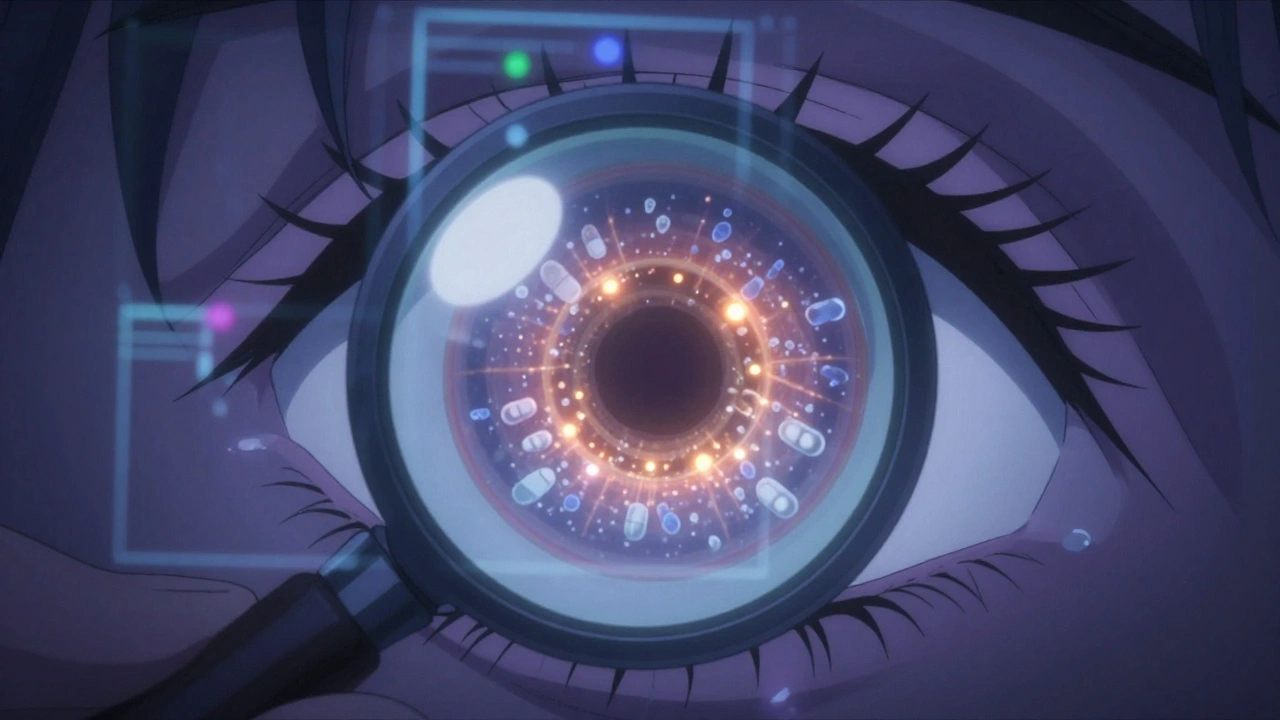
It’s not magic. It’s biology.Some drugs act like magnets for eye tissue. Hydroxychloroquine sticks to the retinal pigment layer. Amiodarone deposits in the cornea. Tamoxifen builds up in the retina. These deposits scatter light - that’s the halos. Others make your brain hypersensitive to light. The thalamus, which processes sensory input, gets overstimulated. Your optic nerve and pain nerves start talking to each other in ways they shouldn’t. Suddenly, sunlight feels like a physical attack.
For some, like those on ethambutol (a tuberculosis drug), the damage hits the optic nerve directly. At high doses, up to 50% of patients lose peripheral vision or can’t tell colors apart. And here’s the scary part: in 95% of cases, there are no symptoms until the damage is already done.
How to Protect Your Vision
If you’re on any of these meds, you need a plan. Not a wish. A plan.- Get a baseline eye exam before starting high-risk drugs like hydroxychloroquine or tamoxifen. This isn’t optional. It’s your legal and medical safety net.
- Annual eye exams are non-negotiable for hydroxychloroquine users after five years. For ethambutol, monthly vision tests during treatment are standard. Don’t wait for symptoms. By then, it’s too late.
- Use FL-41 tinted glasses. These aren’t regular sunglasses. They’re specially filtered lenses that block the specific wavelengths of light that trigger photophobia. Studies show they reduce symptoms by 40-70%. They’re worn indoors, too - not just outside.
- Adjust your lighting. Swap bright white LEDs (5000K+) for warm white bulbs (2700K-3000K). Dim them to 50-70%. Avoid fluorescent lights. Use blackout curtains at night. This isn’t a hack - it’s therapy.
- Follow the 20-20-20 rule - every 20 minutes, look at something 20 feet away for 20 seconds. Do it in dim light. It reduces eye strain and gives your visual system a reset.
- Report changes immediately. New halos? Blurry vision? Pain when looking at light? Don’t wait. See an ophthalmologist within 48 hours. It could be acute angle-closure glaucoma - a medical emergency that can blind you in days if untreated.
A 2022 JAMA Ophthalmology study tracked over 2,400 people on hydroxychloroquine. Those who followed the screening guidelines had a 1.2% risk of retinal damage. Those who didn’t? 7.3%. That’s a six-fold difference. Your eyes aren’t a gamble.
Real People, Real Consequences
One user on Reddit, ‘MigraineWarrior89,’ started amiodarone for atrial fibrillation. Within three weeks, halos around streetlights made night driving impossible. He had to quit his job as a delivery driver. Another, ‘CancerSurvivor2020,’ took vemurafenib. Even sitting near a window caused blistering sunburns in minutes. He had to wear UV-blocking clothing indoors. And then there’s ‘VisionSaver2022,’ who had Dilantin-induced photophobia so bad she couldn’t work for six months. After switching to FL-41 glasses, she returned to her office job. Her story isn’t rare - it’s repeatable.These aren’t outliers. They’re examples. And they’re preventable.
What to Do Right Now
If you’re on any of these medications:- Check your prescription label. Look for warnings about vision changes, light sensitivity, or eye damage.
- Call your eye doctor. Ask: “Do I need a baseline or annual eye exam because of my medication?”
- If you’ve had new light sensitivity or halos in the last month - schedule an appointment today.
- Consider getting FL-41 tinted glasses. They’re not cheap, but they’re cheaper than losing your vision.
- Don’t stop your medication on your own. Talk to your doctor. Some side effects fade after stopping the drug - but only if you don’t wait too long.
The goal isn’t to scare you. It’s to empower you. Most of these side effects are silent until it’s too late. But you have control - if you act early.
What’s Being Done About It?
The problem is growing. The global market for photophobia management is expected to hit $2.4 billion by 2028. Why? Because more people are being prescribed these drugs - and more are reporting vision issues.The European Medicines Agency now requires stronger warnings on fluoroquinolone antibiotics after 3.7% of users developed light sensitivity. The NIH just funded a $4.2 million project to build a real-time monitoring network across 50 medical centers. Their goal? Cut the average delay in diagnosing drug-induced vision damage from 8.2 months to under 30 days.
That’s progress. But it’s not fast enough. You can’t wait for the system to fix itself.
Can over-the-counter painkillers like ibuprofen cause light sensitivity?
Yes. While less common than with prescription drugs, NSAIDs like ibuprofen and naproxen can cause photophobia in up to 3% of users. This is often mistaken for a migraine symptom, so it’s underreported. If you notice new light sensitivity after starting these, talk to your doctor - it might be the medication, not the headache.
Are FL-41 tinted glasses worth it?
For people with medication-induced photophobia, yes. Clinical studies show FL-41 lenses reduce symptoms by 40-70%. They’re not regular sunglasses - they block specific blue-green wavelengths that trigger nerve pain in the eye. Many users report being able to return to work, drive at night, or read without discomfort after using them. They’re an investment, but far cheaper than vision loss.
Is vision damage from hydroxychloroquine reversible?
No. Retinal damage from hydroxychloroquine is permanent. That’s why annual eye exams are critical - the goal isn’t to fix damage, it’s to catch it before it happens. By the time you notice blurry vision or halos, the damage is already done. Prevention is the only effective treatment.
How long does it take for light sensitivity to go away after stopping a medication?
It depends. For drugs like antipsychotics or NSAIDs, symptoms often improve within 7-14 days after stopping. For hydroxychloroquine or tamoxifen, damage may be permanent even after stopping. Always consult your doctor before discontinuing any medication. Never assume symptoms will fade on their own.
Can I still drive if I have halos from medication?
If halos make it hard to see streetlights, oncoming headlights, or road signs at night - no, you shouldn’t drive. Many patients report being forced to stop night driving after starting amiodarone or hydroxychloroquine. Safety comes first. Talk to your doctor about alternatives or protective lenses. Some people can drive again with FL-41 glasses - but only after testing their vision in real-world conditions.
Should I get an eye exam even if I feel fine?
Absolutely. For high-risk medications like hydroxychloroquine, tamoxifen, or ethambutol, up to 95% of retinal damage is asymptomatic in the early stages. You won’t feel it until it’s too late. Annual eye exams with optical coherence tomography (OCT) and visual field testing are the only way to catch damage before it’s permanent.
Final Thought: Your Eyes Are Worth Protecting
Medications save lives. But they don’t come with warning labels that say, “This might steal your vision.” You have to be your own advocate. If you’re on a drug linked to eye side effects, don’t wait for symptoms. Don’t assume it’s normal. Get checked. Get the right glasses. Adjust your lights. Speak up.Because once your vision is gone, no pill can bring it back.
FL-41 glasses changed my life. I was on lamotrigine and couldn't even read without squinting. Bought a pair on Amazon for $60. Now I work full-time again. No drama, just facts.
It's wild how we trust pills so much but forget our bodies are made of flesh, not circuits. Eyes don't have a mute button. Maybe we need to treat them like sacred things, not afterthoughts.
OMG YES!! I’ve been wearing my FL-41s indoors since my doc said ‘you’re not crazy’ 😭 Thank you for writing this. My husband thought I was being dramatic until he saw me cry over a ceiling light.
So you're telling me the FDA lets drug companies sell poisons that blind people but won't ban them because they make too much money? And now you want me to believe this is about safety not profit? Please. The real problem is capitalism not corneas
This is exactly why we need better patient education. I’m a nurse and I’ve seen too many people dismissed when they say ‘my eyes hurt.’ Doctors focus on the heart or the brain and forget the eyes are part of the system too. You’re not overreacting. You’re awake.
One must consider the epistemological framework through which pharmaceutical oversight operates - it is not merely a regulatory apparatus but a socio-political mechanism embedded in neoliberal hegemony wherein bodily integrity is subordinated to corporate profitability. The halos you perceive are not merely optical phenomena but metaphors for the blinding nature of institutional negligence
Why are we even talking about this? Everyone knows if you take drugs you get side effects. If you can't handle a little light sensitivity then maybe you shouldn't be on meds at all. Stop being weak and go outside and deal with the sun like a real American
I’ve seen this happen to my sister on tamoxifen. She didn’t know until she couldn’t read her grandson’s birthday card. Now she gets OCT scans every six months. It’s not scary if you’re prepared. Knowledge is the light that cuts through the halos.
It makes me wonder - if we treated the body as a whole system instead of a collection of broken parts, would we see fewer of these cascading side effects? Maybe the real issue isn’t the drugs, but how we use them.
Photoreceptor dysregulation secondary to pharmacokinetic accumulation in retinal pigment epithelium - it’s not just ‘light sensitivity,’ it’s a neuro-ophthalmic cascade. The FL-41 filter attenuates 480–520 nm wavelengths, which correlates with peak melanopsin activation. I’ve seen this in my practice. It’s not anecdotal. It’s biophysical.
They’re putting this stuff in the water too. You think it’s just pills? Watch the news. Fluoride. 5G. Big Pharma. They want you blind so you’ll keep buying their glasses. FL-41? That’s a trap. They sell it so you think you’re safe but you’re still being watched. Trust no one.
In India, many patients are unaware of these risks. I recently had a patient on hydroxychloroquine for five years without a single eye check. He lost 70% of his peripheral vision. We are now advocating for mandatory screening programs in rural clinics. Education is the first step toward prevention.
Oh great, another guilt-trip article. So now I’m supposed to feel bad for taking my blood pressure pill? My dad died of a stroke. I’m not going to risk that for some ‘halos’ that probably come from staring at my phone too much. You people are obsessed with fear.
And yet… the system persists. The FDA, the AMA, the insurance companies - all of them are complicit in the slow erosion of patient autonomy. You’re told to ‘just get an eye exam’ as if that’s a solution - when the real solution is dismantling the profit-driven pharmaceutical-industrial complex that turns human bodies into test subjects. FL-41 glasses? A Band-Aid on a severed artery.
They’re doing this on purpose. You think it’s an accident that so many drugs cause vision problems? Nah. It’s to keep you dependent. No vision = more disability payments = more control. They want you broke, scared, and buying their stuff. FL-41? They own the patent. You’re being played.