
When you pick up a generic pill at the pharmacy, you’re saving money-often 80% or more compared to the brand-name version. But have you ever wondered why some generics take years to appear on shelves, even after the brand-name drug’s patent expires? The answer isn’t just about patents. It’s about FDA approval costs-and the hidden regulatory barriers that make bringing low-cost drugs to market harder than it should be.
The Real Cost of Getting a Generic Drug Approved
The FDA doesn’t approve generic drugs for free. Under the Generic Drug User Fee Amendments (GDUFA), companies must pay fees just to get their application reviewed. For each generic drug application, manufacturers pay around $136,485 in product fees, plus $238,055 in facility fees if they make the drug in their own plant. Add in the application fee, and the total cost per submission hits roughly $375,000. That’s just to start the process.
Compare that to brand-name drugs, where a single New Drug Application (NDA) can cost over $3.6 million. On paper, generics should be cheaper and faster. But here’s the catch: the FDA’s review process for complex generics has become slower, not faster.
Why Complex Generics Get Stuck
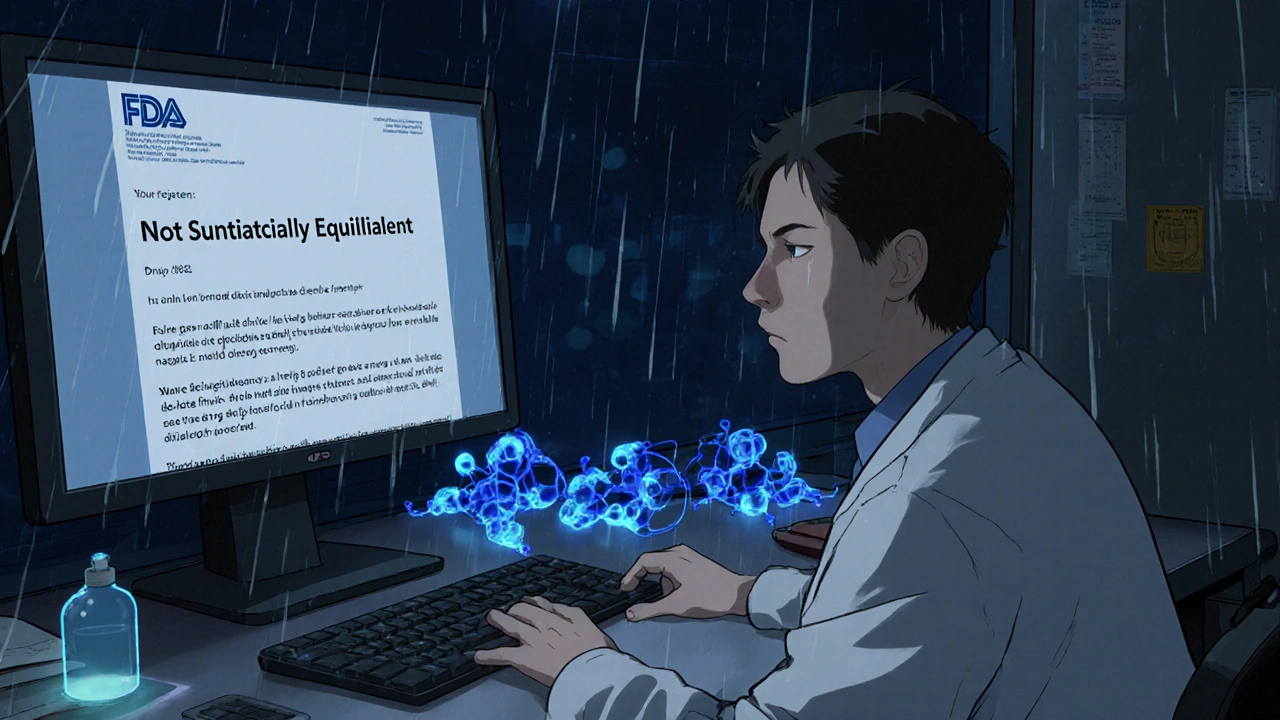
Not all generics are created equal. A simple tablet with one active ingredient is easy to copy. But nasal sprays, inhalers, injectables, or creams with complex delivery systems? Those are a different story. In 2015, the FDA stopped giving manufacturers detailed feedback on formulation issues. Instead of saying, “Your active ingredient concentration is off by 5%,” they’d send back a vague letter: “The product is not substantially equivalent.”
That one change turned approval timelines from months into years. One mid-sized generic company told regulators they spent $8.7 million and three separate reformulations over six years just to get a nasal spray approved. Each failed attempt cost them millions-and added two to three years to the timeline. That’s not innovation. That’s guesswork.
According to FDA data, only 42% of complex generic applications get approved on the first try. For standard generics, it’s 65%. That gap isn’t random. It’s policy. And it’s expensive-for companies, and for patients.
Who Pays the Price?
When a generic drug gets delayed, patients pay. Take testosterone replacement therapy. Between 2016 and 2020, no generic version was approved. Patients were forced to pay up to 300% more for the brand-name version. Some paid over $1,200 a month out of pocket. On Reddit, hundreds of people shared stories of skipping doses because they couldn’t afford the brand. One person wrote: “I’ve been taking glipizide for 12 years. The generic came out two years late. I paid $900 for a 30-day supply. Now it’s $45. I wish I could get that time back.”
The savings are real-when generics arrive. In 2024, generic drugs saved the U.S. healthcare system $467 billion. They made up 90% of all prescriptions but only 12% of total drug spending. That’s the power of competition. But 83% of brand-name drugs still have no generic competitor five years after their patent expires. Why? Approval delays.
The System Is Working-But Only for Some
The FDA says it’s doing its job. They point to record numbers: over 1,000 generic drugs approved in 2024. That’s true. But behind that number is a growing backlog. There are 287 applications stuck in “tentative approval” because of patent lawsuits. Another 143 are delayed due to manufacturing issues. And for complex generics? The average review time is 11.2 months-even though GDUFA III promised 10 months.
Pharmacists and regulators argue that strict reviews prevent disasters. They cite the 2022 valsartan recall, which affected 22 million patients. That’s valid. But the solution isn’t silence. It’s clarity. If the FDA gave detailed feedback on formulation problems, companies could fix them faster. Instead, they’re forced to rebuild from scratch-multiple times.
What’s Changing in 2025 and Beyond
There’s momentum for change. In September 2025, Congress introduced H.R. 1843, the “Increasing Transparency in Generic Drug Applications Act.” It would require the FDA to resume giving specific feedback on formulation differences. The Congressional Budget Office estimates this could cut approval times for complex generics by 18 to 24 months. That means 12 to 15 more complex generics hitting the market each year.
If passed, this law could generate $1.8 to $2.3 billion in annual savings. Over five years, that adds up to $18 to $23 billion. Patients would get cheaper drugs faster. Companies wouldn’t waste millions on failed reformulations. The FDA could even reduce its backlog.
The FDA’s Office of Generic Drugs is hesitant. They worry that without more staff, faster reviews could hurt quality. But the real issue isn’t safety-it’s resources. GDUFA IV, the next funding round starting in 2028, is already being discussed. Industry groups want a 3-5% annual fee increase to hire more reviewers. The FDA says they need $725-750 million a year to meet goals. That’s not a lot compared to the $467 billion generics already saved last year.
What Manufacturers Are Doing Differently
Smart companies are adapting. Those who succeed use early meetings with the FDA-called Type II meetings-to clarify expectations before submitting. According to a survey by the Association for Accessible Medicines, 78% of companies that got first-cycle approval used these meetings. On average, they cut review time by 3.2 months.
They’re also hiring regulatory consultants and investing in better documentation. ANDA submissions now average 150,000 to 200,000 pages. That’s triple the size of submissions from 2013. Preparation alone can cost $1-2 million. It’s no longer just about making the drug. It’s about writing a 200,000-page manual to prove you made it right.
Why This Matters to Everyone
Generic drugs aren’t a niche market. They’re the backbone of affordable care. Medicare Part D enrollees saved $1,152 per person in 2024 thanks to generics. Three billion prescriptions were filled with generics. For people on fixed incomes, chronic conditions, or without insurance, that’s life-changing.
But if the system stays broken, those savings will stall. Complex generics for cancer treatments, heart medications, and insulin are still stuck in review limbo. Patients are paying hundreds more each month. Pharmacies are forced to ration stock. And manufacturers are walking away from entire drug classes because the cost of approval is too high.
The FDA’s job isn’t to slow down generics. It’s to make sure they’re safe and effective-quickly. The tools exist. The data is clear. The political will is building. What’s missing is the commitment to give manufacturers the feedback they need to succeed-not just the fees they have to pay.
How much does it cost to get a generic drug approved by the FDA?
The total cost for a single generic drug application averages around $375,000. This includes a product fee of $136,485, a facility fee of $238,055 (if the company owns the manufacturing site), and additional application fees. These are just the FDA fees-companies also spend millions on research, testing, and documentation before submitting.
Why do some generic drugs take years to get approved?
Complex generics-like nasal sprays, inhalers, or injectables-face major delays because the FDA stopped giving detailed feedback on formulation issues in 2015. Without knowing exactly what’s wrong, manufacturers must guess and reformulate, often multiple times. Each failed attempt adds 1-2 years and millions in costs. Only 42% of complex generics get approved on the first try.
How do generic drug costs compare to brand-name drugs?
Generic drug approval costs are about 1/10th of brand-name drug approval. A brand-name New Drug Application (NDA) costs $3.685 million in FDA fees alone. Generics cost around $375,000. But while brand-name drugs take 8-12 years to develop, generics can be ready in 3-5 years-assuming the FDA approves them quickly. The real cost difference isn’t in fees-it’s in time and uncertainty.
What’s H.R. 1843, and how could it help?
H.R. 1843, introduced in September 2025, would require the FDA to restore detailed feedback on generic drug formulations. This means instead of vague rejection letters, companies would get specific guidance on what to fix. The Congressional Budget Office estimates this could speed up approval for 12-15 complex generics per year, saving $1.8-$2.3 billion annually and reducing patient costs by thousands per person.
Are generic drugs safe if they’re approved faster?
Yes. Generics must meet the same quality, strength, and purity standards as brand-name drugs. The issue isn’t safety-it’s clarity. The FDA’s 2015 policy change didn’t make drugs less safe; it made the approval process slower and more expensive. More detailed feedback would reduce failed attempts and improve consistency, not compromise safety.
How much money do generic drugs save patients?
In 2024, generic drugs saved the U.S. healthcare system $467 billion. Patients paid 80-95% less for generics compared to brand-name versions. For Medicare Part D enrollees, that meant $1,152 in savings per person. For chronic conditions like diabetes or high blood pressure, switching to generics can cut monthly costs from $500 to $50.
The FDA's current system is a classic case of bureaucracy eating its own tail. You pay nearly $400K just to ask for permission, then get back a one-line rejection that could mean anything. Companies aren't lazy-they're drowning in ambiguity. Imagine trying to build a car, but every time you submit a design, they say 'it doesn't feel right' without telling you which bolt's crooked. That's not regulation. That's performance art with a taxpayer-funded budget.
And don't get me started on the 287 applications stuck in 'tentative approval' because of patent trolling. The system isn't broken-it was designed this way to protect big pharma's profits under the guise of safety. Meanwhile, diabetics are skipping insulin doses because the generic they need has been stuck in review for five years. We're not talking about luxury drugs here. We're talking about life-or-death medications.
The real tragedy? The solution is right in front of us. Give clear feedback. Hire more reviewers. Stop pretending that vague letters protect patients. They don't. They just protect corporate margins. H.R. 1843 isn't radical-it's common sense. And if Congress doesn't pass it, we should start asking why the FDA answers to lobbyists more than to the people who can't afford their meds.
Also, if you're a manufacturer reading this: use those Type II meetings. They're not optional perks. They're your lifeline. Seventy-eight percent of first-time approvals? That's not luck. That's strategy.
Let's stop calling this a 'regulatory process.' It's a tax on compassion.
Oh wow, another ‘poor generic manufacturers’ sob story. Let me grab my violin. Meanwhile, the FDA is the only thing standing between us and a nation of people injecting paint into their veins because some startup thought ‘close enough’ was good enough.
Remember the valsartan recall? Yeah, that’s what happens when you rush things. You want faster approvals? Fine. Let’s start with the 2022 scandal where 22 million people got contaminated blood pressure meds because someone skipped a step. Who do you think paid for that? Taxpayers. Patients. The system. Not the FDA.
And don’t even get me started on ‘complex generics.’ If it’s too hard to copy, maybe it shouldn’t be copied. Maybe the brand-name drug deserves its monopoly. Innovation isn’t a crime. Greed is. But pretending every drug needs a generic version is just economic fundamentalism dressed up as healthcare reform.
Oh, and H.R. 1843? That’s just a lobbyist’s dream. Next thing you know, they’ll be asking for tax breaks too. Let the market sort it out. If a drug is truly essential, someone will make it. If not? Then maybe it’s not worth $45 a month anyway.
I’m from India, and we have a huge generic drug industry here. But even we struggle with FDA approval. One friend’s company spent 4 years and $12 million trying to get a topical cream approved. They got rejected 3 times for ‘insufficient bioequivalence data.’ But when they asked for specifics, the FDA said ‘we don’t have the bandwidth to explain.’
I just… I don’t understand how a country that claims to care about affordable medicine can make it so hard to produce affordable medicine. It’s like building a bridge and then refusing to give the engineers the blueprints. How is that not sabotage?
Let me tell you something that keeps me up at night: a 72-year-old widow in rural Ohio who’s choosing between her insulin and her heating bill. That’s not a hypothetical. That’s real. And it’s happening because the FDA treats generic drug approvals like a slow dance with a blindfold on.
They’re not saying no to safety-they’re saying no to clarity. Imagine you’re a chef. You follow the recipe exactly. You use the same ingredients. You bake it for the same time. Then the food critic says, ‘It’s just not the same.’ No explanation. No feedback. Just ‘not good enough.’ Now imagine you have to pay $375,000 every time you try again. That’s not regulation. That’s emotional abuse.
And don’t even get me started on the 143 applications delayed for manufacturing issues. If the FDA had a single inspector in every plant, they’d know what’s wrong. But they don’t. They send a letter. And then they wait. And wait. And wait.
H.R. 1843 isn’t just a bill. It’s a lifeline. It’s the difference between a kid with asthma getting their inhaler this year or waiting until next Christmas. It’s the difference between a veteran with PTSD paying $1,200 for testosterone or $45. And if Congress doesn’t act, they’re not just failing policy-they’re failing people.
Don’t tell me ‘safety first.’ Tell me why safety has to mean suffering.
And yes-I cried reading that Reddit post about the guy who paid $900 for glipizide. I cried. Because I know someone who did the same thing. And now he’s dead. And we’re still arguing about paperwork.
OMG I’m literally crying rn 😭 like why is everyone so dramatic?? The FDA is just trying to keep us from dying?? Like, duh. Who even cares if a generic takes 5 years? People still buy brand names anyway lol. And $375k? Pfft. That’s less than a Tesla. Stop whining. Also, H.R. 1843?? Sounds like a bad fanfic title. Who even wrote this? Some PhD with a Twitter account??
Also, why are we even talking about this?? I just want my Adderall to be cheap. Not a 10-page essay on regulatory reform. I’m not a policy wonk. I’m a person. With bills. And anxiety. And a cat who needs food. Can we just… move on??
Look, I get it. I used to work in pharma. I’ve seen the stacks of paperwork. I’ve sat in rooms where regulators said ‘we can’t approve this’ and then walked out without saying why. It’s insane. And it’s not just the cost-it’s the time. One company I knew spent six years on a nasal spray. Six years. They had to re-formulate it three times. Each time, they lost a year. And every time, they had to pay the same $375K fee again.
Meanwhile, the FDA’s backlog is growing because they’re understaffed and overworked. They’re not evil. They’re just drowning. And the system’s designed to punish innovation, not protect it.
But here’s the thing: it’s fixable. We don’t need to tear it down. We just need to give them more people. More clarity. More accountability. H.R. 1843? Yeah, that’s the bare minimum. And if we don’t pass it, we’re not just failing patients-we’re failing the manufacturers who are trying to do the right thing.
And yeah, I’m crying again. Not because it’s sad. Because it’s unnecessary.
As a pharmacist, I see this every day. A patient comes in asking for their generic insulin. We tell them it’s not available yet. They ask why. I have no good answer. I can’t say ‘because the FDA lost the paperwork.’ I can’t say ‘because it costs too much.’ I just say ‘I’m sorry.’
And then they leave. And I sit there wondering if they’ll skip doses. Or if they’ll go to the ER next month. Or if they’ll end up on dialysis because they couldn’t afford the meds.
Generics aren’t ‘cheaper drugs.’ They’re lifelines. And right now, we’re treating them like bureaucratic afterthoughts.
H.R. 1843 isn’t a political issue. It’s a moral one. If you believe in affordable healthcare, you believe in this bill. No exceptions. No ‘buts.’ Just action.
It is an incontrovertible fact that the United States Food and Drug Administration operates under a statutory mandate to ensure the safety, efficacy, and quality of pharmaceutical products. To suggest that the agency's rigorous review process constitutes an impediment to public health is to fundamentally misunderstand the nature of pharmaceutical regulation. The 2022 valsartan incident, which resulted in significant morbidity and mortality, was a direct consequence of inadequate oversight. To reduce scrutiny in the name of expediency is not progress-it is negligence.
Moreover, the assertion that the FDA lacks sufficient resources is disingenuous. The agency receives substantial appropriations from taxpayer funds and user fees. The real issue lies not in funding, but in the proliferation of applications that lack adequate scientific substantiation. The solution is not to lower standards, but to enforce them more stringently.
Furthermore, the notion that H.R. 1843 will result in meaningful cost savings is speculative at best. The Congressional Budget Office’s estimates are predicated on assumptions that lack empirical validation. One must be cautious in embracing policy proposals that are rooted in anecdotal evidence rather than robust data.
Let us not mistake sentimentality for sound policy.
My dad worked at a generic drug plant in Indiana for 20 years. He told me stories about how they’d spend months perfecting a formula, only to get a letter back saying ‘not substantially equivalent.’ No details. No help. Just a slap in the face.
And you know what? They’d just start over. Again. And again. And again. Because if they didn’t, they’d go out of business. And then who’d make the cheap meds?
I used to think the FDA was just being careful. Now I think they’re just tired. And overworked. And underfunded. And honestly? They’re scared. Scared of lawsuits. Scared of headlines. Scared of being the reason someone died.
But here’s the thing: if you don’t tell people what’s wrong, you’re not protecting them. You’re just punishing them.
H.R. 1843? Yeah. Pass it. And hire more people. And stop treating manufacturers like criminals.
They’re not trying to poison anyone. They’re trying to keep people alive.
Stop pretending this is about patients. It’s about profit. The ‘generic industry’ wants to cut corners. The FDA isn’t the villain-greed is.
And H.R. 1843? A Trojan horse. Let them get feedback? Then they’ll flood the market with half-baked drugs. You think this is about cost? It’s about control. The big pharma lobby doesn’t want competition. They want to keep prices high. And you’re letting them pretend this is about morality.
Wake up. This isn’t healthcare. It’s capitalism.
I read this whole thing. Honestly? I’m bored. Can we talk about something else? Like why my Wi-Fi is slow? Or how my dog ate my shoes again? This is just… too much. I don’t care about FDA fees. I just want my pills to be cheap. And if they’re not? I’ll just buy them from Canada. Problem solved.
It’s not complicated. The FDA needs more staff. The fees are high, but they’re not the main problem. The problem is the lack of communication. If you give clear feedback, companies fix things faster. That’s not risky. That’s efficient.
And if we can approve 1,000 generics in a year, why can’t we approve them faster? The system isn’t broken. It’s just outdated.
H.R. 1843 is a simple, smart fix. Let’s not overthink it.
Okay, but let’s be real-why is the FDA the only agency that treats companies like they’re guilty until proven innocent? No other industry gets this kind of silent treatment. You wouldn’t let a baker submit a cake recipe and then get back a note that says ‘not tasty enough’ with no explanation. So why do we let them do it with life-saving medicine?
And honestly? The fact that we’re even having this conversation means we’ve already lost. We’re not arguing about policy. We’re arguing about whether people deserve to live. And the answer should be obvious.
The FDA’s current approach reflects a systemic misalignment between regulatory intent and operational capacity. While the agency’s mandate to ensure safety is unequivocal, its operational framework has not evolved in tandem with the complexity of modern pharmaceutical manufacturing. The absence of granular feedback mechanisms is not a failure of intent, but of resource allocation.
Moreover, the financial burden on manufacturers is not solely attributable to FDA fees, but to the cumulative cost of iterative reformulation cycles necessitated by opaque regulatory guidance. The data presented in the original post are consistent with peer-reviewed analyses indicating that regulatory ambiguity significantly increases time-to-market and reduces innovation incentives.
H.R. 1843, while modest in scope, represents a necessary corrective. It does not diminish safety standards; it enhances procedural transparency. The Congressional Budget Office’s projections are conservative, given the latent potential for efficiency gains in the generic drug pipeline.
It is not a question of whether we can afford to act-it is a question of whether we can afford not to.