
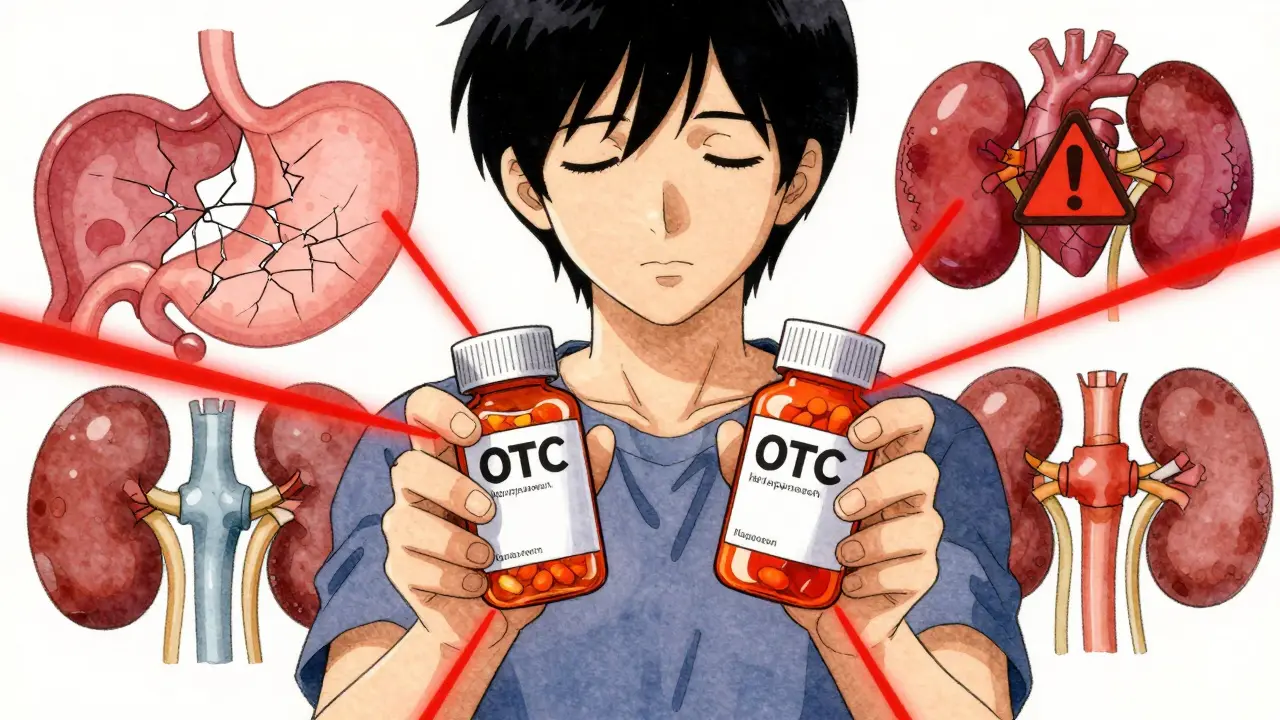
Every year, millions of people reach for ibuprofen or naproxen to ease a headache, sore back, or menstrual cramps. These are the two most common over-the-counter NSAIDs - simple, fast, and seemingly harmless. But here’s the truth most people don’t read on the label: ibuprofen and naproxen aren’t just pain relievers. They’re powerful drugs with real risks, even at OTC doses.
What You’re Actually Taking
Ibuprofen and naproxen belong to a class of drugs called NSAIDs - nonsteroidal anti-inflammatory drugs. They work by blocking enzymes in your body that cause pain and swelling. That’s why they help with arthritis, sprains, and fevers. But they don’t just target the bad enzymes. They also block ones that protect your stomach lining and help your kidneys function properly. In Australia and the U.S., OTC ibuprofen comes in 200 mg tablets. You’ll see brands like Advil or Nurofen. Naproxen sodium is sold as 220 mg tablets under brands like Aleve. Sounds small, right? But take more than you should, and you’re putting yourself at risk.Dosage Limits: The Numbers You Can’t Ignore
The maximum daily dose for OTC ibuprofen is 1,200 mg. That’s six 200 mg tablets. For naproxen sodium, it’s 600 mg - three 220 mg tablets. That’s it. No more. Not even if your pain is bad. Here’s the catch: ibuprofen lasts about 2 hours. That’s why people think, “I’ll just take another one in three hours.” But taking it every 4 to 6 hours, four or five times a day, quickly adds up. Naproxen lasts longer - up to 17 hours. So you only need it twice a day. But because it sticks around, it builds up in your system. That’s why even one extra tablet can push you over the limit. The FDA and health agencies worldwide agree: don’t use either for more than 10 days in a row without seeing a doctor. That’s not a suggestion. It’s a safety line.Cardiovascular Risks: It’s Not Just for Older People
You might think heart risks only matter if you’re 70 and have high blood pressure. Wrong. In 2020, the FDA strengthened warnings for all NSAIDs, including OTC ones. They found that even short-term use - as little as one week - can raise the risk of heart attack or stroke. For people with existing heart disease, the risk jumps even higher. A 2024 study in The Lancet showed that just 7 days of NSAID use increased heart attack risk by 20% in high-risk patients. Naproxen has a slightly better safety profile than ibuprofen when it comes to the heart. A 2015 FDA review found naproxen was less likely to trigger clotting events. But that doesn’t mean it’s safe. Both carry the same warning label now. If you have heart disease, high blood pressure, or even just high cholesterol, talk to your doctor before using either.Gut Problems: The Silent Danger
Your stomach doesn’t scream when it’s being damaged. That’s why NSAIDs are so dangerous. Studies show NSAIDs increase your chance of developing a stomach ulcer by 2 to 4 times. One user on Reddit took 1,600 mg of ibuprofen daily for three weeks - way over the limit - and ended up in hospital with a bleeding ulcer. That’s not rare. It’s common. Naproxen is actually more likely than ibuprofen to cause stomach bleeding at anti-inflammatory doses. Why? Because it stays in your system longer. The longer it’s there, the more it wears down your stomach lining. Take them with food. Yes, the label says that. But even then, it’s not foolproof. If you’re over 65, have a history of ulcers, or take steroids or blood thinners, you’re at much higher risk. And you shouldn’t be taking them at all without a doctor’s advice.
Kidneys, Blood Pressure, and the Hidden Toll
NSAIDs reduce blood flow to your kidneys. That’s how they help with swelling - but it’s also how they damage them. A 68-year-old patient in the FDA’s adverse event database developed acute kidney injury after taking the maximum OTC dose of naproxen for 14 days straight. That’s two days past the 10-day limit. He didn’t have prior kidney problems. He just thought, “It’s OTC, so it’s safe.” NSAIDs also cause fluid retention. That means higher blood pressure. If you’re already on medication for hypertension, NSAIDs can make it worse. In people with heart failure, that’s dangerous. The American Heart Association now says: avoid NSAIDs if you have heart disease - unless there’s no other option.Who Should Avoid Them Completely?
There are nine groups who should not take OTC NSAIDs without talking to a doctor:- People with kidney disease
- People with heart disease or high blood pressure
- Anyone with a history of stomach ulcers or bleeding
- Pregnant women, especially after 20 weeks
- People over 65
- Those taking blood thinners like warfarin or aspirin
- People with asthma triggered by painkillers
- Anyone with liver disease
- Children and teens with viral infections (risk of Reye’s syndrome)
What About Aspirin?
If you’re on low-dose aspirin to prevent heart attacks, ibuprofen can interfere with it. Taking ibuprofen within 8 hours of aspirin can block aspirin’s protective effect. Naproxen doesn’t do this as much - but it’s still risky. Talk to your doctor if you take both.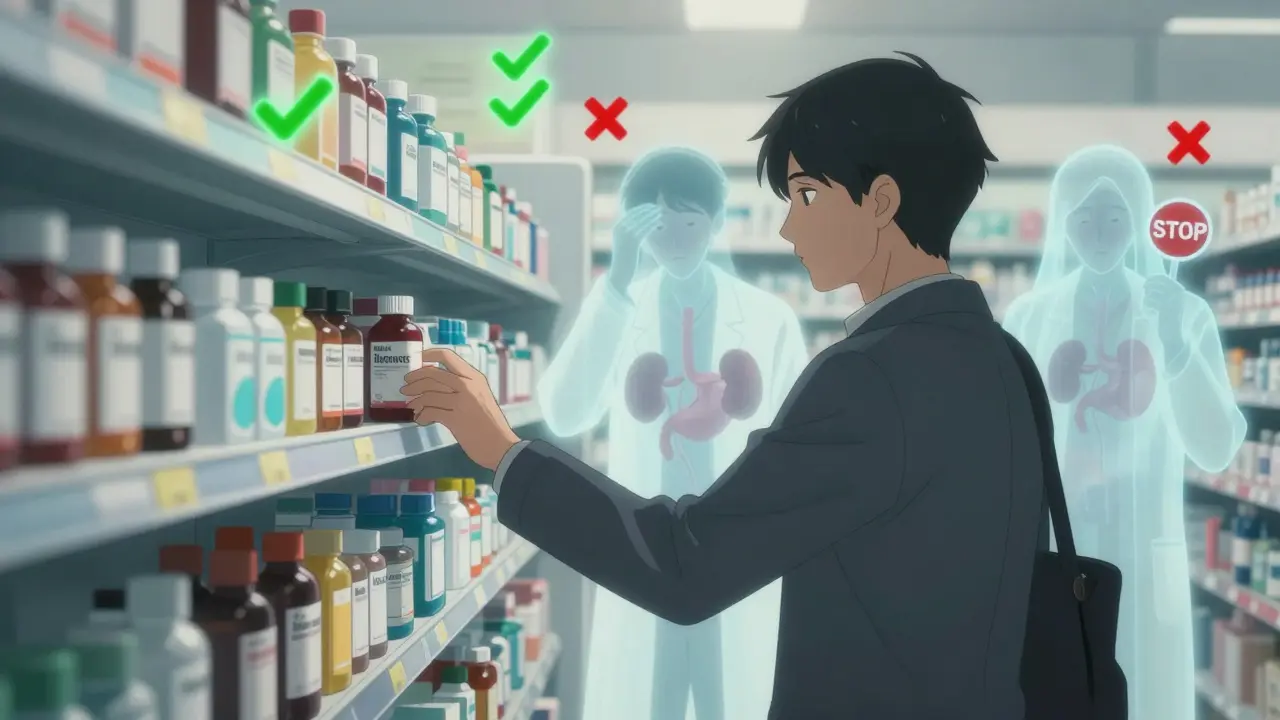
Real User Stories - And What They Teach Us
On Drugs.com, ibuprofen has a 6.2 out of 10 rating. 45% say it works well. 32% say it gave them stomach pain. Naproxen scores lower - 5.8 - with similar complaints. One review says: “200 mg ibuprofen works perfectly for my cramps when taken with food.” That’s the right way. Another says: “I took 800 mg daily for months for back pain. Ended up with ulcers. Hospitalized.” That’s the wrong way. The difference? One person followed the rules. The other didn’t.What to Do Instead
NSAIDs aren’t the only option. For mild pain, try:- Acetaminophen (paracetamol) - easier on the stomach and heart
- Topical creams - diclofenac gel applied to the skin reduces pain without hitting your stomach or kidneys
- Heat or ice packs
- Physical therapy or stretching
- Massage or acupuncture
When to See a Doctor
You don’t need to wait until you’re in pain to ask for help. If you’re using OTC NSAIDs more than 2 or 3 times a week for more than a few weeks, you’re already in the danger zone. See your doctor. Your pain might need a different solution - physical therapy, a different medication, or even lifestyle changes. And if you’ve taken more than the daily limit - even once - watch for signs of trouble: black or bloody stools, vomiting blood, sudden swelling in your legs, chest pain, or shortness of breath. These aren’t normal. Call your doctor or go to the ER.Final Rule: Less Is More
NSAIDs aren’t candy. They’re not harmless just because you can buy them without a prescription. The same drug that helps you run a marathon can also land you in the hospital. Use the lowest dose for the shortest time. Never combine them. Don’t take them daily unless your doctor says so. And always read the Drug Facts label - even if you’ve used it for years. The warnings are there for a reason. Your body doesn’t lie. If you feel stomach burning, dizziness, or swelling, it’s telling you something. Listen.Can I take ibuprofen and naproxen together?
No. Taking both together doesn’t give you better pain relief - it doubles your risk of stomach bleeding, kidney damage, and heart problems. Never combine NSAIDs unless a doctor specifically tells you to.
Is naproxen safer than ibuprofen?
For heart risk, yes - naproxen has a slightly better profile based on FDA data. But for stomach bleeding, it’s worse. Neither is safe for long-term use. The best choice is the lowest dose for the shortest time - regardless of which one you pick.
Can I take OTC NSAIDs if I’m pregnant?
Avoid them after 20 weeks of pregnancy. NSAIDs can cause serious kidney problems in the fetus and reduce amniotic fluid. Before 20 weeks, they’re not recommended unless your doctor says so. Acetaminophen is the safer choice for pain during pregnancy.
How do I know if I’ve damaged my stomach?
Early signs include persistent stomach pain, heartburn, nausea, or feeling full quickly. More serious signs: black, tarry stools; vomiting blood; or sudden, sharp abdominal pain. These are emergencies. Stop the NSAID and get medical help right away.
Can I use NSAIDs for chronic pain like arthritis?
OTC NSAIDs are not meant for daily, long-term use. For chronic conditions like arthritis, your doctor may prescribe a lower-risk medication, recommend physical therapy, or suggest a topical NSAID gel. Relying on OTC pills long-term increases your risk of serious side effects without addressing the root cause.
What’s the safest OTC painkiller?
For most people, acetaminophen (paracetamol) is the safest option - as long as you don’t exceed 3,000 mg per day. It doesn’t harm the stomach or heart like NSAIDs do. But if you have liver disease, NSAIDs might be safer - under medical supervision. Always check with your doctor before choosing.
Ibuprofen is fine for occasional headaches, but I used to take it daily for cramps and ended up with acid reflux. Stopped cold turkey and switched to heat packs. My stomach thanked me.
Always read the label. Even if you’ve used it for 10 years.
OTC my ass. These things are just pharma’s way of turning you into a walking side effect. Naproxen? More like naproxen-icidal. 200mg? More like 200mg of slow suicide. 🤡
Bro. I took 800mg ibuprofen every day for 3 months for my lower back. Thought I was being tough. Ended up in the ER with a bleeding ulcer. No joke. My stomach looked like a pizza with extra pepperoni. Don’t be me. Just… don’t.
Heat pack. Stretch. Walk. Your body ain’t a vending machine.
There is a profound ethical dissonance in our pharmaceutical culture: we commodify pain relief as if it were a consumer good, while simultaneously ignoring the physiological betrayal inherent in its mechanism. NSAIDs do not heal-they obscure. They are the opiate of the masses, masquerading as wellness. The body whispers warnings; we scream louder with another pill.
Let us not mistake suppression for resolution.
Why are we even talking about this? In America, you can buy a gun easier than you can get a prescription. But if you take 200mg of ibuprofen? Oh no, now you’re a danger to society. This is why I hate medical overreach. It’s not your job to tell me how to manage my pain.
Also, naproxen is fine. I’ve taken it for years. I’m fine.
my mom takes naproxen like it’s candy. 2 pills every day for 5 years. says she feels ‘better’. i think she’s just used to the buzz. she’s 72. i’m gonna have to sit her down and show her this post.
also, i use a heating pad now. it’s weirdly satisfying.
Stop being weak. I’ve taken ibuprofen since high school. Never had a problem. Your body’s fine. You just need to toughen up.
While the pharmacological risks of NSAIDs are well-documented, the real issue lies in the normalization of self-medication without clinical oversight. The absence of regulatory barriers does not equate to safety. It is not merely a matter of dosage-it is a cultural failure to respect pharmacological potency.
Education, not restriction, is the solution.
Hey everyone! I’m from India and we use painkillers like candy here too. But after my uncle had a bleed, we all switched to turmeric milk and yoga. It’s slow, but it works. No hospital trips. 🙏
Try it! Your body will thank you 😊
Oh wow. So the solution to ‘pain’ is… more suffering? Let me get this straight. Instead of a pill, I should… stretch? Ice? Cry into my yoga mat? How poetic.
Meanwhile, my actual doctor prescribed me a topical gel and said ‘take two pills max per day.’ So… who’s the real expert here? The guy who wrote a 10-page essay or the one who actually sees patients?
Also, I love how ‘philosophers’ act like pain is a spiritual journey. I have a deadline. I need to type. Give me the damn pill and stop lecturing me.
i used to take naproxen for my period and then i realized i was peeing less. like… not just a little. i panicked and went to the doc. turns out my kidneys were stressed.
now i use a heating pad and cry quietly. 🥲
THIS IS WHY AMERICA IS BROKEN. You can’t even take a pill without some guy in a lab coat telling you you’re going to die. I’m 34. I’m healthy. I take 2 ibuprofen when I need it. If you’re scared, don’t take it. But don’t tell me what to do with my body.
Also, the FDA is just a tool of the pharma giants. Wake up.
🔥🇺🇸