
MAOI-Opioid Safety Checker
Check Your Medications
Select your medications and click "Check Safety" to see if they're compatible.
Combining opioids with MAOIs isn't just risky-it’s deadly. This isn’t theoretical. People have died from this mix. Even if you’ve been told a medication is "safe" or "mild," if it’s an opioid and you’re on an MAOI, you’re playing Russian roulette with your nervous system.
Why This Combination Kills
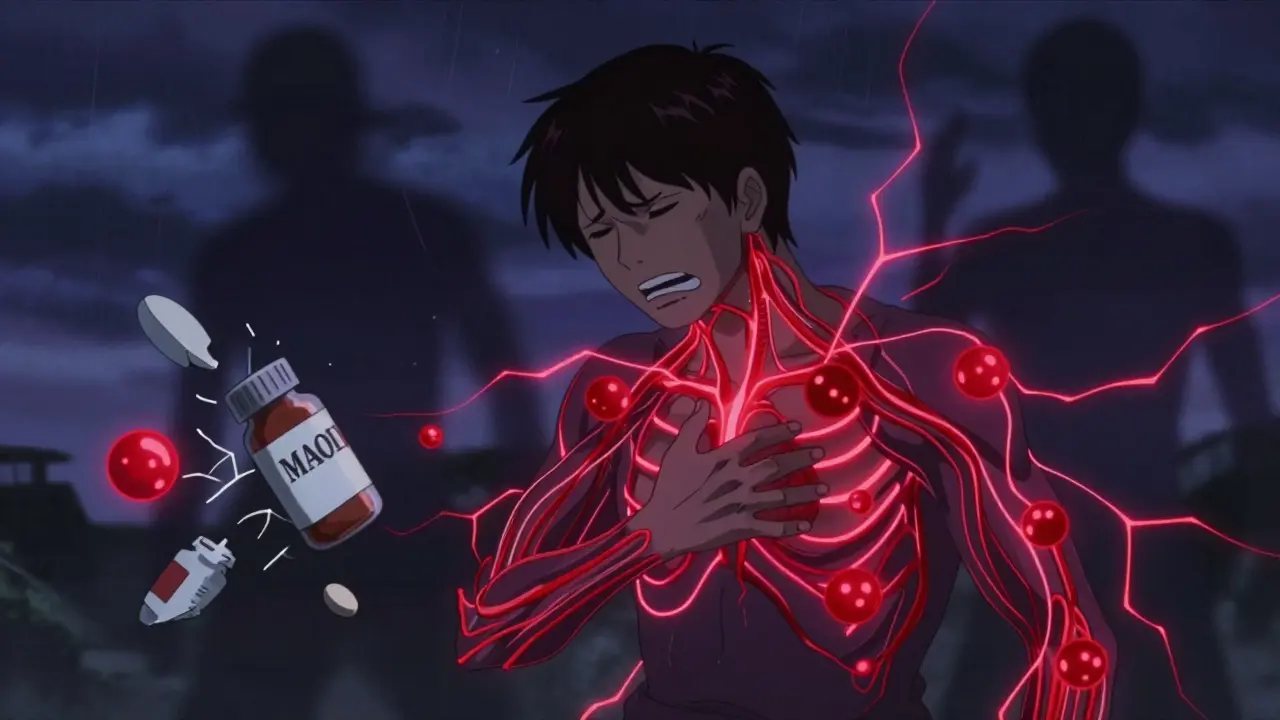
Monoamine oxidase inhibitors (MAOIs) like phenelzine, tranylcypromine, and isocarboxazid were originally developed to treat tuberculosis. Today, they’re used for treatment-resistant depression. They work by blocking the enzyme that breaks down serotonin, norepinephrine, and dopamine. That’s good for mood-but dangerous when paired with certain opioids. Opioids like tramadol, meperidine, and methadone don’t just relieve pain. They also flood your brain with extra serotonin and norepinephrine. When you mix them with an MAOI, your body can’t clear these chemicals fast enough. The result? A runaway surge in neurotransmitters that triggers serotonin syndrome. Serotonin syndrome isn’t just nausea or restlessness. It’s a medical emergency. Symptoms include high fever (over 104°F), muscle rigidity so severe you can’t move, seizures, rapid heart rate, and confusion. In severe cases, it leads to organ failure and death. Studies show mortality rates between 2% and 12% in confirmed cases. And it can happen within hours.The Opioids That Are Most Dangerous
Not all opioids are equally risky. Some are outright forbidden. Others are ticking time bombs.- Meperidine (Demerol): The worst offender. Since the 1960s, over 37 deaths have been directly linked to meperidine combined with MAOIs. It doesn’t just increase serotonin-it releases it directly. The FDA has a black box warning for this combo.
- Tramadol: Often mistaken as "non-narcotic" because it’s not morphine. But it’s a serotonin reuptake inhibitor with opioid effects. Between 2010 and 2022, 68 cases of serotonin syndrome from tramadol + MAOIs were reported to the WHO. One Reddit user, on phenelzine, developed a 107.1°F fever and seizures after a single dose.
- Methadone: Used for pain and addiction treatment. It blocks serotonin reuptake and affects NMDA receptors. Risk is moderate, but still high enough to warrant avoidance.
- Dextromethorphan: Found in cough syrups. Even over-the-counter doses can trigger reactions when taken with MAOIs.
- Morphine, oxycodone, hydromorphone: Lower risk, but not zero. They still have indirect serotonergic effects. Avoid unless absolutely necessary and under close supervision.
The 14-Day Rule: You Can’t Rush This
If you’re switching from an MAOI to an opioid-or vice versa-you can’t just stop one and start the other the next day. Irreversible MAOIs permanently disable the enzyme. It takes about 14 days for your body to make new enzymes. That’s why the FDA, Mayo Clinic, and American Psychiatric Association all require a 14-day washout period before starting any high-risk opioid. Even if you feel fine after 7 days, your brain is still flooded with inactive MAOIs. Starting tramadol or methadone too soon is like lighting a fuse. Reversible MAOIs like moclobemide are different. They clear faster. A 24-hour gap is usually enough. But don’t assume your doctor knows this. Many still default to the 14-day rule out of caution.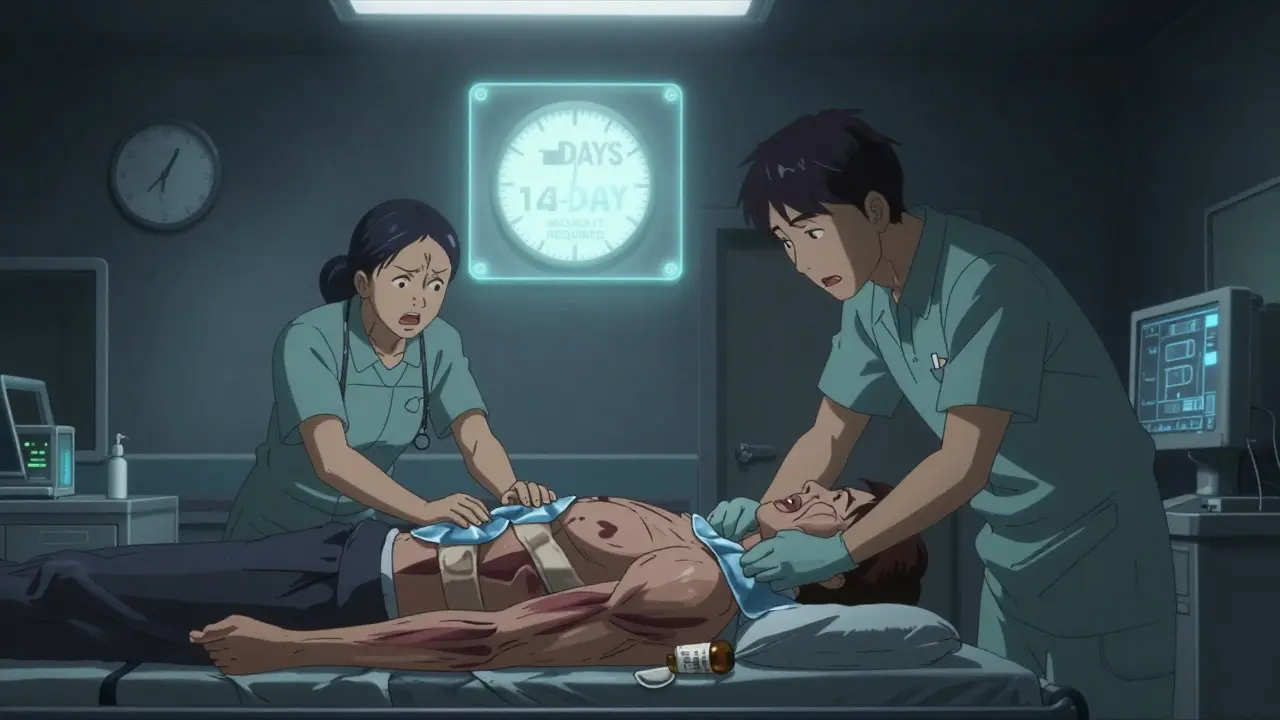
What to Use Instead for Pain
If you’re on an MAOI and need pain relief, you still have options-but you have to be smart about it.- Buprenorphine: The safest opioid choice. Low doses (0.2-0.4 mg sublingual) have been used safely in over 140 patients on MAOIs without serotonin syndrome. It has minimal serotonin effects.
- Acetaminophen (Tylenol): Safe at standard doses. No interaction risk. Use it first.
- NSAIDs: Ibuprofen, naproxen, celecoxib. These work for inflammation-based pain. Avoid if you have kidney issues or stomach ulcers.
- Physical therapy, nerve blocks, or acupuncture: Non-drug options that reduce reliance on meds.
How Prescribing Errors Still Happen
You’d think this is common knowledge by now. But it’s not. A 2022 study in JAMA Internal Medicine found that 4.3% of MAOI users were prescribed a contraindicated opioid within 14 days of starting their antidepressant. That’s over 11,000 dangerous prescriptions every year in the U.S. alone. Why? Because:- Primary care doctors don’t always know the details of psychiatric meds.
- Patients don’t mention they’re on an MAOI when they go to the ER or dentist.
- Tramadol is still marketed as "non-addictive" or "not a real opioid," so prescribers underestimate the risk.
- Pharmacies still override electronic alerts 14% of the time.
What You Should Do Right Now
If you’re on an MAOI:- Check every medication you take-even over-the-counter ones. Dextromethorphan is in cough syrup, cold pills, and sleep aids.
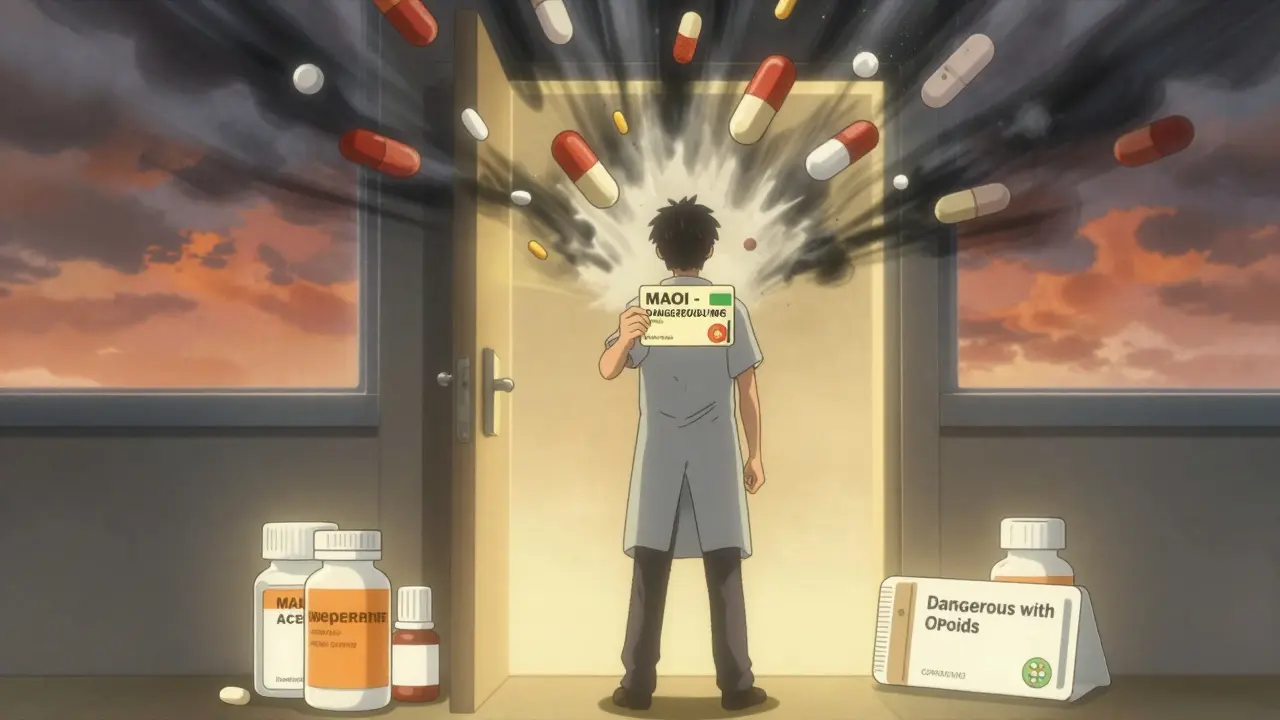
- Carry a wallet card listing your MAOI and all contraindicated drugs. NAMI offers free ones.
- Tell every doctor, dentist, and pharmacist you see-every time. Don’t assume they’ll check your file.
- Never take a new painkiller without asking: "Is this safe with my MAOI?" If they hesitate, walk out and get a second opinion.
- Stop taking it.
- Call your psychiatrist or pharmacist immediately.
- Do not wait for symptoms. By the time you feel fever or rigidity, it’s already too late.
Emergency Response: What to Do If Symptoms Start
If you or someone you know starts showing signs of serotonin syndrome after taking an opioid:- Call 911 or go to the ER immediately.
- Do not wait to see if it gets better.
- Bring your medication list.
- Inform staff you’re on an MAOI and took an opioid.
- Cyproheptadine (12 mg loading dose) to block serotonin receptors.
- Benzodiazepines to control seizures and muscle rigidity.
- Cooling measures for fever.
- ICU monitoring for at least 24 hours.
Why This Keeps Happening
Despite decades of evidence, education gaps remain. A 2022 study found 31% of emergency room doctors didn’t know tramadol was contraindicated with MAOIs. That’s not negligence-it’s a system failure. Pharmaceutical companies have been sued for downplaying risks. Purdue Pharma paid $4.7 million in 2021 for failing to warn about tapentadol. The FDA updated MAOI medication guides in January 2023 to list 12 contraindicated opioids. The European Medicines Agency now requires mandatory training for prescribers. But real change needs patients to be their own advocates. You are the last line of defense.Final Warning
This isn’t about being careful. It’s about being absolute. There is no safe gray area between MAOIs and opioids like meperidine or tramadol. No dose is small enough. No timing is quick enough. No exception is justified. Your life isn’t worth the risk. If you’re on an MAOI, treat every opioid like a loaded gun. Ask the questions. Say no. Walk away. And never, ever assume someone else knows better than the science.Can I take tramadol if I’m on an MAOI?
No. Tramadol is extremely dangerous when combined with MAOIs. It increases serotonin levels and inhibits reuptake, which can trigger serotonin syndrome within hours. Over 68 cases have been reported worldwide, including fatal outcomes. Never take tramadol while on an MAOI, even if your doctor says it’s "low risk."
How long after stopping an MAOI can I take an opioid?
Wait at least 14 days after stopping an irreversible MAOI like phenelzine or tranylcypromine before starting any opioid with serotonergic effects. For reversible MAOIs like moclobemide, a 24-hour gap may be sufficient-but always confirm with your prescriber. The enzyme takes time to regenerate. Rushing this can be fatal.
Is morphine safe with MAOIs?
Morphine carries a lower risk than tramadol or meperidine, but it’s not risk-free. It has indirect serotonergic effects and can still contribute to serotonin syndrome, especially at high doses or with prolonged use. Avoid if possible. If absolutely necessary, use the lowest effective dose under close medical supervision.
What painkillers are safe with MAOIs?
Acetaminophen (Tylenol) and NSAIDs like ibuprofen or naproxen are generally safe. Buprenorphine at low doses (0.2-0.4 mg) has been shown to be safe in clinical studies. Avoid all opioids unless explicitly cleared by your psychiatrist and pain specialist. Always check labels for dextromethorphan in cold medicines.
Can I use over-the-counter cough syrup with an MAOI?
Many OTC cough syrups contain dextromethorphan, which is contraindicated with MAOIs. Even a single dose can trigger serotonin syndrome. Always read the active ingredients. Look for alternatives like guaifenesin-only formulas or honey-based remedies. If unsure, ask your pharmacist to check the label.
What should I do if I accidentally took an opioid while on an MAOI?
Call emergency services immediately. Do not wait for symptoms. Serotonin syndrome can progress rapidly. Inform them you took an opioid while on an MAOI. If possible, bring your medication bottles. Early intervention with cyproheptadine and supportive care can save your life.
Are newer MAOIs safer with opioids?
Transdermal selegiline (Emsam) has lower brain penetration and carries less risk than oral MAOIs, but it’s not risk-free. The FDA still advises avoiding high-risk opioids even with the patch. Selective MAO-B inhibitors like rasagiline are being studied for depression and may offer safer profiles, but they’re not yet widely used for this purpose. Never assume any MAOI is safe with opioids.
this is why i dont trust doctors. they give you tramadol like its candy and never ask about your meds. i took it once on nardil and woke up feeling like my bones were melting. 911 called. no joke.
thank you for posting this!! 🙏 I'm on phenelzine and just got a script for ibuprofen for my back-was terrified it might be risky. So glad I checked. You just saved me from a nightmare. Stay safe out there!
Let me be crystal fucking clear: if your doctor prescribes you tramadol while you're on an MAOI, they’re either incompetent, lazy, or actively trying to kill you. I’ve seen two patients in the ER from this exact combo. One had to be intubated. The other still has tremors. This isn’t a ‘maybe’-it’s a death sentence wrapped in a prescription pad.
This is an exceptionally well-researched and vital post. The clinical details are accurate, the warnings are appropriately urgent, and the actionable advice is clear. I wish more medical professionals would treat this with the gravity it demands. Thank you for taking the time to compile this.
I mean… think about it… the entire psychiatric-industrial complex is built on a foundation of unspoken dangers, right? We’re told SSRIs are safe, MAOIs are ‘last resort,’ opioids are ‘necessary,’ and yet nobody talks about how the system is designed to keep us medicated, not healed… and when two of these ‘safe’ things collide? Boom. You’re a statistic. A footnote in a JAMA study. And they’ll just write another article. And another. And another. But the bodies? They don’t get to write back.
How is it still 2025 and we’re having this conversation? Let me guess: the pharmacist overrode the alert because ‘the patient seemed insistent.’ And the doctor didn’t know MAOIs were still in use. And the patient didn’t know to ask. And now someone’s in the ICU. This isn’t negligence-it’s a systemic failure wrapped in a white coat.
I’ve been on moclobemide for 3 years and switched to buprenorphine for chronic pain last year. My psychiatrist and pain specialist coordinated the transition with a 24-hour gap-confirmed with pharmacokinetic data. It worked. No issues. But I had to push hard for it. Most providers default to ‘14 days for everything.’ Don’t accept that without asking why.
lol america. we invent life-saving meds then let some guy in a pharmacy override 14 alerts because ‘he said he needed it for back pain.’ Meanwhile in India, we just use turmeric and pray. At least we don’t die from cough syrup.
maois are for people who cant handle real depression. just take ssris like a normal person.
I just… I just took tramadol last week… I didn’t know… I’m on phenelzine… I didn’t think… I’m not sick yet… but I feel… weird… like my skin is buzzing… should I go to the hospital…?
You’re all overreacting. I’ve been on Parnate for 8 years and took oxycodone for a broken toe. Zero issues. You people need to chill. This isn’t a horror movie. Stop scaring everyone.
i got a script for nyquil last month. didn’t read the label. just saw ‘pain relief’. woke up sweating, heart racing, felt like i was gonna die. turned out to be dextromethorphan. called my psych. she screamed at me for 10 mins. i’m alive. don’t be me.
This is why I carry a laminated card in my wallet: ‘On MAOI - DO NOT TAKE: Tramadol, Meperidine, Dextromethorphan, Methadone.’ I show it to every nurse, dentist, ER doc. Even if they roll their eyes, I don’t care. My life > their impatience. 💪🩺