
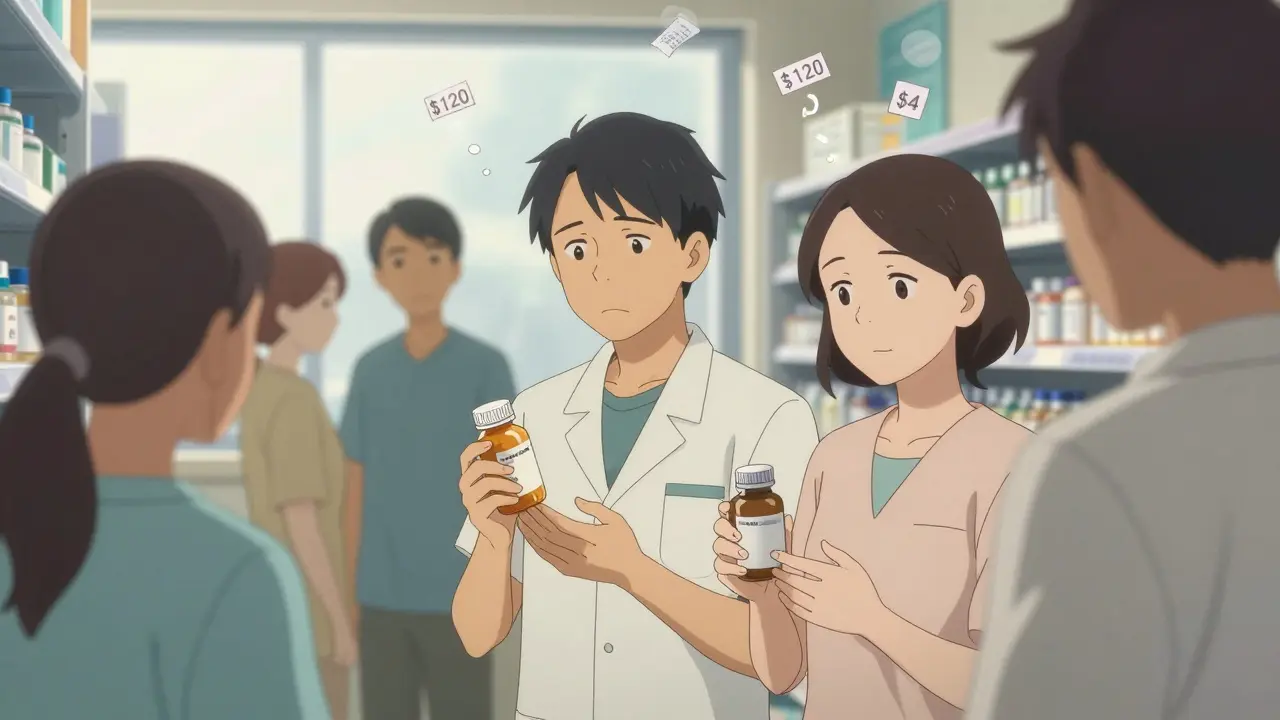
When you pick up a prescription, you might see two options: the brand-name drug you’ve heard of, or a cheaper generic with a plain label. Most people assume the generic is just a copy-same active ingredient, less money. But is that really the whole story? What does it actually cost-financially, clinically, and even emotionally-to switch from brand to generic? This isn’t just about saving a few dollars at the pharmacy. It’s about how healthcare systems make decisions that affect millions of lives, and whether those decisions actually work in real life.
What You’re Really Paying For
The biggest myth about generic drugs is that they’re just cheaper versions of the same thing. That’s mostly true-but only if you look at the active ingredient. The FDA requires generics to match brand-name drugs in strength, dosage, safety, and how well they’re absorbed by the body. That’s called bioequivalence: the generic must deliver 80-125% of the same amount of medicine into your bloodstream as the brand. That’s not a guess. It’s a lab-tested standard. But here’s where things get messy. The FDA doesn’t require generics to match the brand in inactive ingredients-things like fillers, dyes, or coatings. These don’t treat your condition, but they can affect how your body reacts. A 2024 analysis of over 12,000 patient reviews found that 68% of negative experiences with generics cited “different effectiveness,” even when clinical data showed no difference. People reported new side effects after switching: dizziness, nausea, or even a return of symptoms they thought were under control. Some of this is placebo effect-people expect generics to be worse. But some of it isn’t. Inflammatory bowel disease patients switching from brand to generic mesalamine, for example, have shown higher relapse rates in real-world studies, even when bioequivalence standards were met.The Numbers Behind the Savings
Let’s talk money. In the U.S., generics make up 90% of prescriptions but only 22% of total drug spending. That’s a massive gap. For a common drug like lisinopril, the brand version might cost $120 for a 30-day supply. The generic? $4. That’s a 97% drop. For chronic conditions-diabetes, high blood pressure, cholesterol-those savings add up fast. Health economics researchers call this cost-benefit analysis. But they don’t just look at the price tag. They look at what happens after you fill the prescription. A 2023 meta-analysis by ISPOR found patients on generics had 5-15% higher adherence rates than those on brand-name drugs. Why? Because they can afford to take them. When a patient skips doses because the cost is too high, it doesn’t just hurt them-it hurts the system. Uncontrolled hypertension leads to emergency room visits. Poor diabetes control leads to kidney failure. These are expensive outcomes. One study tracked patients on generic statins versus brand. The generic group had 7% fewer hospitalizations for heart attacks over two years. That’s not because the drug worked better. It’s because more people took it consistently. The total cost of care dropped by 12-18% when generic use hit 70% or more in a population. That’s the real win: lower spending across the board, not just at the pharmacy counter.
When Generics Don’t Save Money
But here’s the catch: not every switch saves money. For drugs with a narrow therapeutic index-like warfarin, levothyroxine, or seizure medications-tiny differences in absorption can be dangerous. Even a 5% variation in blood levels can mean the difference between a seizure and a stroke. That’s why 47% of primary care doctors are hesitant to switch patients on these drugs, even when generics are available. And then there’s the hidden cost: administrative burden. Insurance companies and pharmacy benefit managers (PBMs) often require prior authorization before approving a brand-name drug if a generic exists. That means extra paperwork, phone calls, delays. A 2023 PBM report showed that while generic use saved plans $1,200-$1,800 per member per year, it also increased prior authorization requests by 8-12%. That’s more work for doctors, pharmacists, and patients. And if a patient gives up because the process is too hard, they might not take the drug at all.What Health Economics Really Measures
This is where outcomes economics-also called HEOR (Health Economics and Outcomes Research)-steps in. It’s not just about price. It’s about quality of life, hospital stays, missed work, and even how patients feel. HEOR studies use tools like the EQ-5D and SF-36 to measure patient-reported outcomes. They track people for months, not just days. They look at whether switching to a generic affects someone’s ability to work, sleep, or play with their kids. One 2024 study followed 2,000 patients with depression who switched from brand to generic SSRIs. The brand group had slightly higher satisfaction scores at first. But after six months, the generic group reported equal or better mental health outcomes-plus they were 11% more likely to still be taking the medication. That’s the kind of data that matters to insurers and policymakers. It’s not just about saving $10 a month. It’s about keeping someone out of the hospital and back at their job. But HEOR isn’t perfect. It takes time, money, and data. A full HEOR analysis for a single generic drug class can cost $500,000 to $2 million and take 18-24 months. Most small clinics don’t have that kind of team. That’s why most doctors still rely on formularies and price lists, not deep economic models.
Who’s Using This Data-and Who Isn’t
The big players use HEOR. Medicare Part D plans? All of them require HEOR dossiers before covering a drug. PBMs? 95% use it to decide which generics to push. But primary care doctors? Only 35% use formal HEOR data when choosing medications. Most still go by what’s cheapest, what’s on formulary, or what they’ve always prescribed. That’s changing. With CMS pushing Medicare Advantage plans to adopt value-based care by 2027, HEOR will become mandatory for most coverage decisions. AI tools are starting to help-machine learning models can now predict which patients are most likely to respond well to a generic based on their history, age, and other meds. That’s the future: not just one-size-fits-all substitution, but personalized switching.What This Means for You
If you’re on a chronic medication, ask your pharmacist: “Is there a generic? What’s the difference?” Don’t assume it’s the same. Ask if your insurance requires prior authorization for the brand. Ask if switching could affect your symptoms. If you’ve had side effects after switching, tell your doctor. It’s not all in your head-some people really do react differently. If you’re paying out of pocket and the generic is $20 cheaper, go with it. The odds are you won’t notice a difference. If you’re on a narrow therapeutic index drug and your doctor says to stick with the brand, listen. That’s not about profit-it’s about safety. The real cost of generics isn’t just the price on the bottle. It’s the time it takes to adjust, the anxiety of wondering if it’ll work, the paperwork to get it covered. But the benefit? Lower hospital bills, fewer missed days at work, and more people getting the medicine they need. That’s not just economics. That’s healthcare.Are generic drugs really as effective as brand-name drugs?
Yes, for most people and most medications. The FDA requires generics to deliver the same active ingredient at the same rate and amount as the brand, meeting strict bioequivalence standards (80-125% absorption). But for drugs with a narrow therapeutic index-like warfarin, levothyroxine, or epilepsy meds-small differences can matter. Some patients report changes in how they feel after switching, even when clinical data shows no difference. If you notice new side effects or worsening symptoms, talk to your doctor.
Why do some people say generics don’t work as well?
There are a few reasons. First, inactive ingredients like fillers or dyes can cause reactions in sensitive people-some report stomach upset or rashes after switching. Second, there’s a psychological effect: if you believe generics are inferior, you might notice side effects more. Third, some studies show slightly higher discontinuation rates during the switch period, especially with complex drugs like biologics. But overall, 76% of patients report no noticeable difference in effectiveness when cost savings are over $20 per prescription.
Do generics save money for the healthcare system?
Absolutely. Generics make up 90% of prescriptions in the U.S. but only 22% of drug spending. When patients can afford to take their meds consistently, hospitalizations drop. Studies show total care costs fall by 12-18% when generic use reaches 70% or more in a population. For example, patients on generic statins had 7% fewer heart attacks over two years-not because the drug was stronger, but because more people took it regularly.
Why do some doctors hesitate to switch patients to generics?
For drugs with a narrow therapeutic index-like warfarin, lithium, or levothyroxine-even small changes in blood levels can be risky. Doctors worry about unintended consequences, even if bioequivalence is proven. Also, if a patient has been stable on a brand for years, switching might disrupt that stability. And some doctors are still unaware of the full evidence showing generics are safe for most patients. Only 47% of primary care physicians feel comfortable switching on narrow index drugs.
Is it worth asking for the brand name if the generic makes me feel worse?
Yes. If you notice new side effects, changes in how you feel, or a return of symptoms after switching, tell your doctor. You’re not imagining it. Some people genuinely react differently to inactive ingredients or minor formulation changes. Your doctor can request a brand exception from your insurer, especially if you’ve been stable on the brand. Insurance companies are required to allow exceptions for medical necessity-your experience counts.
Generics are just a government scam to make us sicker so we need more drugs. I switched to generic thyroid med and now I’m exhausted all day. My doctor says it’s fine but I know better.
The empirical evidence supporting bioequivalence standards is robust and methodologically sound, as validated by the FDA’s ANDA review framework. However, pharmacokinetic variability in non-active excipients remains an underappreciated confounder in real-world adherence dynamics.
I was skeptical too-until I switched my blood pressure med to generic. No side effects, no crashes. Just saved $110 a month and still feel like myself. Sometimes the simplest choice is the smartest one.
they dont tell you the truth about generics the big pharma companies own the fda and they want you to stay sick so you keep buying their overpriced crap. i switched to generic adderall and now i cant focus at all. its all connected.
It is imperative to recognize that the cost-benefit paradigm espoused by contemporary health economics is fundamentally flawed when divorced from patient-specific pharmacodynamic profiles. The conflation of aggregate population-level savings with individual clinical outcomes represents a dangerous reductionism that ignores the heterogeneity of human physiology. Moreover, the institutional incentives driving PBM-driven formulary substitutions often prioritize fiscal efficiency over therapeutic integrity, thereby creating a perverse moral hazard wherein the most vulnerable patients bear the brunt of systemic negligence.
Interesting read. I’ve worked in Canadian pharmacy for 18 years, and the data here aligns closely with what we see north of the border. Generics work for most. But for elderly patients on multiple meds? We always check in. Small changes matter.
…And yet… you… ignore… the… elephant… in… the… room… The… real… issue… isn’t… bioequivalence… it’s… the… monopolistic… control… of… the… supply… chain… by… three… PBMs… who… profit… from… the… chaos… they… create…
Oh wow, so the government’s just lying to us again? Next they’ll say the moon landing was real. I tried a generic asthma inhaler. Now I’m wheezing like a broken accordion. Guess I’ll be paying $200 for the brand… again.
just switched to generic omeprazole and my acid is gone no more burning no more panic just a 20 dollar savings and my life is better i wish i did this years ago
My grandma’s on levothyroxine. We stuck with the brand because her TSH was stable. Doctor said if it ain’t broke, don’t fix it. Makes sense to me. Don’t risk her health for $10 a month.
The 68% of patients reporting ‘different effectiveness’ aren’t imagining things. The FDA’s bioequivalence window of 80-125% is a legal loophole, not a medical guarantee. When you’re talking about seizure thresholds or anticoagulation, that margin is a death sentence waiting to happen.
You think this is about medicine? No. This is about the Anglo-American capitalist machine crushing the poor with false choices. In India, we have generics that cost pennies and work better than your overpriced American brands. Your system is broken because it values profit over people. The FDA is a puppet. The doctors are complicit. The patients are the victims.
I’ve had patients switch from brand to generic and come back saying they feel worse. I always listen. Sometimes it’s the filler. Sometimes it’s stress. But if they say it’s different, I don’t push. We tweak, we test, we respect their experience. That’s medicine.
the fda is controlled by big pharma and the generics are laced with lithium to make you docile. i tested mine with a home kit and the color changed. they dont want you to wake up. this is why we need to go off grid and grow our own herbs.