
When a pharmaceutical company spends over a decade and $2 billion developing a new drug, it doesn’t get to enjoy its patent protection for the full 20 years. By the time the FDA approves the drug, as much as 8 to 10 years of that patent life has already been eaten up by clinical trials and regulatory reviews. That’s where patent term restoration comes in - a legal tool designed to give innovators back some of what they lost. It’s not a loophole. It’s a congressionally approved compensation system, written into U.S. law to balance innovation incentives with generic competition.
How Patent Term Restoration Works
Patent term restoration (PTR), also called patent term extension (PTE), is governed by the Hatch-Waxman Act of 1984. The law lets patent holders apply for extra time on their patents - up to five years - to make up for the time lost during FDA review. But it’s not automatic. The clock only starts ticking after the drug enters human testing. The calculation is strict: it’s half the time spent in clinical trials plus the entire time the FDA took to review the application. For example, if a drug spent 6 years in clinical testing and 3 years under FDA review, the extension would be 3 years (half of 6) plus 3 years, totaling 6. But the law caps it at 5 years. And even then, the total market exclusivity can’t exceed 14 years from FDA approval.The extension only applies to the specific product approved by the FDA. If your patent covers multiple uses or formulations, you can only extend protection for the one that got approved. You can’t use the extension to block generics from making similar but unapproved versions. This rule was confirmed by the Federal Circuit in Merck & Co. v. Kessler, making it clear: the extension is narrow, not broad.
Who Qualifies and When to Apply
PTR isn’t available for every patent. Only patents covering human drugs, medical devices, food additives, or animal drugs (after the 1988 expansion) can qualify. The patent must have been issued before the product was submitted to the FDA. And the application window is razor-thin: you have just 60 days from the date of FDA approval to file with the U.S. Patent and Trademark Office (USPTO). Miss that deadline, and you lose the chance forever. According to FDA data, 37% of denied PTR applications fail because of this timing error.There’s also a due diligence requirement. The FDA can reduce or deny the extension if they find the patent holder didn’t act with reasonable speed during testing or review. One biotech company lost 12 months of extension because their clinical trial enrollment dragged on for too long without justification. On the flip side, Johnson & Johnson secured a 4.8-year extension for Stelara® by keeping meticulous records of every FDA interaction, showing they moved as fast as humanly possible.
Patent Term Restoration vs. Other Exclusivity Tools
It’s easy to confuse PTR with other forms of market protection. But they’re not the same.- Patent Term Adjustment (PTA) fixes delays caused by the USPTO, not the FDA. If the patent office takes too long to issue your patent, you get extra days added. PTA and PTR can stack - but they address completely different delays.
- Data exclusivity is a separate FDA rule that prevents generics from relying on your clinical data for 5 years (for new chemical entities) or 3 years (for new clinical studies). You don’t need a patent to get this. It’s automatic. But it doesn’t stop generics from making their own versions - it just stops them from using your data to prove safety.
- Orphan drug exclusivity gives 7 years of market protection for drugs treating rare diseases, regardless of patent status. Again, this is separate from PTR.
Here’s the key difference: PTR extends the actual patent. That means you can sue generic makers for infringement during the extended period. Data exclusivity doesn’t give you that power. You can’t stop someone from copying your drug if they do their own testing - you just can’t stop them from using your data to do it.
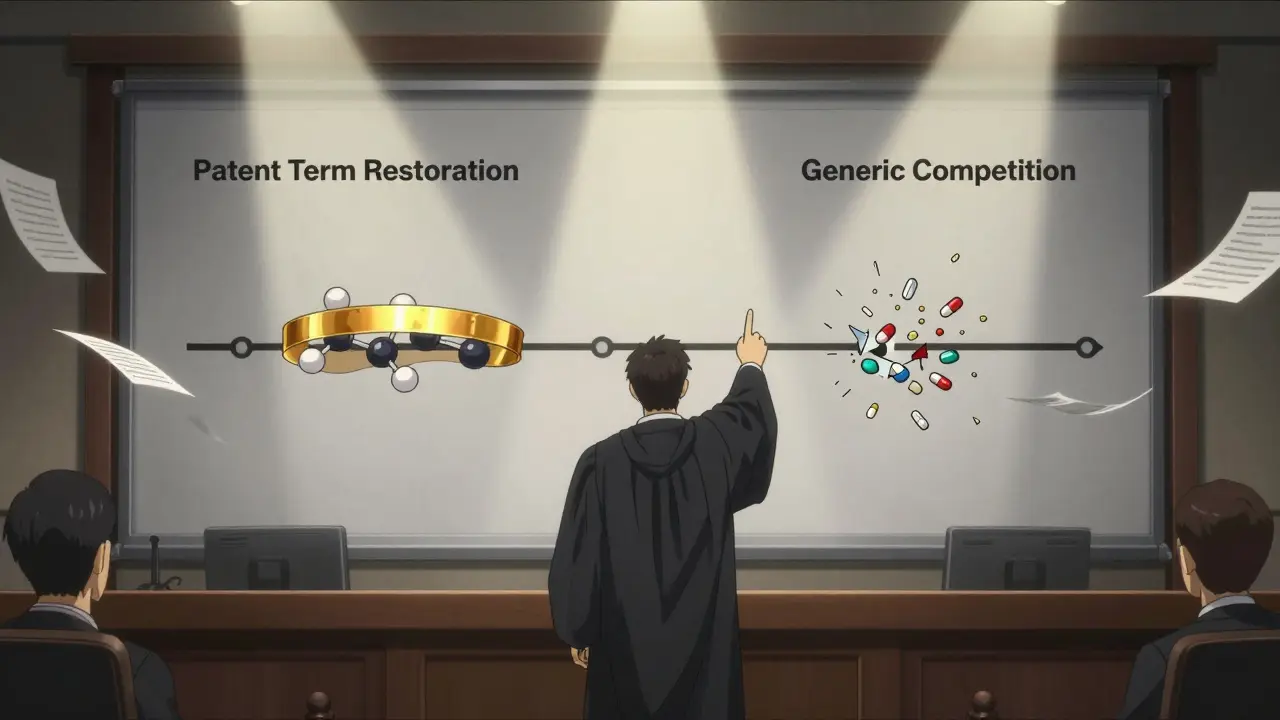
Why It Matters Economically
Without PTR, many drugs wouldn’t be profitable. The average time from IND submission to FDA approval is 8.2 years, according to FDA internal reports. That means nearly half of a 20-year patent is gone before the drug even hits the market. Dr. Robert Grabowski of Duke University found that PTR increases the net present value of a new drug by 11-15%. For companies investing billions, that’s the difference between breaking even and turning a profit.But there’s a cost. The Congressional Budget Office estimated that PTR extensions cost Medicare $5.2 billion per year by delaying generic competition. That’s why critics call it “evergreening” - a way for big pharma to squeeze out extra years of monopoly pricing. The FTC found that 12% of PTR applications between 2015 and 2019 involved “product hopping,” where companies made minor changes - like switching from a tablet to a capsule - just to reset the clock. The FDA still approves these, as long as the new version is clinically distinct. But the practice is controversial.
Who Uses It and How Often
PTR isn’t rare. In fact, it’s standard practice. Evaluate Pharma found that 87% of the top 100 selling drugs in the U.S. in 2022 used PTR to extend exclusivity. For small-molecule drugs, the rate is 98%. Even biologics - which have their own 12-year exclusivity under the Biologics Price Competition and Innovation Act - still use PTR when eligible. The average extension is 3.2 years, with some drugs getting close to the 5-year cap.Large companies like Pfizer, Merck, and AbbVie apply for PTR on nearly every eligible product. Smaller biotechs rely on it even more. Without it, many wouldn’t be able to recoup R&D costs. A 2022 survey by Fish & Richardson showed that 92% of pharmaceutical companies consider PTR a “critical component” of their IP strategy.

Common Mistakes and How to Avoid Them
Even experienced patent attorneys mess up PTR applications. Here are the top three errors:- Missing the 60-day deadline. This is the #1 reason for denial. Set calendar alerts. Double-check the FDA approval date.
- Picking the wrong patent. Only one patent per product can be extended. Companies often have multiple patents covering the same drug - the active ingredient, a formulation, a method of use. You must pick the one that claims the exact approved product. If you pick the wrong one, your application gets rejected.
- Not proving due diligence. The FDA looks for evidence that you didn’t drag your feet. If your clinical trial enrollment took 18 months longer than similar studies, you need to explain why. Poor documentation = reduced extension.
Many firms now use specialized software like Patexis PTR Calculator to avoid calculation errors. A 2021 study found it cut mistakes by 78%. The FDA also publishes detailed guidance - and 89% of approved applicants say they followed it closely.
The Future of Patent Term Restoration
PTR is under pressure. Politicians have tried to cap extensions at 3 years. The “Lower Drug Costs Now Act” proposed that in 2021, but it stalled. Still, the trend is clear: drug development is getting longer, not shorter. With more complex therapies - especially in oncology and rare diseases - the time from IND to approval is rising. Evaluate Pharma predicts PTR applications will grow 15% over the next five years.There’s also legal uncertainty. The Supreme Court’s 2021 decision in Amgen v. Sanofi tightened the rules on how broadly patents can claim biological inventions. That’s made it harder to draft patents that survive scrutiny - which means fewer patents will qualify for extension. The USPTO updated its manual in April 2022 to reflect this, making the process even more technical.
For now, PTR remains a cornerstone of pharmaceutical innovation. It’s not perfect. It’s expensive for consumers. But without it, the pipeline of new drugs would dry up. The system isn’t broken - it’s just complicated. And for anyone working in pharma IP, mastering it isn’t optional. It’s essential.
Can a patent be extended more than once under patent term restoration?
No. Only one patent per FDA-approved product can receive a term extension, even if multiple patents cover the same drug. Companies must choose which patent to extend - usually the one with the broadest claims or the one expiring soonest. This rule is written into 35 U.S.C. § 156(d)(1).
Does patent term restoration apply to biologics?
Yes, but less commonly. Biologics have a separate 12-year data exclusivity period under the Biologics Price Competition and Innovation Act. However, if a biologic has a patent that meets Hatch-Waxman criteria - covering the product itself and submitted to the FDA - it can still qualify for PTR. In practice, only about 82% of biologics receive PTR, compared to 98% for small-molecule drugs.
What happens if the FDA delays approval beyond the expected time?
The extension is based on actual time, not expected time. If the FDA takes longer than usual to review a drug - say, due to requests for additional data - that extra time counts toward the extension. The law is designed to compensate for delays caused by the government, not the company. As long as the applicant acted with due diligence, the full review period counts.
Can a generic manufacturer challenge a patent term extension?
Yes. Third parties have 180 days after the FDA publishes the regulatory review period to file a petition claiming the applicant failed to act with due diligence. These challenges have increased by 22% since 2018. They’re unpredictable and often hinge on internal documents and timelines, making them costly and risky for the patent holder.
Is patent term restoration available outside the U.S.?
The U.S. system is unique in its structure and scope. Some countries, like Japan and Australia, have similar mechanisms, but they’re narrower. For example, Australia allows up to 5 years of extension but only for pharmaceutical patents and only if the patent was filed after 1998. Most European countries do not offer patent term restoration at all. Companies seeking global exclusivity must navigate different rules in each market.
This system is a scam disguised as innovation. Big Pharma spends billions on marketing and then cries poor when the patent clock ticks. They don't need extensions-they need accountability.
Patent term restoration isn't a loophole-it's a statutory carve-out designed to balance public access with private incentive. The math is transparent, the limits are codified, and the FDA's due diligence review is non-negotiable. If you're calling it corruption, you haven't read the law.
Let me break this down for you simple folk PTR is not extension its a regulatory offset under 35 USC 156 and the FDA controls the clock not the pharma giants the data exclusivity is separate and the orphan drug thing is a whole different beast you need to stop conflating IP instruments
Wow this actually makes sense now 😊 I always thought it was just big pharma gaming the system. Thanks for clarifying the difference between PTR and data exclusivity.
Look I get why folks are mad but imagine you’re a small biotech with 12 people and $200M in venture cash. You spend 9 years in trials. You finally get approved. Then the generics swarm in 11 months later. Without PTR you’re not just out of profit-you’re out of existence. This isn’t greed. It’s survival. And honestly? The system works better than you think.
They’re lying to us. They say it’s fair but then they make tiny changes to the pill shape and call it a new product. That’s not innovation. That’s manipulation. And the FDA lets them. I’m not surprised. They’re all in bed together.
so i read this whole thing and i think i get it?? like the patent clock starts ticking when they start testing right? and the fda takes forever so they get some time back? but only up to 5 years? and you can only pick one patent? wow that’s kinda fair i guess lol
Most people don’t realize that the 20-year patent clock starts the moment you file the patent application which is usually years before human trials even begin. So by the time you get FDA approval you’ve already lost half your exclusivity. PTR doesn’t give you more than you’re owed-it gives you back what was taken by a slow, bureaucratic system that wasn’t designed for modern drug development. The real problem is the FDA’s review times, not the law. Fix that and you won’t need to vilify the companies trying to stay alive.
Another American corporate welfare program. Why should American taxpayers pay for this? Every time one of these extensions gets approved, I pay more for my insulin. This isn’t innovation. It’s theft dressed up in legal jargon.
They’re not just extending patents-they’re gaming the system with shell companies and patent thickets. The USPTO approves 98% of these applications because they’re underfunded and overworked. Meanwhile, the real inventors-the scientists-are getting paid in coffee and stress. This isn’t capitalism. It’s feudalism with lawyers.
Bro I used to work in pharma IP and let me tell you-missing that 60-day window is the dumbest mistake you can make. I’ve seen companies lose millions because someone forgot to file. PTR isn’t magic. It’s paperwork. And if you’re not on top of it, you’re dead in the water.
It’s easy to hate the system when you’re on the outside. But think about it-without PTR, would we have had breakthroughs like Keytruda or Humira? Would small startups even try? Innovation doesn’t happen in a vacuum. It needs a return. Maybe the system isn’t perfect-but it’s the only one that’s kept the pipeline flowing for 40 years. Let’s fix the delays, not the remedy.
You think this is fair? You think it’s ethical? A company gets to charge $700K per year for a drug because they got an extra 4 years? And you call that innovation? That’s exploitation. That’s a moral failure. And if you defend it, you’re part of the problem.
One thing people miss-PTR only applies to the exact approved product. So if a generic makes a slightly different salt form or delivery method, they can still enter the market. That’s why so many follow-on products pop up right after exclusivity ends. The system isn’t a wall-it’s a timed gate. And honestly? That’s kind of brilliant.