

Penicillin Allergy Assessment Tool
This tool helps you determine if you might be eligible for penicillin allergy testing based on your allergy history. More than 90% of people labeled as penicillin allergic are not truly allergic. Testing could help you avoid unnecessary antibiotics that are more expensive, less effective, and more dangerous.
Your Results
Recommendations
Why This Matters
More than 10% of people in the U.S. say they’re allergic to penicillin. But here’s the startling truth: 90 to 95% of them aren’t. They’ve been told they are - maybe after a rash as a kid, a stomachache after a dose, or a family history passed down like a warning label. And because of that, they’re being given worse, costlier, and riskier antibiotics every time they need treatment.
Why Penicillin Allergy Labels Are Dangerous
Penicillin and its close relatives - like amoxicillin and ampicillin - are among the safest, cheapest, and most effective antibiotics we have. They work well for common infections: ear infections, sinus infections, strep throat, pneumonia, and even syphilis. But when someone is labeled allergic, doctors avoid them completely. Instead, they reach for alternatives like clindamycin, azithromycin, or fluoroquinolones.
These alternatives aren’t just less effective - they’re more dangerous. Patients with a penicillin allergy label are 69% more likely to develop a Clostridioides difficile (C. diff) infection, a severe and often recurrent gut infection that can lead to hospitalization or death. They’re also 50% more likely to get surgical site infections and 30% more likely to have treatment failure.
Costs add up, too. A single course of amoxicillin costs about $35. An alternative like clindamycin? Around $95. Multiply that across millions of prescriptions, and you’re talking about billions in unnecessary spending. Hospitals lose money. Patients lose time. And everyone loses out on the best possible treatment.
How Penicillin Allergy Testing Works
Penicillin allergy testing isn’t guesswork. It’s science. The standard method is a two-step process: skin testing followed by an oral challenge.
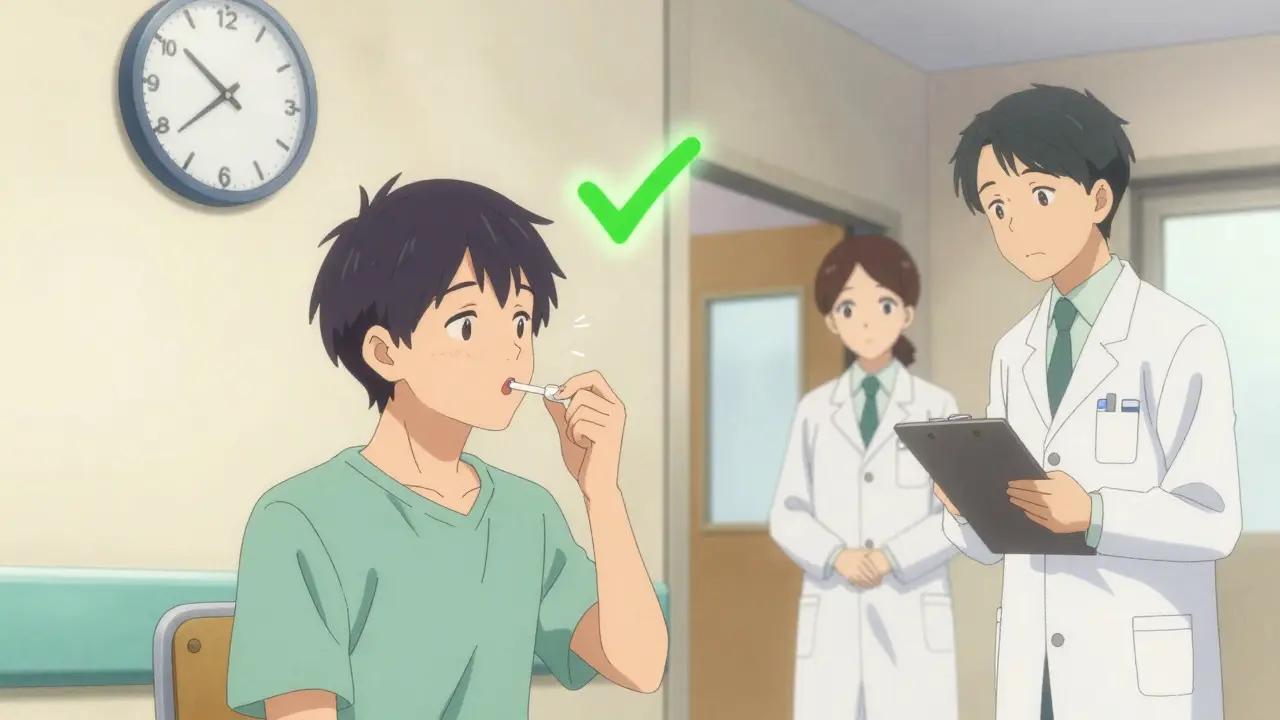
First, a small amount of penicillin reagent is placed on the skin - usually the forearm or back - and the skin is lightly pricked. If there’s no reaction, a tiny injection is made just under the skin. This tests for IgE antibodies, the kind that trigger immediate allergic reactions like hives, swelling, or anaphylaxis. The whole process takes less than an hour.
If the skin test is negative, the next step is the oral challenge. The patient is given a small dose of amoxicillin - 250 mg - and watched for an hour. If nothing happens, they’re given a second dose. No reaction? They’re cleared. That’s it.
And here’s the kicker: if both tests are negative, the chance of ever having a true penicillin allergy drops to nearly zero. It’s not just low - it’s as safe as if they’d never claimed an allergy in the first place.
The FDA-approved skin test reagent in the U.S. is called PRE-PEN. It contains the major antigen (penicilloyl-polylysine) that most allergic reactions target. But experts are pushing for a new, all-in-one kit that also includes minor determinants and amoxicillin. Early results show a 98% negative predictive value - meaning if the test says you’re not allergic, you almost certainly aren’t. This could make oral challenges unnecessary in the near future.
Who Should Get Tested
Not everyone needs testing. But if you’ve ever been told you’re allergic to penicillin - even once - you should talk to your doctor about it.
Low-risk histories include:
- A rash that showed up more than 72 hours after taking the drug
- A family history of penicillin allergy
- Headache, nausea, or stomach upset - not hives or breathing trouble
- A reaction that happened more than 10 years ago
These patients often skip skin testing and go straight to an oral challenge.
Higher-risk cases - like hives within an hour of taking the drug, swelling of the face or throat, or a history of anaphylaxis - need full skin testing first. And if you’ve had a severe delayed reaction like Stevens-Johnson syndrome, DRESS, or toxic epidermal necrolysis, you should never be tested. Those reactions are not IgE-mediated, and re-exposure could be deadly.
What Happens After a Negative Test
Getting cleared isn’t just about feeling better - it’s about changing your medical record.
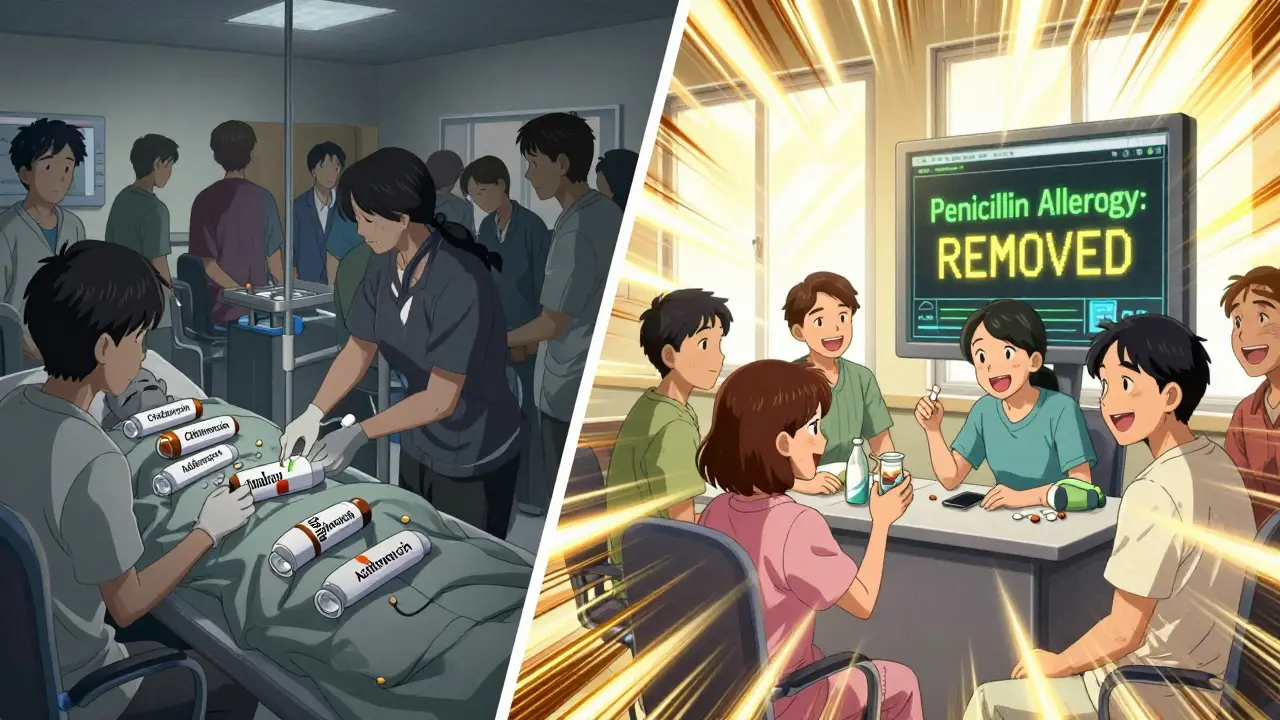
Many hospitals now have pharmacists or nurses trained to run these tests. After a successful challenge, they document: “Patient tolerated amoxicillin. Penicillin allergy removed from EHR.” That update goes straight into your electronic health record. Next time you’re in the ER, or your dentist prescribes antibiotics before a procedure, they’ll know you’re safe.
And that matters. One study found that after de-labeling, penicillin use in hospitals jumped by 40%. More patients got the right drug. Fewer got C. diff. Hospital stays got shorter. Costs dropped.
Barriers to Testing - And How They’re Being Broken
Here’s the problem: most people don’t know this exists. And even if they do, access is uneven. In 2022, only 39% of U.S. hospitals offered inpatient penicillin skin testing. Only 44% had allergists on call.
But change is happening fast. Pharmacists are stepping in. Nurses are being trained. At Mayo Clinic, Johns Hopkins, and UCSF, new point-of-care tests are cutting testing time from 60 minutes to under 30. These protocols are just as accurate. And they’re being rolled out in emergency rooms and primary care clinics.
Insurance coverage is improving too. Most plans now cover skin testing and oral challenges - especially since the CDC updated its guidelines in 2023 to include penicillin allergy testing for syphilis treatment. That’s a big deal: 97% of people who think they’re allergic to penicillin can safely get the only drug that cures syphilis after testing.
The Bigger Picture: Antibiotic Stewardship
This isn’t just about one drug. It’s about fighting antibiotic resistance. When we overuse broad-spectrum antibiotics - like vancomycin or carbapenems - we push bacteria to evolve. Superbugs get stronger. Treatments fail. Deaths rise.
Penicillin allergy testing is one of the most powerful tools we have to reverse that trend. It’s low-cost, low-risk, and high-impact. The CDC predicts that by 2027, 85% of U.S. hospitals will have formal testing programs in place. That could prevent 50,000 to 70,000 cases of C. diff every year.
If you’ve ever been told you’re allergic to penicillin - even if it was decades ago - ask your doctor: “Can I get tested?” It might save your life next time you get sick.
So let me get this straight - we’ve been scaring people away from the most effective antibiotic for decades because of a rash they got at 7? And now we’re supposed to be impressed that hospitals are finally catching up? This isn’t innovation. It’s damage control. I’ve seen ER docs prescribe vancomycin for a sinus infection because someone’s mom said penicillin gave her hives in 1982. We’re not just overtreating - we’re weaponizing ignorance.
The data here is undeniable. Penicillin allergy labels are a public health blind spot. Removing them isn’t just about saving money - it’s about reducing C. diff rates, surgical complications, and antibiotic resistance. Hospitals that have implemented formal testing programs report measurable improvements in patient outcomes. This is one of those rare wins where clinical evidence, cost efficiency, and patient safety all align.
I’m not saying this isn’t important… but who funded this study? Pharma? The CDC? The same agencies that told us hydroxychloroquine was a miracle cure and then retracted it? I’ve read about false positives in allergy testing before. What if the skin test misses something? What if the oral challenge triggers a delayed reaction? We’re trading one risk for another - and calling it progress.
Stop labeling. Start testing. Simple.
THIS IS A MASSIVE COVER-UP!!! Why aren’t we hearing about this on the news?!?! The FDA approved PRE-PEN in 1998… and yet 95% of people still think they’re allergic?!?! The pharmaceutical industry is PROFITING from unnecessary antibiotics - and doctors are TOO LAZY TO TEST!!! I’ve seen my cousin get hospitalized because they gave her azithromycin instead of amoxicillin - and now she’s on probiotics for life!!! This is systemic corruption!!! #PenicillinCoverUp #StopKillingPatientsWithExpensiveDrugs!!!
This is one of those quiet wins in medicine that doesn’t get enough attention. A simple, safe test that can change someone’s entire treatment trajectory - and reduce antibiotic resistance at the same time. It’s rare to see something this effective, this low-risk, and so easy to implement. The fact that we’re only now scaling it up feels like a missed opportunity - but better late than never.
The fundamental flaw here is the conflation of IgE-mediated hypersensitivity with non-specific adverse reactions. The literature consistently demonstrates that the majority of penicillin ‘allergies’ are, in fact, non-immunologic adverse events - often misclassified due to inadequate clinical correlation. The absence of validated biomarkers beyond skin testing and oral challenge remains a significant limitation in population-level de-labeling initiatives.
I’ve worked in primary care for 18 years. I’ve seen patients avoid penicillin because their cousin had a reaction in the 70s. I’ve seen kids get IV antibiotics for ear infections because their chart says ‘allergic’ - even though they never actually took it. This testing protocol is a game-changer. Simple. Safe. Effective. If you think you’re allergic - ask your doctor. No judgment. Just science.
I got my penicillin test done last year. Skin prick, then swallowed a pill. 10 minutes later, I was eating a burrito like nothing happened. My EHR now says ‘penicillin allergy: REMOVED.’ My dentist gave me amoxicillin last month - no drama, no fuss. I didn’t die. My tooth didn’t fall out. My insurance paid less. And I’m alive. Why isn’t this routine?
I’m 52 and was told I was allergic when I was 8 after a rash. Never tested. Last year I got pneumonia and they gave me something that gave me nausea and dizziness - and I still didn’t get better. I finally asked my doctor about testing. Turned out I was fine. Took amoxicillin like it was candy. Felt like a weight lifted. Why did no one ever explain this to me?
I live in a country where even basic allergy testing is hard to access. But if this is as safe and effective as described, I hope it becomes standard everywhere. I’ve seen friends suffer because they couldn’t get the right antibiotics. This isn’t just medical - it’s about equity too.
I can’t believe this isn’t in every hospital. My sister had a C. diff infection after they gave her clindamycin because she was ‘allergic’ - and she almost died. They didn’t even consider testing. She’s been scared of antibiotics ever since. Now she’s terrified of hospitals. This isn’t just a medical issue - it’s a trauma. We’re failing people. And it’s not because they’re wrong - it’s because we’re lazy.