
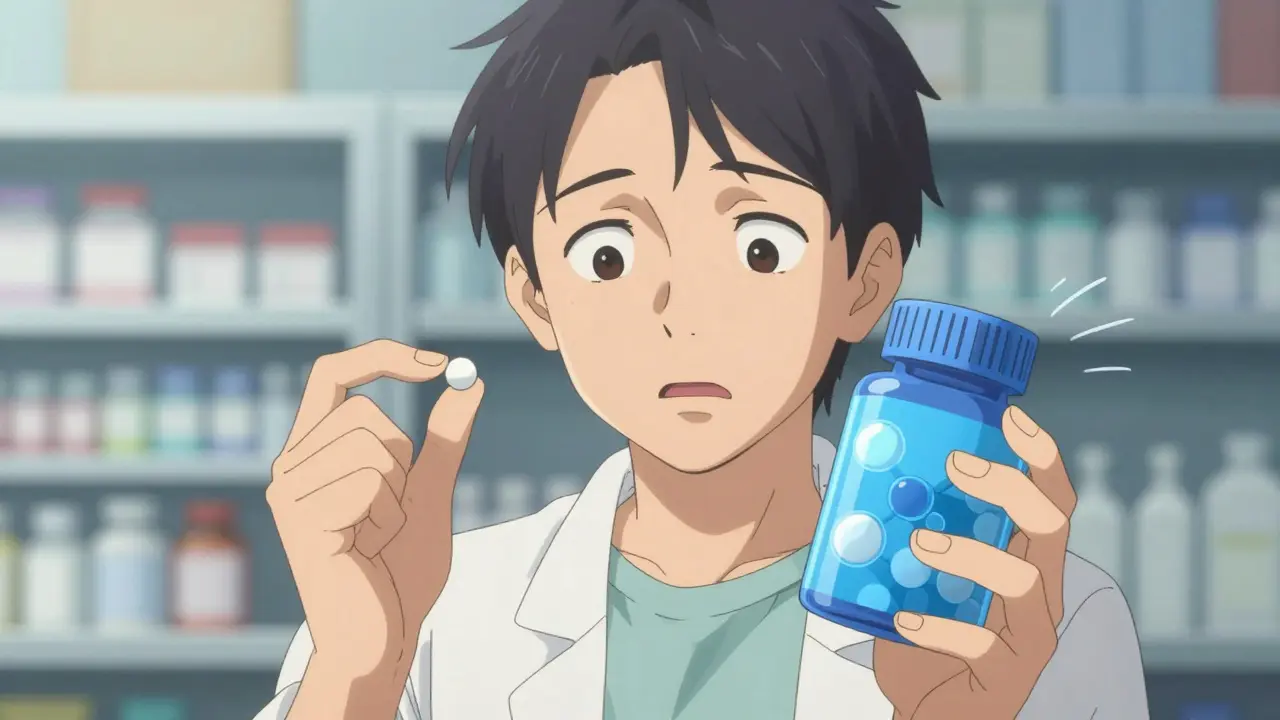
When you pick up a prescription and see a pill that looks completely different from what you’ve been taking, it’s normal to feel confused. Maybe it’s a smaller pill, a different color, or even a weird logo stamped on it. You might wonder: Is this the same medicine? The answer is yes - if it’s an FDA-approved generic. But knowing that isn’t enough. What you need to know is why it’s the same, what might be different, and how to make sure it works for you.
Generics aren’t cheaper because they’re weaker
A lot of people think generic drugs are lower quality because they cost less. That’s not true. The FDA requires every generic drug to have the same active ingredient, strength, dosage form, and route of administration as the brand-name version. That means if you’re taking lisinopril for high blood pressure, the generic version has the exact same molecule that lowers your blood pressure. The only difference? The inactive ingredients - things like fillers, dyes, or preservatives - which don’t affect how the drug works in your body.The FDA tests every generic drug to prove it’s bioequivalent. That means it releases the same amount of medicine into your bloodstream at the same rate as the brand. The acceptable range? 80% to 125% of the brand’s performance. In over 99.5% of cases, generics perform identically in real-world use. A 2018 study tracking 12.7 million patients found that switching to generics actually improved adherence by 8.2% - meaning people took their meds more consistently because they were cheaper and easier to afford.
What your pharmacist must tell you
By law, pharmacists are required to counsel you when you get a generic drug. This isn’t just a formality. It’s a critical step in making sure you stay healthy. Under OBRA ’90, pharmacies that bill Medicaid must document that they’ve explained key details. Even if you’re not on Medicaid, most pharmacies follow the same standards.Your pharmacist should cover these five things:
- The generic name - “This is lisinopril. The brand name was Zestril.”
- Why it’s the same - “It has the same active ingredient and works the same way.”
- Why it looks different - “The shape and color changed because the manufacturer is different. The medicine inside is identical.”
- Cost difference - “This version saves you $200 a month.”
- What to watch for - “If you’ve had allergic reactions to dyes or lactose before, let me know. The inactive ingredients might be different.”
Good pharmacists don’t just talk - they check if you understood. They’ll ask you to repeat back what you’ll do with the pill. “Can you tell me how you’ll take this?” This is called the teach-back method. Studies show it cuts confusion by nearly half.
Appearance changes can make you stop taking your meds
One of the biggest reasons people quit taking their meds? The pill looks different. A 2019 survey found that 31% of patients got confused when their pill changed color or shape. Eighteen percent admitted they skipped doses because they didn’t recognize it. That’s not just inconvenient - it’s dangerous. For chronic conditions like diabetes, high blood pressure, or thyroid disease, missing doses can lead to hospitalization.That’s why your pharmacist should point out the difference before you leave. “Your old pill was blue, this one is white. But it’s still the same medicine.” If they don’t say it, ask. Don’t assume they know you’re worried. Most pharmacists want to help - they just don’t know you’re unsure.

When generics might not be automatic
Not all drugs can be swapped without caution. Some have a narrow therapeutic index - meaning the difference between a helpful dose and a harmful one is tiny. These include:- Warfarin (blood thinner)
- Levothyroxine (thyroid hormone)
- Phenytoin (seizure control)
- Lithium (mood stabilizer)
In 24 states, pharmacists can’t automatically switch these to generics unless your doctor says it’s okay. Even then, many doctors prefer to stick with one brand to avoid small variations that could throw off your levels. If you’re on one of these, ask your pharmacist: “Is this a generic substitution? Has my doctor approved it?”
Also, if you have allergies - especially to lactose, dyes, or gluten - check the inactive ingredients. The brand and generic might use different fillers. One patient on Drugs.com had a reaction because the generic had lactose and the brand didn’t. That’s not common, but it’s preventable. Always tell your pharmacist about known allergies. Don’t assume they already know.
What the law says - and what you’re entitled to
All 50 states allow pharmacists to substitute generics. But 17 states - including California, Texas, and Florida - require you to give consent before the switch. That means they have to ask you: “Do you want this generic version?” If you say no, they have to give you the brand or call your doctor.Even in states without consent laws, you still have the right to refuse a generic. You don’t need a reason. Just say, “I’d like the brand.” If they push back, ask to speak to the pharmacist in charge. You’re not being difficult - you’re being informed.
Pharmacies must also document whether they counseled you and whether you accepted the generic. That record goes into your file. If they didn’t, you can report it. In Medicaid programs, failure to counsel can mean the pharmacy loses reimbursement - so they’re legally motivated to get it right.

What to do if something feels off
You switch to a generic. A few days later, you feel different. Maybe you’re more tired, dizzy, or your symptoms came back. Don’t assume it’s “all in your head.” It might be a real reaction - even if it’s rare.Here’s what to do:
- Don’t stop the med cold. Call your pharmacist or doctor.
- Ask: “Could this be the generic?”
- Check the pill’s imprint code on the FDA’s website or ask your pharmacist to look it up in the Orange Book.
- If you’re still unsure, ask for the brand again - or ask for the same generic manufacturer you had before.
Some people do better on one generic manufacturer than another. That’s because even though the active ingredient is identical, the way the pill dissolves can vary slightly. If you’ve had success with one brand of generic, stick with it. Ask your pharmacist to fill your script with the same manufacturer each time.
How to get the most out of your pharmacy visit
You don’t have to wait for your pharmacist to start the conversation. Take charge:- Always ask: “Is this a generic?”
- Ask: “What’s the difference between this and what I was taking?”
- Ask: “Are there any ingredients here I should avoid if I’m allergic to X?”
- Ask: “Can you show me the FDA’s rating for this?” (They can pull up the Orange Book on their computer.)
- If you’re not sure you understood, say: “Can you explain that again? I want to make sure I get it right.”
Some pharmacies now offer video counseling. A 2022 study found patients who watched a short video about generics were 37% more likely to accept them - and 82% said they felt more confident taking them. Ask if your pharmacy has one. If not, the FDA’s website has free, easy-to-understand videos you can watch at home.
Why this matters - for your health and your wallet
Generic drugs saved the U.S. healthcare system $1.9 trillion between 2009 and 2019. That’s not just numbers - it’s people who didn’t have to choose between medicine and rent. But savings only happen if people actually take the meds. And that only happens if they understand them.Proper counseling doesn’t just prevent confusion. It prevents hospital visits, emergency room trips, and complications from missed doses. Patients who get clear counseling are twice as likely to stick with their meds long-term. That’s the real win.
Next time you pick up a prescription and see a pill you don’t recognize, don’t just take it. Ask. Learn. Confirm. You’re not just saving money - you’re protecting your health.
So glad someone finally wrote this. I used to panic every time my pill changed color-thought I was getting fake meds. Turns out, it’s just the manufacturer. My pharmacist showed me the Orange Book once and I’ve been calmer ever since.
Also, the teach-back method? Genius. I didn’t know pharmacists were trained to do that. Feels like they actually care.
My grandma took her blood pressure med for 12 years, switched to generic, and thought she was dying because the pill was white instead of blue. She called 911. Turned out she just needed someone to say, ‘It’s the same stuff, honey.’
Pharmacists: stop assuming we know what we’re doing. We don’t. We just want to live.
Can we just agree that the FDA’s 80%-125% bioequivalence range is wild? That’s like saying a car that gets 30 mpg is ‘equivalent’ to one that gets 37.5 mpg-and then saying, ‘It’s fine, trust us.’
And yet, somehow, it works? I don’t get it. But I’m not arguing with my wallet. Still… I wish they’d make the pills look the same. My brain doesn’t like surprises.
For people on levothyroxine: stick with the same generic manufacturer if you can. I switched from one to another and my TSH went haywire. Took three months to stabilize. My endocrinologist said it’s not the active ingredient-it’s the dissolution rate. Small differences, big consequences.
Ask for the manufacturer name on the bottle. Write it down. And if your pharmacy says ‘we don’t track that,’ find a new pharmacy.
It is imperative to note, that the pharmacological equivalence of generic medications is not merely a regulatory formality, but a scientifically validated phenomenon, grounded in rigorous bioavailability studies conducted under controlled conditions. The FDA’s criteria, while seemingly broad, are empirically robust, and deviations in inert components are meticulously documented and monitored. One must not conflate visual dissimilarity with therapeutic inadequacy, as this cognitive bias frequently leads to non-adherence, which is, in fact, a far greater public health risk than any hypothetical variability in excipients. Furthermore, the OBRA '90 mandate ensures that patient education is not an afterthought, but a statutory obligation, thereby reinforcing the integrity of pharmaceutical care delivery systems. It is therefore incumbent upon the patient to engage in informed dialogue with their pharmacist, and to request clarification without hesitation, as such engagement is both a right and a responsibility.
People act like generics are some kind of conspiracy. Nah. It’s just capitalism. Brand names charge $200 for a pill that costs $2 to make. The FDA doesn’t care if you like the color. They care if it works. And guess what? It does.
Stop being dramatic. Take the white pill. Live longer. Save money. Don’t be the guy who cries because his pill isn’t blue anymore.
Okay but let’s be real-this whole generic thing is a scam disguised as healthcare. I’ve been on the same med for 7 years, switched to generic, and suddenly I’m dizzy, nauseous, and my anxiety spiked. My pharmacist said ‘it’s placebo’ but I know better. The fillers are different, the coating is different, the whole thing is different. They’re just trying to save a buck while we pay with our health.
And why do they even let you switch without consent? It’s not like we’re doctors. You don’t just swap out a car engine and say ‘it’s fine, same horsepower.’
Also, why do pharmacies never tell you the manufacturer? That’s the real red flag. If they’re hiding it, they know something’s off. And don’t even get me started on the ‘teach-back’ thing-it’s just a script they read while scrolling on their phone.
Someone needs to sue. Someone always needs to sue.
Deep, I hear you. I’ve been there too-felt weird after switching, thought I was losing my mind. Turned out, it was the new generic’s coating. Took me three tries with different manufacturers before I found one that didn’t make me feel like a zombie.
Here’s what helped: I started asking for the manufacturer name on the label. Now I only take the one with ‘Watson’ on it. My pharmacist remembers. We’ve got a little system.
And yeah, the ‘teach-back’ thing? It’s not just a script. I’ve seen pharmacists sit down, make eye contact, and say, ‘So tell me how you’ll take this.’ That’s not routine. That’s care.
It’s not about trust in the system. It’s about asking for what you need. And you deserve that.