

Most sinus infections don’t need antibiotics
Let’s cut through the noise: if you’ve had a stuffy nose, facial pressure, and thick mucus for a few days, you’re probably not sick with a bacterial infection. You’re likely dealing with a viral sinus infection - and antibiotics won’t help. In fact, taking them when you don’t need them can hurt you.
About 90 to 98% of acute sinus infections are caused by viruses, the same ones that give you colds. These infections usually clear up on their own in 7 to 10 days. The other 2 to 10%? Those are bacterial. And those are the only ones that might benefit from antibiotics.
But here’s the problem: most people - and even some doctors - treat all sinus symptoms like they’re bacterial. That’s why nearly 8 out of 10 antibiotic prescriptions for sinusitis are unnecessary, according to research published in JAMA Otolaryngology. And each unnecessary pill adds to the growing global crisis of antibiotic resistance.
How to tell if your sinus infection is viral or bacterial
It’s not about how bad you feel. It’s about how long you’ve felt that way - and how your symptoms change.
Viral sinusitis typically starts like a cold: clear or white mucus, mild facial pressure, congestion, maybe a low-grade fever. Symptoms peak around days 3 to 5, then slowly get better. By day 7 to 10, you’re feeling noticeably improved. If you’re getting better on your own, it’s viral.
Bacterial sinusitis behaves differently. Look for one of these two patterns:
- Symptoms last longer than 10 days without any improvement.
- You start to feel better after 5 to 7 days, then suddenly get worse - worse congestion, higher fever, more pain. This is called a "double-worsening" pattern.
Other signs that point to bacteria include:
- Thick, yellow or green mucus that sticks around for more than 3-4 days
- Severe pain on one side of your face, especially under your eyes or in your upper teeth
- Fever above 102°F (38.9°C) that lasts more than 3 days
Don’t rely on mucus color alone. Clear mucus doesn’t mean it’s viral, and green mucus doesn’t automatically mean bacterial. It’s the combination of duration, severity, and progression that matters.
What to do for viral sinusitis (and why antibiotics won’t fix it)
If you’ve got a viral infection, your body is already doing the work. Your job is to support it.
- Hydrate: Drink at least 2 to 3 liters of water a day. Thinner mucus drains better.
- Saltwater nasal rinses: Use a neti pot or nasal spray with sterile saline twice a day. This flushes out irritants and reduces swelling. Most people get the hang of it after 3 to 5 tries.
- Humidify your air: Keep indoor humidity between 40% and 60%. Dry air makes mucus thicker and harder to clear.
- Pain relief: Take acetaminophen (650-1000mg every 6 hours) or ibuprofen (400-600mg every 6 hours) for pain or fever. Don’t exceed the daily max.
- Rest: Your immune system needs energy. Skip the gym, skip the late nights.
These steps aren’t just "home remedies." They’re backed by clinical evidence. A 2022 study in The Laryngoscope found that 75% of people using nasal irrigation correctly saw major improvement within a week - without any drugs.
Antibiotics? They don’t kill viruses. Taking them for a viral infection doesn’t speed up recovery. It just exposes your gut to drugs that can wipe out good bacteria - and sometimes leads to serious side effects like Clostridioides difficile infection, which causes severe diarrhea and can be life-threatening in older or immunocompromised people.

When antibiotics are actually needed - and which ones work
If your symptoms hit the bacterial red flags - lasting over 10 days, double-worsening, high fever - then antibiotics may help.
The first-line choice is amoxicillin: 500mg three times a day for 5 to 10 days. It’s cheap, effective, and well-tolerated.
If you’ve taken an antibiotic in the last 3 months, or you live in an area with high rates of penicillin-resistant bacteria (common in many U.S. cities), your doctor may prescribe amoxicillin-clavulanate (500/125mg twice daily for 7-10 days). This combo fights resistant strains better.
But avoid these:
- Macrolides (like azithromycin): Resistance rates for common sinus bacteria are over 30%. They rarely work anymore.
- Trimethoprim-sulfamethoxazole: Resistance exceeds 40% for Haemophilus influenzae, one of the top bacterial culprits.
A 2022 Cochrane review of over 5,000 patients found antibiotics only helped a small group: you’d need to treat 15 people to see one extra person feel better at 7 to 15 days. And 5 to 10% of those people had side effects - mostly diarrhea or rash.
That’s why guidelines from the American Academy of Family Physicians and the Infectious Diseases Society of America strongly recommend not prescribing antibiotics for symptoms under 10 days. In 14 clinical trials with 3,407 patients, there was no meaningful difference between those who took antibiotics and those who took a sugar pill.
What doctors won’t always tell you - and what you should ask
Many patients expect antibiotics. They’ve been told for years that "green mucus = infection," and they’ve seen friends get better after taking azithromycin. But that improvement was likely just time doing its job.
On Healthgrades, 62% of negative reviews for sinusitis care say: "Doctor prescribed antibiotics too quickly." Meanwhile, 78% of positive reviews mention: "Doctor explained why I didn’t need them."
Ask your doctor:
- "Is this likely viral or bacterial?"
- "What specific signs are you looking for to decide?"
- "Can we wait a few more days before trying antibiotics?"
- "What should I watch for that means I need to come back?"
Doctors who use symptom tracking tools - like a daily diary noting mucus color, pain level (1-10), and fever - are far more likely to make the right call. The American Rhinologic Society offers free printable trackers online. Use one.
New tools are changing how we diagnose
For the first time, we now have real diagnostic help.
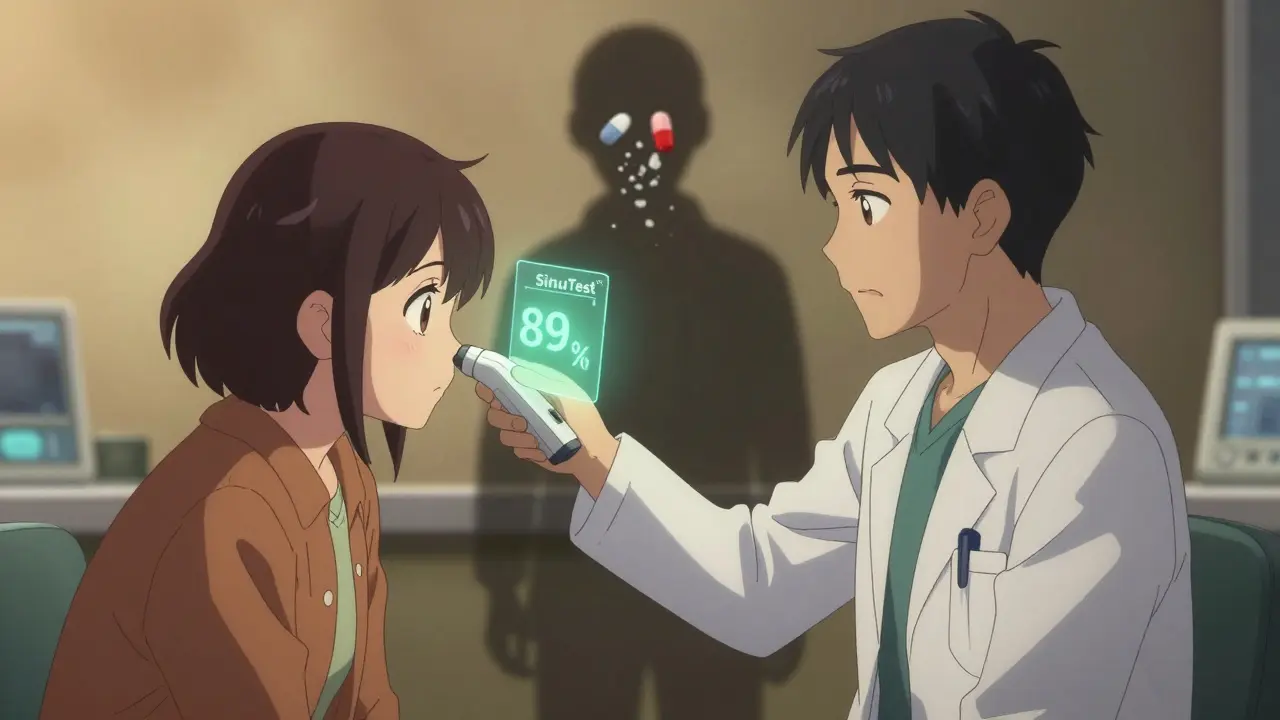
In May 2023, the FDA approved SinuTest™, a rapid point-of-care test that detects bacterial markers in nasal fluid. It’s 89% sensitive and 93% specific - meaning it correctly identifies most bacterial cases and avoids false alarms.
Another emerging tool is measuring nasal nitric oxide levels. If your levels are below 50 ppb, it suggests a bacterial infection. This isn’t widely available yet, but it’s being used in research clinics and will likely reach doctors’ offices soon.
Even more promising? Nasal probiotics. A 2023 clinical trial (NCT04876321) showed that using a nasal spray with beneficial bacteria reduced recurrent sinus infections by 42% compared to placebo. It’s not a cure, but it’s a new way to keep your sinuses healthy long-term.
What happens when you take antibiotics unnecessarily
Every time you take an antibiotic you don’t need, you’re helping bacteria become stronger.
The CDC estimates that 2.8 million antibiotic-resistant infections happen in the U.S. every year. At least 35,000 people die from them. Many of those cases trace back to unnecessary prescriptions - including for sinus infections.
One patient on PatientsLikeMe developed life-threatening C. diff colitis after taking azithromycin for a viral sinus infection. She was hospitalized for weeks. Her recovery took months. She now has to avoid all antibiotics unless absolutely necessary.
And it’s not just you. Antibiotic-resistant bacteria spread. They live on doorknobs, in public spaces, in food. Every unnecessary pill you take increases the risk for your kids, your parents, your neighbors.
There’s also a financial cost. Sinusitis costs the U.S. healthcare system $3.5 billion a year. A huge chunk of that goes to unnecessary antibiotics, follow-up visits, and treating complications like C. diff.
When to go to the doctor - and when to wait
Most viral sinus infections don’t need a doctor. But here’s when you should call:
- Symptoms last more than 10 days without improvement
- Double-worsening: you feel better, then suddenly get worse
- Fever above 102°F for more than 3 days
- Severe headache, swelling around the eyes, or vision changes
- Stiff neck, confusion, or difficulty breathing
These are red flags for complications - like abscesses, meningitis, or orbital cellulitis. They’re rare, but serious.
For most people, waiting 10 days and using supportive care is the safest, smartest move. The CDC’s "Get Smart" campaign has helped reduce inappropriate antibiotic requests by 27% in clinics that use their educational materials. You can download their free guides - in English, Spanish, and other languages - online.
What works long-term - beyond antibiotics
Recurrent sinusitis? You’re not alone. One WebMD user avoided 7 antibiotic courses over 2 years by sticking to daily saline rinses and a nasal corticosteroid spray. Within 6 months, her infections dropped from monthly to once a year.
Long-term strategies include:
- Daily saline irrigation (even when you’re not sick)
- Nasal corticosteroid sprays (like fluticasone) - safe for daily use
- Avoiding smoke, strong perfumes, and dry air
- Managing allergies - they’re a major trigger for chronic sinus inflammation
Future research is looking at genetic markers that predict who responds to antibiotics and who doesn’t. In the next few years, we may have personalized treatment plans - no more guessing.
bro i just had a sinus thing last month and i took azithromycin because my cousin said it "works magic" 🤡 turned out i just needed a neti pot and sleep. my gut has been weird ever since. why do we still think green boogers = antibiotics? 😅
The clinical evidence presented in this post is unequivocal and aligns with the most current guidelines from the American Academy of Family Physicians and the Infectious Diseases Society of America. The overprescription of antibiotics for viral sinusitis constitutes a public health emergency, contributing directly to the proliferation of multidrug-resistant organisms. It is imperative that patient education be prioritized over patient demand.
This is so true. I used to panic when my mucus turned green. Now I just rinse and wait. My doctor even gave me a tracker sheet. Game changer.
in india we call this 'jhatka' infection - everyone runs to the pharmacy for antibiotics like it's a lottery. my aunt took 5 courses last year for colds. now she gets diarrhea if she eats spicy food. we need more of this education here too 🙏
I used to be one of those people who demanded antibiotics. Then I got C. diff after taking amoxicillin for a 'bad cold.' Spent 3 weeks in the hospital. Now I do saline rinses daily. My sinuses haven't been this clear in years. Don't be me.
this is why doctors are lazy. if they just tested every patient, they wouldn't have to guess. but they don't wanna spend 5 mins. so they give you a pill and send you on your way. meanwhile, your microbiome is in shambles. #antibioticabuse
Okay but let’s be real - if 90% of sinus infections are viral, why does every single OTC sinus med have pseudoephedrine and phenylephrine in it? Why are we being sold decongestants like they’re magic bullets? And why do we still have commercials for azithromycin for sinus infections? This is systemic. The pharma industry profits from confusion. The CDC’s 'Get Smart' campaign? Barely funded. Meanwhile, Big Pharma spends millions on TV ads telling you to ask your doctor for 'the antibiotic that works faster.' It’s not ignorance. It’s exploitation.
I’ve been waiting for someone to say this. The real tragedy isn’t the antibiotics - it’s the cultural myth that illness must be 'fixed' with a pill. We’ve turned our bodies into machines that need software updates. But healing isn’t a download. It’s a dance. And sometimes… you just gotta let the virus do its thing. 🌿 The sinuses are not a battlefield. They’re a river. Don’t dam it. Let it flow.
Oh wow. So the answer to modern medicine’s failures is… more saline? I’m shocked. 🙃 Next you’ll tell me sunlight and sleep cure depression. What a revolutionary concept. Meanwhile, I’ll be taking my amoxicillin because my Instagram doctor said it’s 'the real MVP.'
This is exactly what my grandmother used to say: 'Let the body heal itself.' I started doing saline rinses after my second sinus surgery and now I go years without infection. It’s not magic - it’s consistency. And yes, I use a neti pot every morning like brushing my teeth. Small habits, big results.
The Cochrane review cited here is methodologically flawed due to selection bias in patient recruitment and inadequate blinding protocols. Furthermore, the 15 NNT metric is statistically insignificant when applied to heterogeneous populations. This post is a classic example of evidence misinterpretation masquerading as public health guidance.
The notion that viral sinusitis resolves spontaneously is a reductionist fallacy. While the majority of cases may be self-limiting, the absence of antibiotic intervention in patients with subclinical bacterial colonization may lead to chronic biofilm formation, which is far more difficult to eradicate than acute infection. The long-term consequences of under-treatment are not adequately addressed in this narrative.
i took amoxicillin for my cold last year and now i can’t eat yogurt without feeling like i’m gonna die. also my dog got sick after licking my socks. antibiotics are a scam. 🤡