
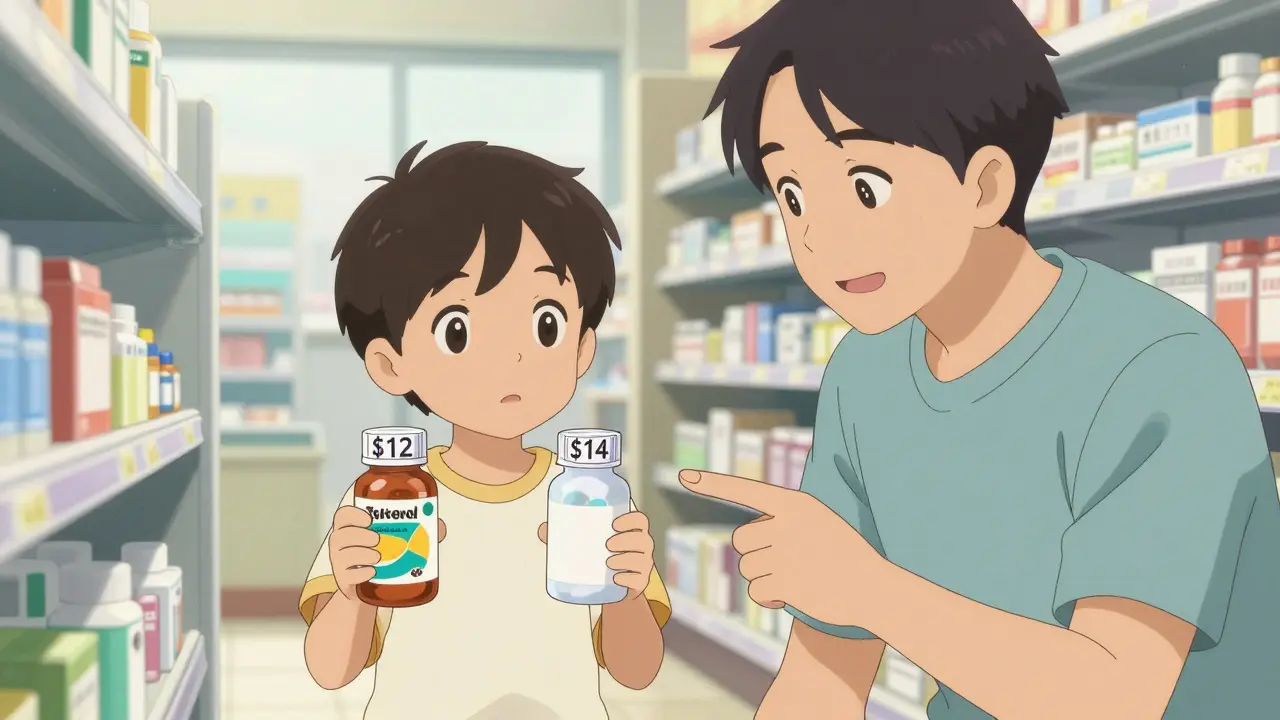
Most kids don’t know the difference between a brand-name pill and a generic one. They see the colorful packaging of Tylenol or Advil and assume that’s the only kind that works. But here’s the truth: generic drugs are just as safe, just as effective, and often cost a fraction of the price. Teaching children about this early isn’t about saving money-it’s about building smart, informed health habits that last a lifetime.
Why Kids Need to Understand Generic Drugs
Children are surrounded by medicine. They take syrup for coughs, chewables for fevers, and sometimes even pills for allergies or asthma. But they rarely hear the full story. If a child sees their parent switch from a branded medicine to a cheaper version, they might think, ‘Did they just give me a fake one?’ or ‘Is this weaker?’ That’s where misunderstanding starts-and where education can help.
Studies show that even young kids can grasp basic concepts about medicine if it’s explained clearly. A 2023 study from the University of Adelaide found that children as young as six could correctly identify that two pills with different labels could have the same active ingredient. When taught with visuals and simple language, they didn’t just memorize facts-they started asking better questions. Like: ‘Why does this one cost less?’ or ‘Can I take this instead?’
How Generic Drugs Really Work
Let’s break it down like you’re talking to a 7-year-old:
- A brand-name drug is like a new toy with a fancy box and a big logo.
- A generic drug is the same toy, but in a plain box. Same parts. Same function. Just cheaper.
The active ingredient-the part that actually treats the illness-is identical. Whether it’s paracetamol in Panadol or in a store-brand version, it works the same way in the body. The difference? The name on the box, the color, the shape, and the price. Generic drugs don’t have to spend millions on ads or fancy packaging. That’s why they cost less.
Some parents worry generics are ‘lower quality.’ But that’s not true. In Australia, the Therapeutic Goods Administration (TGA) checks every generic medicine before it’s sold. They test it to make sure it works just like the brand name. Same strength. Same safety. Same results.
When to Start Talking About It
You don’t need to wait until your child is in high school. Start early, with simple ideas:
- Ages 4-7: Use toys or stickers to show ‘same medicine, different wrapper.’ Let them pick between two identical-looking pills (one real, one placebo) and talk about why the labels are different.
- Ages 8-12: Bring them to the pharmacy. Show them the shelf with brand names and generics side by side. Ask: ‘Which one would you choose if they both fixed your headache?’ Let them see the price difference.
- Ages 13+: Talk about how insurance works, why pharmacies recommend generics, and how saving money on meds helps families afford other things-like food, school trips, or doctor visits.
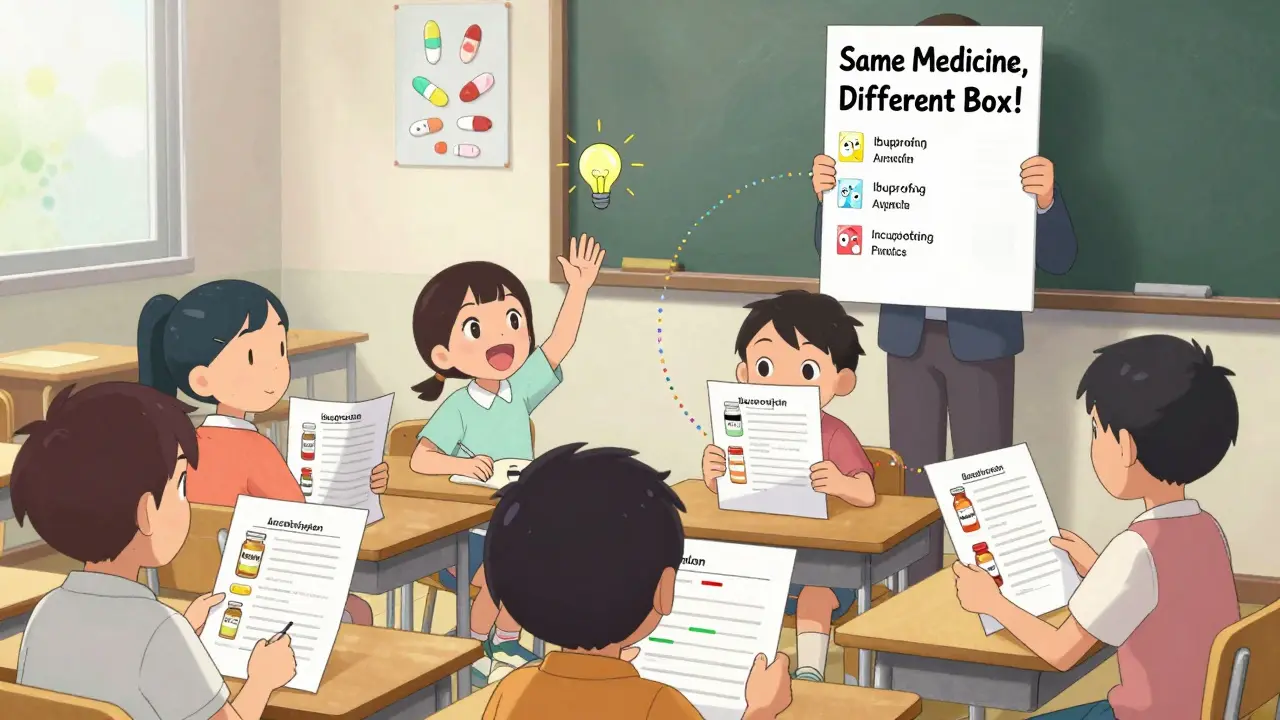
One school in Melbourne started a ‘Medicine Detective’ program for Year 5 students. Kids got a worksheet with pictures of common medicines. They had to match the generic name to the brand name. By the end of the week, 92% could correctly identify at least three generic drugs. And 80% told their parents they’d rather pick the cheaper option next time.
What Not to Say
Some adults accidentally scare kids by saying things like:
- ‘Generic drugs are bad.’
- ‘The doctor only gives us these because they don’t care.’
- ‘Brand name is better, even if it costs more.’
These messages create distrust-not understanding. Instead, say:
- ‘Both medicines have the same healing power.’
- ‘This one saves us money so we can do something fun this weekend.’
- ‘The government checks them to make sure they’re safe.’
Research from the U.S. shows that kids who hear honest, calm explanations are 3 times more likely to use generics responsibly as teens. They’re also less likely to believe myths like ‘generic means fake’ or ‘if it’s cheap, it doesn’t work.’
Real-Life Examples That Work
Here’s what this looks like in real homes:
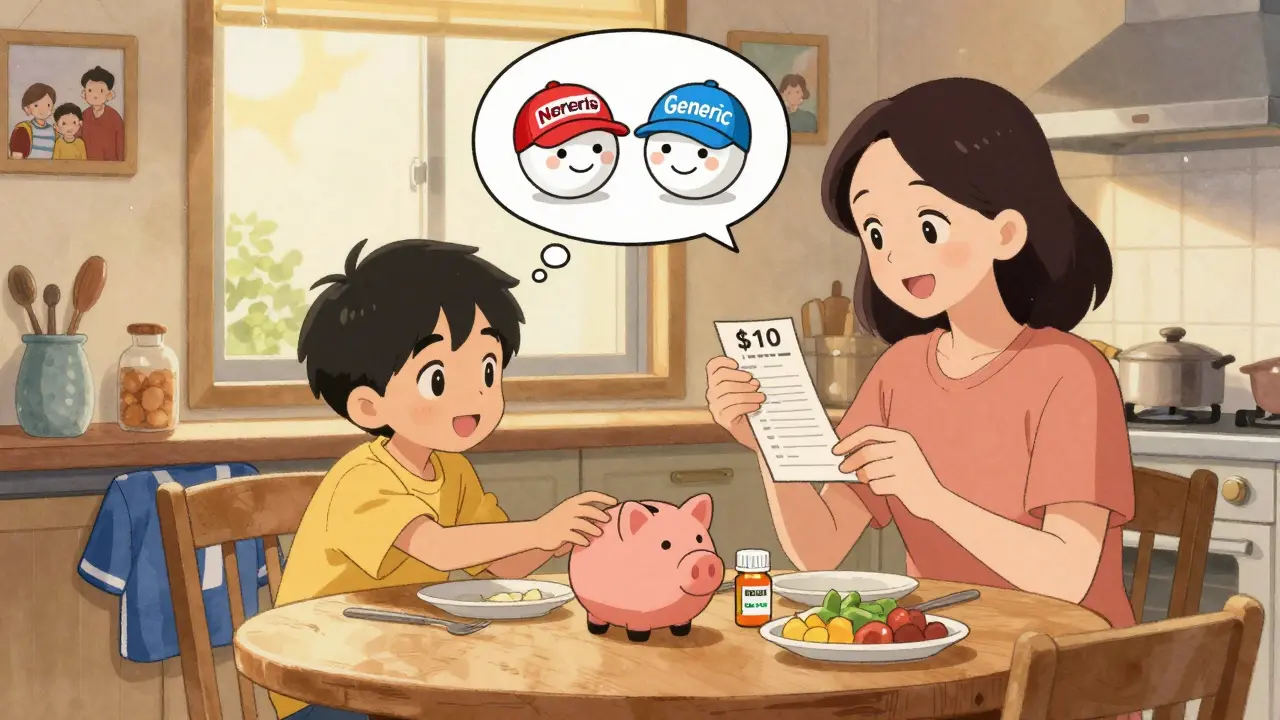
- Emma’s mom switched her son’s ibuprofen from Nurofen to a generic version. She didn’t tell him at first. But when he asked why the bottle looked different, she said, ‘It’s the same medicine, just a different name. Like how you can call a dog ‘Buddy’ or ‘Max’-it’s still your dog.’ He nodded and said, ‘So we saved $10?’ She said yes. He put the money in his piggy bank for a new bike.
- At a community health fair in Adelaide, a pharmacist brought in two identical-looking pills-one branded, one generic. Kids were asked to guess which was cheaper. Most picked the branded one. Then she showed them the price tag. Their jaws dropped. One girl said, ‘So the company just made up the extra cost?’ Exactly.
These moments stick. They turn confusion into curiosity. And curiosity leads to better health choices later.
How Schools Can Help
Teachers don’t need to be pharmacists to teach this. Simple activities work:
- Matching Game: Print out pictures of common medicines (paracetamol, amoxicillin, loratadine) and their brand names. Let kids match them.
- Price Challenge: Show two bottles-one $12, one $4. Ask: ‘Which one would you choose if you were helping your family?’
- Story Time: Read a short story about a kid who learns that ‘same medicine, different box’ is okay.
Programs like Generation Rx offer free classroom kits for teachers. They include posters, worksheets, and even a ‘Medicine Safety Patrol’ badge kids can earn. No fancy tech needed. Just a printer and a willingness to talk.
What Parents Can Do Today
You don’t need a degree to start. Here’s how:
- When you pick up a prescription, say out loud: ‘This is the generic version. It’s the same as the brand name, but cheaper.’
- Let your child see the receipt. Point out the price difference.
- Keep a small medicine cabinet at home with labeled bottles. Include both brand and generic versions (if safe).
- Answer their questions honestly. If you don’t know the answer, say: ‘Let’s look it up together.’
- Don’t shame the choice. If your child says, ‘I want the pink one,’ don’t say, ‘That’s silly.’ Say, ‘Let’s talk about why one costs more.’
One parent in Sydney told her 9-year-old: ‘We use generic medicine because we want to save money for your soccer gear.’ He started asking his friends, ‘Do you know your medicine is the same?’ Soon, half his class was doing the same thing.
The Bigger Picture
Teaching kids about generic drugs isn’t just about saving a few dollars. It’s about teaching them to question marketing. To understand value. To trust science over slogans. To make smart choices-not because they’re told to, but because they understand why.
When kids grow up knowing that a pill’s price doesn’t determine its power, they become adults who don’t fall for expensive ‘miracle cures’ or unnecessary brand loyalty. They become people who ask: ‘What’s in it? Does it work? Is there a cheaper option?’
That’s not just good for wallets. It’s good for health systems. And it starts with a simple conversation at the kitchen table.
Are generic drugs really as safe as brand-name drugs?
Yes. In Australia, the Therapeutic Goods Administration (TGA) requires generic drugs to have the same active ingredient, strength, dosage form, and safety profile as the brand-name version. They undergo strict testing before being sold. The only differences are the inactive ingredients (like color or flavor) and the packaging. Both work the same way in your body.
Can children take generic medicines?
Absolutely. Pediatricians and pharmacists routinely prescribe generic versions of common children’s medicines like paracetamol, amoxicillin, and antihistamines. The dosing is based on weight and age-not brand. Many hospitals in Australia use generics for all pediatric patients because they’re proven safe and effective.
Why do some people think generics are weaker?
It’s mostly because of marketing. Brand-name companies spend millions on ads that make their product look special. But the science doesn’t support it. A 2022 review by the Cochrane Collaboration analyzed over 50 studies and found no difference in effectiveness or side effects between generics and brand-name drugs in children. The belief that generics are weaker is a myth, not a fact.
What if my child’s doctor prescribed a brand-name drug?
Some medicines don’t have a generic version yet, especially newer ones. But for most common pediatric drugs-like antibiotics, pain relievers, and allergy meds-generics are available. Always ask your pharmacist: ‘Is there a generic option?’ If the doctor wrote ‘dispense as written,’ you can still ask if switching is safe. In most cases, it is.
How can I explain generics to a child without confusing them?
Use simple comparisons. Say: ‘It’s like two different brands of apple juice-same juice, different bottle.’ Or: ‘It’s like wearing a red shirt or a blue shirt-you’re still you.’ Avoid technical words like ‘active ingredient.’ Focus on the idea that the medicine does the same job, just costs less. Let them see the price difference. Kids understand value better than you think.
Is it okay to switch from a brand-name drug to a generic one?
Yes, for most medications. Pharmacists are trained to make these switches safely. If your child has a condition like epilepsy or asthma where exact dosing matters, your doctor might recommend sticking with one brand. But for colds, fevers, allergies, and infections, switching is not only safe-it’s smart. Always check with your pharmacist before switching, but don’t assume brand means better.
Next Steps for Families
Start small. The next time you pick up a prescription, bring your child along. Let them hold the box. Read the label with them. Ask: ‘Do you think this is the same as the one we used last time?’ Then show them the price tag. Watch their face. That moment-when they realize the truth-is the first step toward lifelong health literacy.
You’re not teaching them about pills. You’re teaching them to think. And that’s the most powerful medicine of all.
OMG YES THIS!! 🙌 I just taught my 7-year-old the ‘same toy, different box’ thing last week and she started pointing out generic stuff at the pharmacy like a tiny health detective. Now she asks if we can get the ‘cheap medicine’ every time. 😆 I’m basically raising a future pharmacist who also knows how to save money. Worth it.
The comparison to branded toys versus plain-packaged equivalents is pedagogically sound. The cognitive load on children is minimized through analogical reasoning, which aligns with Piagetian preoperational stage learning frameworks. Furthermore, the emphasis on regulatory equivalence-specifically TGA and FDA equivalency protocols-reinforces evidence-based health literacy rather than consumerist mythology. This approach should be standardized in elementary curricula.
Why are we even teaching kids this? In America, we buy name brands because they’re better. If you’re saving money on medicine, you’re probably just being cheap. Brand names exist for a reason.
my kid is 5 and she asked why the pink pill is more expensive than the white one… i told her the pink one has extra sparkles (joke) but then we looked at the label together and she was like ‘oh so same juice diff bottle?’ 🤯 i cried. this is so important. thank u for writing this.
Oh wow, another ‘let’s dumb down medicine for kids’ left-wing propaganda piece. You know what’s cheaper than generics? Not taking medicine at all. But no, let’s teach 6-year-olds to shop for pills like they’re comparing laundry detergent. Meanwhile, real doctors are overworked, pharmacies are closing, and you’re busy turning kids into pharmacy clerks. Next you’ll be teaching them to barter for insulin. 🙄 The FDA doesn’t regulate ‘trust,’ it regulates science-and science says brand names have more consistent manufacturing. Don’t believe the hype. This isn’t empowerment-it’s indoctrination.
That Melbourne ‘Medicine Detective’ program sounds incredible. I’d love to see if any of those kids later became interested in pharmacology or public health. It’s wild how early exposure to science-based reasoning can reshape lifelong attitudes. I wonder if there’s data on whether those kids are more likely to question misleading ads or supplement marketing later in life? Just curious.
Interesting how this article assumes all parents are financially strained enough to care about generic savings. In my neighborhood, we buy name-brand because we can-and because we trust quality over cost-cutting. Children should learn that premium products exist for a reason. This isn’t about saving $10 on Tylenol-it’s about cultivating a culture of mediocrity. If you’re okay with ‘good enough’ medicine, that’s your choice. Don’t make it a virtue.
Just wanted to say-this is the kind of quiet, practical education that actually changes the world. Not with slogans or protests, but with a mom at the pharmacy saying, ‘Same medicine, different box.’ No drama. No guilt. Just truth. That’s all it takes.