
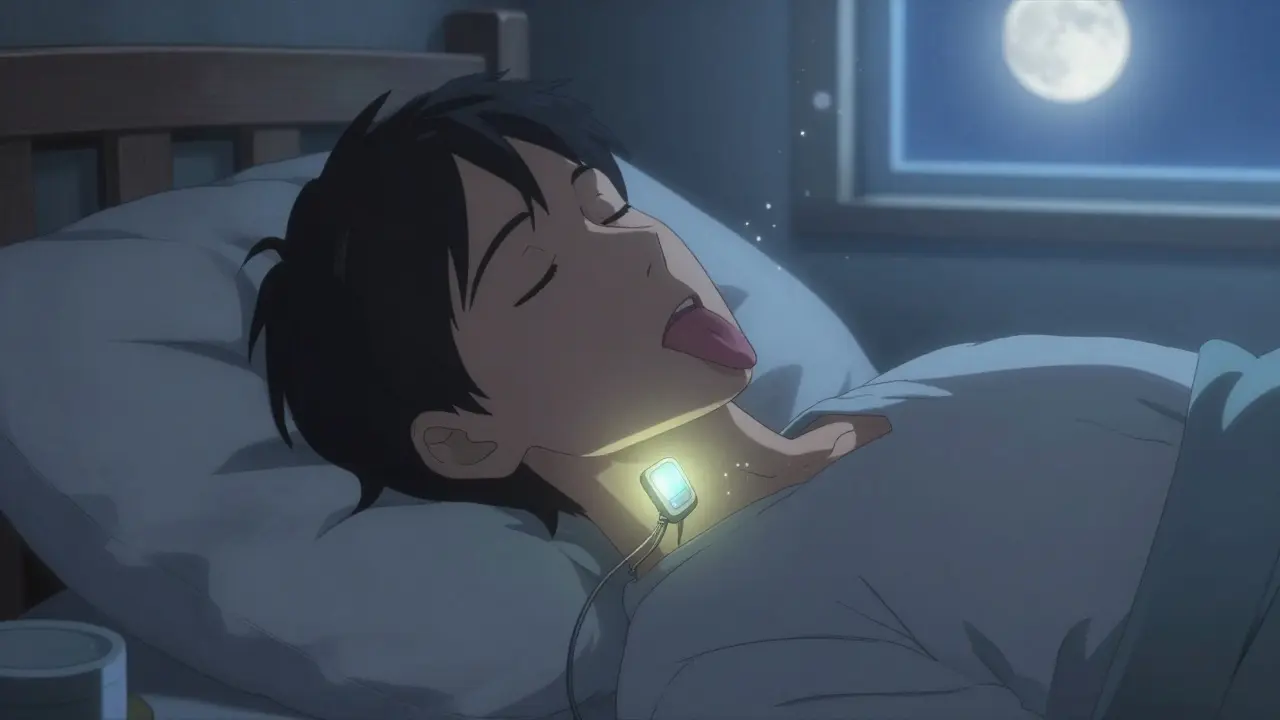
What if you could finally sleep through the night without a mask, hose, or the constant frustration of CPAP? For thousands of people with moderate to severe sleep apnea who can't tolerate CPAP, upper airway stimulation (UAS) isn't just an option-it's a life-changing reality. This isn't science fiction. It's a surgically implanted device that wakes up your airway while you sleep, keeping it open naturally, without masks or pressure. And it's working for people who've tried everything else.
How Upper Airway Stimulation Works
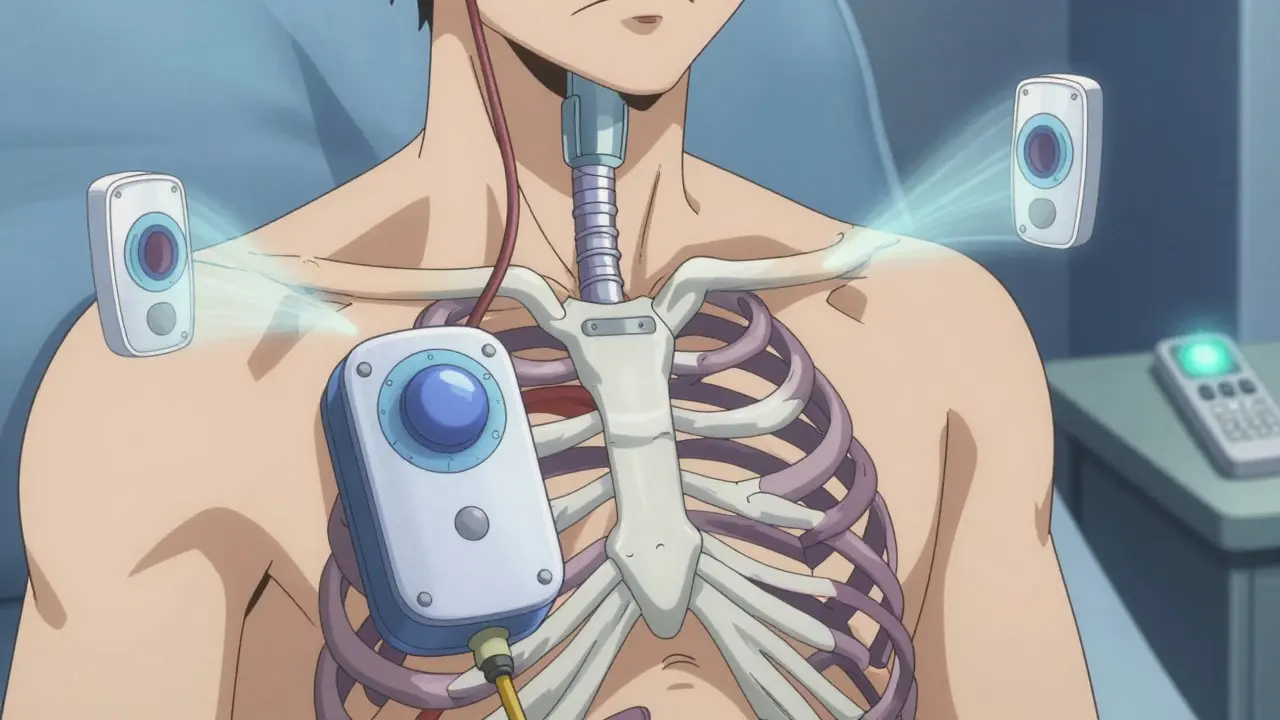
Upper airway stimulation, specifically the Inspire UAS system, doesn't push air into your throat like CPAP. Instead, it works like a pacemaker for your airway. A small device, implanted under your skin, monitors your breathing in real time. When it senses you're inhaling, it sends a gentle pulse to the hypoglossal nerve-the nerve that controls your tongue. That pulse moves your tongue forward, just enough to stop it from collapsing and blocking your airway.
This happens automatically, every night, without you having to think about it. The system only activates during inhalation, so your muscles don't get tired. You turn it on before bed using a small remote, and turn it off in the morning. No masks. No noise. No leaks. Just quiet, restful sleep.
The Three Parts of the System
The Inspire UAS system has three implanted components that work together:
- Implantable pulse generator (IPG): A small device, about the size of a pacemaker, placed under the skin below your collarbone. It's the brain of the system.
- Stimulation lead: A thin wire that runs from the IPG to the hypoglossal nerve in your neck. This delivers the pulse that moves your tongue.
- Sensing lead: A wire that connects to your ribcage to detect your breathing pattern. It tells the device when you're inhaling.
These are all placed during a single outpatient surgery under general anesthesia. The procedure takes about 2 to 3 hours, and most people go home the same day. Recovery is quick-most get back to normal activities within a week.
Who Is This For? (The Exact Criteria)
This isn't a solution for everyone with sleep apnea. It's designed for a very specific group: people who have tried CPAP and couldn't stick with it. To qualify, you need to meet all of these criteria:
- Diagnosed with moderate to severe obstructive sleep apnea (AHI between 15 and 100 events per hour)
- BMI under 35 (or under 32 in some cases)
- Age 22 or older
- Have tried and failed CPAP therapy
- Have no complete blockage or concentric collapse of the soft palate (confirmed by a sleep endoscopy)
- Less than 25% of your apneas are central or mixed (not caused by airway blockage)
These rules aren't arbitrary. The device works by moving the tongue, so if your airway blockage is mostly from your soft palate or you have too many central apneas, it won't help. That's why a sleep specialist must do a special endoscopy test before approval.
How Effective Is It?
The data speaks for itself. In the landmark STAR trial, patients saw their apnea-hypopnea index (AHI) drop from an average of 29.3 events per hour to just 9.0 after one year. That's a 68% reduction. Two out of three patients cut their AHI by at least half. Many ended up with mild or even no sleep apnea.
Long-term results are just as strong. The ADHERE Registry, tracking real-world patients over years, shows consistent improvement-even in people with very severe apnea (AHI over 65) and higher BMI. Patients report feeling more alert during the day, less tired, and more focused at work.
And it's not just about numbers. Bed partners notice it too. The Cleveland Clinic found that 85% of partners said snoring stopped or became very soft after four years. One Reddit user wrote: "My wife says I've stopped snoring completely after 2 years with Inspire, and I feel more rested than I have in decades."
How It Compares to CPAP
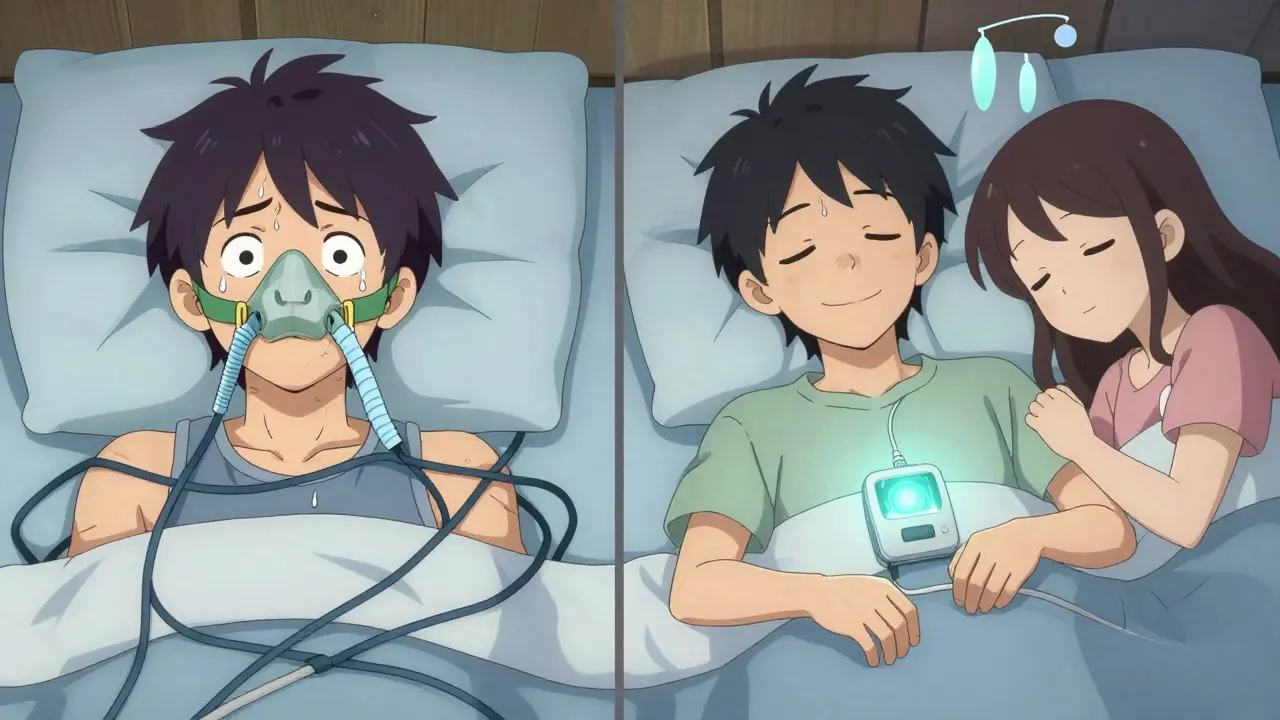
CPAP is the gold standard-but it's also the most abandoned treatment. Between 29% and 46% of people quit using it because it's uncomfortable, noisy, or just too hard to live with. UAS doesn't have those problems.
Here's how they stack up:
| Feature | CPAP | Upper Airway Stimulation (Inspire) |
|---|---|---|
| How it works | Forces air into airway with pressure | Stimulates nerve to move tongue forward |
| Device | Mask, hose, machine | Implanted device + remote |
| Adherence rate | 54-71% (many quit) | Over 90% (users report high satisfaction) |
| Comfort | Can cause dry mouth, skin sores, claustrophobia | No mask, no noise, no hose |
| Adjustment | Pressure can be changed remotely | Stimulation level adjusted by doctor after implant |
| Reversibility | Non-invasive, no surgery | Device can be removed if needed |
UAS doesn't replace CPAP-it replaces CPAP for those who can't use it. It's not a first-line treatment. It's the next step when CPAP fails.
What About Surgery Risks?
It's a surgery, so there are risks. But they're rare. The major complication rate is 99.6% free of serious issues. The most common side effect is temporary tongue weakness, which affects about 5% of patients and usually fades within a few months. Minor infections at the incision site happen in about 2% of cases.
Unlike older surgeries like UPPP (removing part of the soft palate), UAS doesn't cut tissue. It doesn't change your anatomy permanently. It just gives your body a little nudge when it needs it. And if something goes wrong, the device can be removed.
What’s the Catch?
There are two real challenges.
First: you have to remember to turn it on every night. It's not automatic. You use the remote like a TV remote. Some people forget-especially in the first few weeks. But most build the habit quickly.
Second: cost. The procedure averages $35,000 to $40,000. But here's the thing-when you add up CPAP machines, masks, repairs, and follow-up visits over 5-10 years, the total cost isn't that different. And with insurance coverage now expanding, 95% of Medicare patients and 85% of private insurers cover it. That makes a big difference.
What Happens After Implant?
You don't turn it on right away. It takes about a month for healing. Then your doctor activates it and slowly adjusts the stimulation level over several visits. You'll come back at 1, 3, 6, and 12 months. Most people report feeling better within weeks.
Support is built in. Inspire offers a 24/7 patient support line, and 94% of users say they're satisfied with the help they get. There are also online communities-forums, Facebook groups-where people share tips, troubleshoot issues, and celebrate wins.
Is This the Future?
The market for sleep apnea devices is growing fast. Over 200,000 Inspire systems have been implanted worldwide as of 2023. The FDA expanded eligibility in 2023 to include patients with AHI up to 100 and BMI up to 40. That means more people can now benefit.
Research is moving toward smarter systems-using AI to predict airway collapse before it happens, and smaller implants that require less invasive surgery. But for now, the Inspire system is the only FDA-approved UAS device on the market.
For someone who's tried CPAP and given up, this isn't just a treatment. It's a second chance at sleep. At energy. At life.
Is upper airway stimulation the same as a sleep apnea machine?
No. A sleep apnea machine (like CPAP) uses air pressure to keep your airway open. Upper airway stimulation (UAS) is an implanted device that uses mild electrical pulses to move your tongue forward during sleep. It doesn't require a mask, hose, or machine. It's a surgical alternative, not a machine you wear.
Can I still use CPAP after getting an upper airway stimulator?
Technically yes, but it's not necessary. Most people stop using CPAP entirely after the device is activated. The stimulator is designed to fully replace CPAP for eligible patients. Some doctors may recommend keeping CPAP on hand as a backup during device troubleshooting, but it's rarely needed.
How long does the battery last in the implant?
The implantable pulse generator lasts about 8 to 11 years, depending on usage. When the battery runs low, you'll need a minor surgery to replace it-similar to replacing a pacemaker. It's a straightforward procedure, usually done as an outpatient.
Does upper airway stimulation help with snoring?
Yes. In fact, reducing snoring is one of the most noticeable benefits. Studies show that 85% of bed partners report little to no snoring after four years of use. Many patients say their partners sleep better too, which improves relationships.
Is this covered by insurance in Australia?
As of 2026, upper airway stimulation is not yet approved for routine public funding in Australia. It's available privately through specialist sleep centers, but out-of-pocket costs are high-typically $40,000 to $50,000 AUD. Some private health insurers may offer partial coverage depending on your policy. Clinical trials and regulatory reviews are ongoing, and approval for public funding is expected within the next few years.
Next Steps If You're Considering It
If you've struggled with CPAP and still have symptoms-snoring, daytime fatigue, waking up gasping-you should talk to a sleep specialist who has experience with UAS. They'll review your sleep study, do a sleep endoscopy, and check if you meet the criteria. If you do, the next step is a consultation with a surgeon trained in the procedure. Don't wait until you're exhausted. This treatment exists because people refused to accept poor sleep as normal. You don't have to either.
So this thing basically turns your tongue into a tiny airway bouncer? Wild. I had CPAP for three years and hated every second of it - the mask marks, the dry throat, the sound like a jet engine in my bedroom. My wife started sleeping in the guest room. Now I’m considering this. No mask? No noise? Just a little zap to keep my tongue from turning into a human pillow? Sign me up.
This is literally the best thing I’ve ever heard for sleep apnea!!! I got the Inspire last year and I can’t believe how much my life changed!! I sleep like a baby now!! My husband says I don’t snore at all anymore!! I used to wake up 8 times a night!! Now I sleep 7 hours straight!! I even started jogging again!! I’m so happy I did it!! 😭💖🙌
They don’t want you to know this, but the FDA approved this because Medtronic lobbied hard after buying off three senators. This isn’t medicine - it’s a profit machine. The battery lasts 8-11 years? That’s planned obsolescence. They’re selling you a $40k subscription to sleep. Meanwhile, the real cause of sleep apnea? Sugar. Processed carbs. Your tongue doesn’t collapse - your whole body is rotting from inside. But hey, let’s just zap it and keep the profits rolling.
Think about it - we’re now at the point where we implant devices to correct the consequences of modern life instead of fixing the root cause. We eat like garbage, sit like statues, breathe shallowly, and then we surgically rewire our biology to compensate. Is this progress? Or just the slow, quiet surrender of the human body to capitalism? I don’t know. But I do know I’d rather sleep on the floor than wear a mask. So… I get it.
Yanks are spending tens of thousands on implants while we in the UK still have NHS waiting lists longer than your arm. I’ve got sleep apnea and I’m still waiting for my CPAP review. Meanwhile, you Americans are turning into half-bionic sleepers. Next thing you know, you’ll be implanting Wi-Fi routers in your skull so you can dream in HD. Just sayin’.
Wait wait wait - you’re telling me this thing actually works better than CPAP? I’ve been on CPAP for 7 years and I still wake up with a headache. I thought I was just bad at it. But if this thing gives you back your life? Then why isn’t everyone doing it? Why is it still so hard to get approved? Something’s fishy. I’m gonna dig into the insurance paperwork. I’m not letting them take my money without a fight.
So let me get this straight - we’ve got a device that replaces a machine you wear with a machine you *are*. We’re not treating sleep apnea anymore. We’re upgrading the human. Welcome to the transhumanist sleep revolution. Next stop: implanting caffeine directly into your optic nerve so you can stay awake while dreaming. I’m not mad. I’m just… impressed. And slightly terrified. Also, my dog now sleeps on my chest. Coincidence? I think not.
I had this done two years ago, and honestly? It’s been the most profound thing I’ve ever done for myself. I used to wake up gasping, my wife was exhausted, I couldn’t focus at work - I was a zombie. Now? I remember my dreams. I remember my kids’ birthdays. I remember the taste of coffee. The surgery? Not fun. The recovery? Painful. But every single night since, when I turn it on - it’s like my body finally remembers how to breathe. I didn’t know I was dying until I started living again. And yeah, I forget to turn it on sometimes. But I always remember. Because now, sleep isn’t a chore. It’s a gift.
Interesting! In India, we mostly rely on CPAP or weight loss - not many know about this. I’ve seen people with severe apnea just give up. But this sounds like a game-changer. Though I wonder - how accessible is this outside the US? The cost alone would be a mountain for most. Maybe we need global health equity in sleep tech. Everyone deserves to breathe well at night, no matter where they live.
Battery life 8-11 years. Replacement surgery straightforward. No need to panic. Just plan ahead. Insurance covers it. Do the math. CPAP costs more long term. This is better value. Done.
They say it’s 99.6% safe but I read a guy on Twitter who got his tongue paralyzed for 18 months. They don’t tell you that. And what if your device gets hacked? What if some rogue app starts zapping your tongue while you’re driving? I’m not saying it’s evil - I’m saying we’re playing with fire and calling it innovation.
I’m 54, had CPAP for 8 years, hated it. Got Inspire last year. Best decision ever. No more masks. No more noise. Just a little remote. I turn it on before bed like I do my alarm clock. My wife says I sleep like a log now. We’ve been kissing again. I didn’t even know I missed that. It’s not magic. It’s just… working. Like your body was waiting for this. Funny how a little zap can change everything.
So let me get this straight - you’re telling me that after decades of being told "just wear the mask," the real answer was to surgically upgrade my tongue? I mean… wow. I’m not even mad. I’m just… impressed. Also, I’m now the weirdo at parties who talks about hypoglossal nerves. My friends think I’ve joined a cult. I don’t care. I slept through the night. For the first time since 2010. That’s not a cure. That’s a miracle.